Popular

How Black Holes Actually Glow: A Simple Discovery ⚡ экспресс

Original: "Backreaction of stimulated Hawking radiation in an optical analogue"
arXiv:2607.01118 · 2026-07-01 · CC BY 4.0 · ⏱ 1 min · General Relativity
Physicists found that black holes lose energy not through a cascade of particles, but through a simple ejection — like spray from a roaring current.
Abstract

Hawking radiation is a quantum process at the event horizon of a black hole, but it has never been seen in space. In the lab, scientists build its analogues. In a fiber-optic model of an event horizon, physicists discovered that the radiation is born in a simple direct way, not through a complex cascade, and for the first time measured its backreaction on the field. This discovery is transferable to other lab analogues and possibly to real gravitational fields, shedding light on how black holes actually lose energy.

Links in the knowledge graph 1

📄 Showing the "Simple" version — "Popular" is not ready yet. Add it to favorites to help prioritize it.

A black hole is not just a vacuum cleaner. It glows faintly, emitting particles — this idea was proposed by Jacob Bekenstein, who connected the hole's temperature to its [tag:entropy]degree of disorder. Detecting such radiation in space is incredibly difficult.

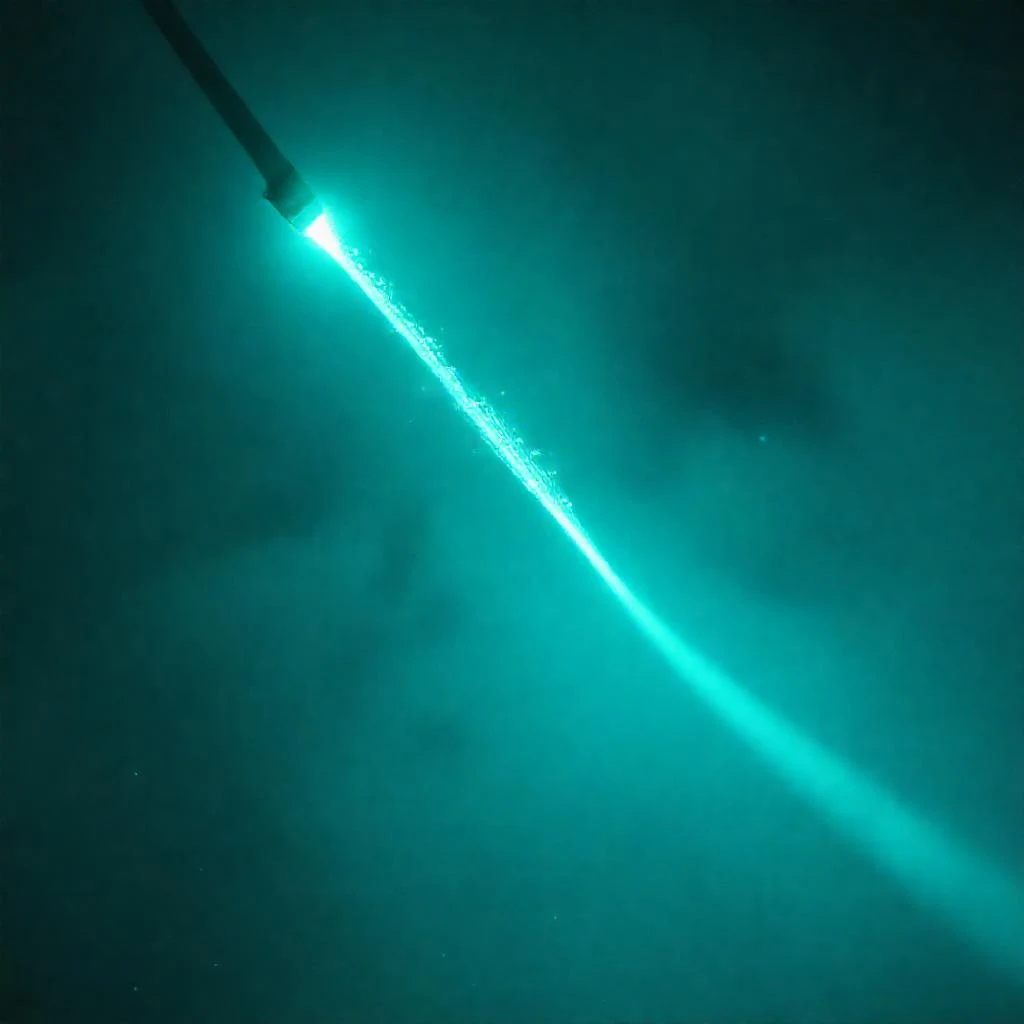
Physicists set up a simple experiment: they fired a laser pulse through a glass fiber so fast that for light a "point of no return" appeared — like in a river with a current stronger than any swimmer. And they waited for "splashes" — quantum bursts, resembling a single splash from a stone in the rapids, not an avalanche. The previous explanation painted a tangled cascade, but nature turned out simpler.

But the main surprise is how ghostly this "simplicity" is. If a black hole weighed as much as the Sun, evaporation in such splashes would take longer than the age of the Universe multiplied by billions of billions. The light is there, but almost none of it. Perhaps someday, by catching particles from real holes, we will resolve the paradox of missing information.

🎯 If a black hole had the mass of the Sun, it would take it billions of billions of times longer than the age of the Universe to completely evaporate.

Scientists
Christian DopplerD. B. McLaughlinDidier QuelozMichel MayorR. A. RossiterStephen Hawking
Tags
black hole entropy speed of light
Laws
second law of thermodynamicsDoppler effectHawking radiationgravitational lensingprinciple of constancy of the speed of lightBekenstein-Hawking entropy
Original: arXiv:2607.01118 · CC BY 4.0 · bridge42worlds