Gravitational Atoms: How Black Holes Give Dark Matter a Voice ✎ express
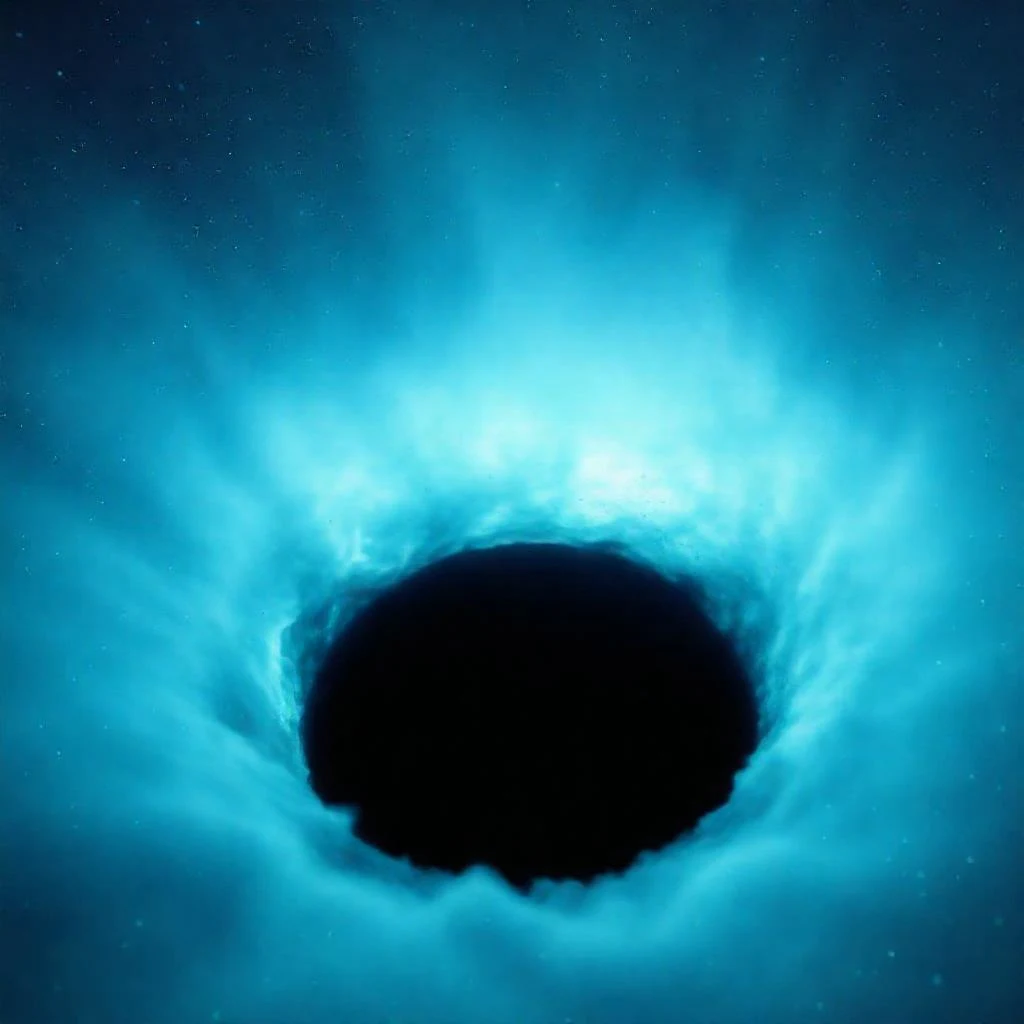
Black holes are rarely alone in the cosmos. They are often shrouded in invisible clouds of hypothetical dark matter particles — so light that they feel only gravity, barely interacting with each other or ordinary matter. When such a cloud becomes dense enough, the system starts to look uncannily like a giant atom: a swarm of particles orbiting the hole just as electrons orbit a nucleus. These objects are called gravitational atoms — a term that highlights the structural analogy, even though the scales and forces involved are entirely different.
When two black holes collide, they merge into a new, more massive hole that 'rings' with gravitational waves — ripples in spacetime that fade like the toll of a bell. By analyzing the equations of general relativity, physicists have calculated that the presence of a dark matter cloud noticeably alters this gravitational-wave signal. The main tone, or oscillation frequency, shifts, and the denser the cloud, the larger the deviation. The metaphor is apt: a bell ringing in thick fog changes its voice — similarly, the particle cloud modulates the 'ring' of the black hole.
However, the calculations reveal a surprising twist: in theory, such a cloud can not only dampen the signal but also amplify it, extracting energy from the black hole's rotation through a mechanism known as superradiance. In that case, the curved spacetime around the hole begins to resonate, generating coherent gravitational waves that we could potentially detect. LIGO and Virgo, which use laser interferometry to measure tiny displacements of mirrors, already have the sensitivity needed to pick up such frequency shifts. This opens a fundamentally new way to 'listen' for dark matter: instead of trying to catch light that it doesn't emit by definition, we can tune into the trembling of the vacuum, extracting information about invisible clouds from the very voice of black holes.
Gravitational atoms could theoretically emit gravitational-wave energy — just as ordinary atoms emit light when electrons jump between levels.
In science fiction, clouds near black holes often serve as sources of mysterious signals or even consciousness. For instance, in Peter Watts's novel Blindsight, an alien intelligence resides in just such a radio cloud.