concept

hidden symmetry quantum

Emergent or concealed symmetries governing particle interactions and quantum order in materials.
7 related articles · 3 formulas

Description

Hidden symmetry in quantum systems refers to symmetries that are not apparent from the system's Hamiltonian or Lagrangian but emerge dynamically, often governing particle interactions and quantum order in materials. These symmetries can be 'hidden' because they appear only at certain energy scales, in certain phases, or after a transformation that reveals a simpler underlying structure. They are crucial for explaining phenomena like topological order, where the ground state degeneracy and quasiparticle statistics are protected by symmetries that are not visible in the local degrees of freedom.

How it works

A hidden symmetry often arises when a system's low-energy effective theory has a larger symmetry than the microscopic theory. For example, in quantum spin liquids, the fractionalized excitations (spinons) obey emergent gauge symmetries that are not present in the original spin Hamiltonian. These symmetries can be uncovered by mapping the system to a dual representation, such as a gauge theory or a free fermion model, where the symmetry becomes manifest. The hidden symmetry then constrains the possible quantum phases and transitions, providing a powerful organizing principle.

In practice

Hidden symmetries are used to classify and predict topological phases of matter, which are candidates for fault-tolerant quantum computing.

Concept graph →

Formulas

$$r_n = rac{ ext{min}(s_n, s_{n+1})}{ ext{max}(s_n, s_{n+1})}$$
Ratio distinguishes Poisson and Wigner-Dyson distributions in quantum chaos.
What is in the formula
r_nvariableLevel spacing ratio for adjacent energy levels — level spacing ratio
s_nvariableSpacing between consecutive energy levels — energy level spacing joule
minoperatorSelects the smaller of the two arguments — minimum function
maxoperatorSelects the larger of the two arguments — maximum function
r_n=\frac{\min(s_n,s_{n-1})}{\max(s_n,s_{n-1})},\quads_n=e_{n+1}-e_n · 2605.02446v2
$$\Delta X \propto \cos[2(\theta - \theta_0)]$$
A physical quantity varies as the cosine squared of an angle offset.
What is in the formula
\Delta XvariableChange in a physical quantity — physical quantity change
\thetavariableAngle variable — angle radian
\theta_0variableReference angle offset — angle radian
\proptooperatorIndicates the left side scales with the right side — proportionality
\cosoperatorComputes the cosine of an angle — cosine function
δr\propto\cos[2(α-α_0)] · 2510.15091
$$k(x, x') = \sigma^2 \exp\left(-\frac{(x-x')^2}{2\ell^2}\right)$$
Gaussian covariance function for smoothness in Gaussian processes.
What is in the formula
xvariableinput point — input variable
x'variableanother input point — input variable
σvariablesignal amplitude — amplitude
ℓvariablelength scale — length scale
expoperatorraises e to the given power — exponential function
k(t,t')=α\exp(-\frac{(t-t')^2}{2\ell^2}) · 2606.29842

Related articles · 7

Mountain Trails of Quantum Phases
In a mountain range, there are trails that can be contracted to a point if you walk through a flat valley. But there are also loop routes that cannot be shrunk without crossing a ridge.
General Relativity2026-08-031 minarXiv:2608.02259express
The Black Hole and Its Secret Twin
A rotating black hole is no calm whirlpool. Space around it shudders and rings at the slightest disturbance, like a guitar string after a pluck. These oscillations are described by the Teukolsky equation — a complex mathematical construct that physicists have studied for half a century. Recently, a strange symmetry was noticed in this equation.
Shadow Theatre of Inflation: Quantum Masks of the de Sitter Vacuum
Inflation is the rapid expansion of the newborn Universe, when quantum fluctuations were stretched to cosmic scales. The cosmic microwave background is the fossilized light of that epoch, shadows on the wall of our cosmic cave.
Quantum Physics2026-05-171 minarXiv:2605.17507express
When Time and Space Swap Roles: The Hidden Symmetry of the Quantum World
A translator gets distracted by every rustle in the hall, and a one-hour meeting stretches into two. That's roughly how ordinary quantum mechanics works: a particle evolves in time, while space serves as the stage. But what if we swapped their roles? Then the particle 'moves' through space, and time becomes a static backdrop.
HEP Theory2026-05-022 minarXiv:2605.01453express
Hidden Symmetry: How Particles Negotiate Their Own Rules
In particle physics, it has long been taken for granted that the forces of nature (electromagnetism, the weak and strong interactions) obey a strict symmetry called gauge symmetry. It's like a set of rules by which particles exchange force carriers. But where do the rules themselves come from?
Optics2026-03-241 minarXiv:2603.23743express
Why Purple Bacteria Always Have Big Rings
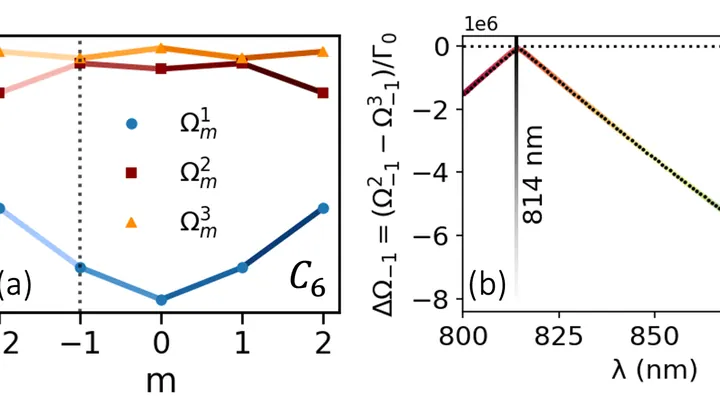
In the depths of murky ponds, purple bacteria lurk. Their secret to surviving in near-total darkness is rings of light-catching molecules, arranged like a round dance: each dancer passes energy to a neighbor. But if the round dance has fewer than seven participants, the dance breaks down — energy scatters, and disorder takes over.
Symmetry rescues entanglement from thermal death
Quantum entanglement is a fragile resource. Heat a system, and thermal fluctuations will tear the delicate threads of correlations: at a sufficiently high but finite temperature, the Gibbs state of a local Hamiltonian becomes separable, that is, representable as a probabilistic mixture of products of local states.