Ionized gas, also known as plasma, is a state of matter where atoms have lost one or more electrons, leaving behind positively charged ions and free electrons. This separation of charges fundamentally changes how the gas interacts with light and electromagnetic fields. Unlike a neutral gas, which can absorb and scatter light, an ionized gas becomes largely transparent to many wavelengths, especially when the electron density is low enough that collisions are rare. This transparency is why we can see through the Sun's corona during a total eclipse, even though it is extremely hot.
How it works
When a gas is heated to high temperatures or subjected to strong electromagnetic radiation, electrons gain enough energy to escape the electrostatic pull of their nuclei. The resulting mixture of ions and electrons behaves collectively, responding to electric and magnetic fields in ways neutral atoms cannot. The degree of ionization and the density of free electrons determine the gas's optical properties: a fully ionized, low-density gas is nearly transparent, while a partially ionized or dense plasma can absorb, reflect, or emit radiation across a broad spectrum.
In practice
Ionized gas is the working medium in fluorescentlights, plasma displays, and fusion reactors, where controlling its behavior is essential for energy generation.
Fun fact
More than 99% of the visible universe is in the ionized gas state, including stars, nebulae, and the intergalactic medium.
In the dark chamber of the trap, thousands of charged particles dance under electric fields. At first they move freely, like a crowd in a square, but cool the cloud and the dance slows: ions begin to sense each other, their steps become constrained.
To probe deeper into the workings of the universe, physicists accelerate electrons and smash them together. An ordinary electron is like a spinning top that wobbles randomly. For delicate experiments, you need particles whose spins all point in the same direction: this is called polarization.
The Sun is a giant cauldron where light struggles through a thick layer of scorching matter. On its way out, photons (light particles) constantly bump into atoms and lose energy. How strongly matter holds back light is called "opacity," and it determines how quickly heat escapes.
Iron is one of the main culprits for opacity in the Sun's interior.
In a world locked in a crystal lattice and cooled nearly to absolute zero, matter knows how to hide its deepest secrets. A quantum spin liquid is a state where electron spins never freeze, even at zero temperature, remaining in an eternally flickering superposition.
An ionic conductor resembles a crowded bus where passengers (ions) try to squeeze toward the exit. Previously, it was thought that fast exit could be achieved either by a gently swaying bus (soft lattice) or by passengers standing in chaotic order (geometric disorder). The new work shows these are not two different tricks but the same one.
If you stick two identical thermometers into a pot of hot water, they'll both read the same, and we relax, thinking the temperature is measured correctly. But in a rarefied gas heated to millions of degrees, this trick stops working.
Usually, isotopes are separated by exploiting the difference in nuclear weight. That difference is tiny, like sorting grains of sand that differ by one hundredth of a millimeter. The new method ignores weight and instead looks at the nucleus's rotation: its spin.
The laser hits the molecules twice with a short pause in between.
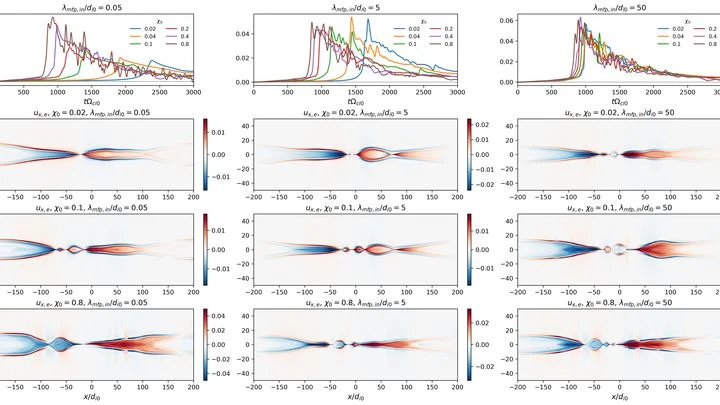
In plasma where some atoms remain neutral, magnetic field lines can rearrange at different speeds. This is like two rubber bands that are initially stuck together, then suddenly snap apart and contract, releasing energy.
A single calcium ion hovers in a vacuum trap, held by electric fields like a pea in an invisible bowl. Around it are two mirrors forming an optical cavity: light bounces between them, amplifying the interaction with the ion.
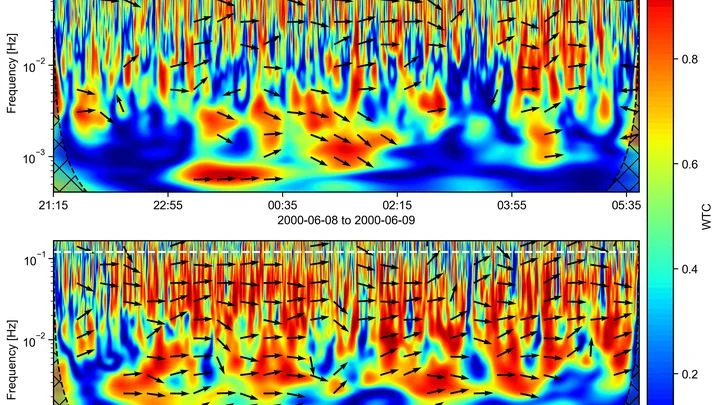
The Sun constantly emits a stream of charged particles, mostly hydrogen — the solar wind. Sometimes the Sun ejects dense blobs of magnetized gas, inside which calm usually reigns. But in 2000, scientists noticed two regions inside one such cloud where the gas was churning.
A few hundred million years after the Big Bang, the universe resembled an endless dark ocean, shrouded in a thick fog of neutral (non-ionized) hydrogen. Then something dispersed the gloom: ultraviolet radiation knocked electrons out of atoms, making the gas as transparent as pure water.
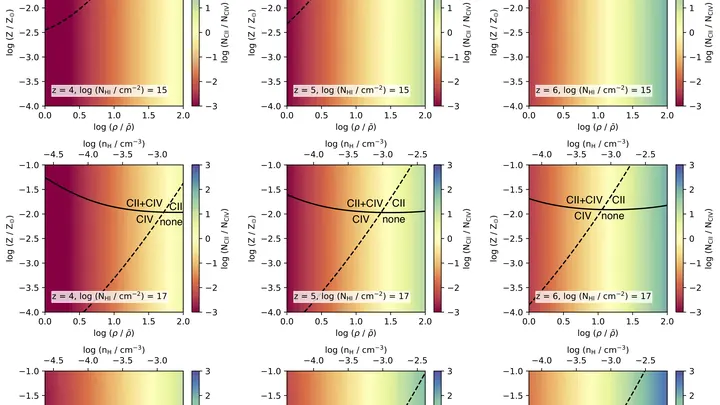
When the universe was less than a billion years old, it resembled a thick fog: ultraviolet light could not travel far because interstellar gas absorbed it. But gradually, as the first stars and galaxies were born, the fog lifted — a process known as the epoch of reionization. Astronomers want to understand exactly how this happened.
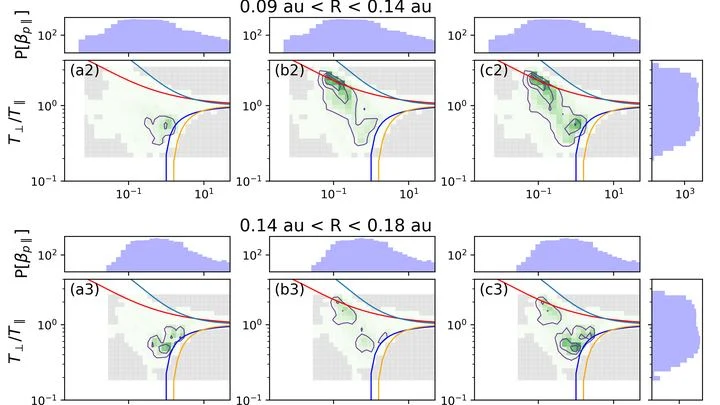
The solar wind isn't a calm stream but a bubbling soup of charged particles. Diving close to the Sun, the Parker probe picked up two types of stirring waves. Left-handed ones, like a whisk in a chef's hand, whip up the material when the temperature differs along and across the flow.
A thin film of thorium dioxide, just 10 nanometers thick, is deposited on a steel disk. A laser pulse strikes it, but instead of the expected glow, the detector catches a stream of electrons.