Chip Royal: How Optomechanics Tamed Thermal Noise and Turned Phonons into Error-Free Qubits express
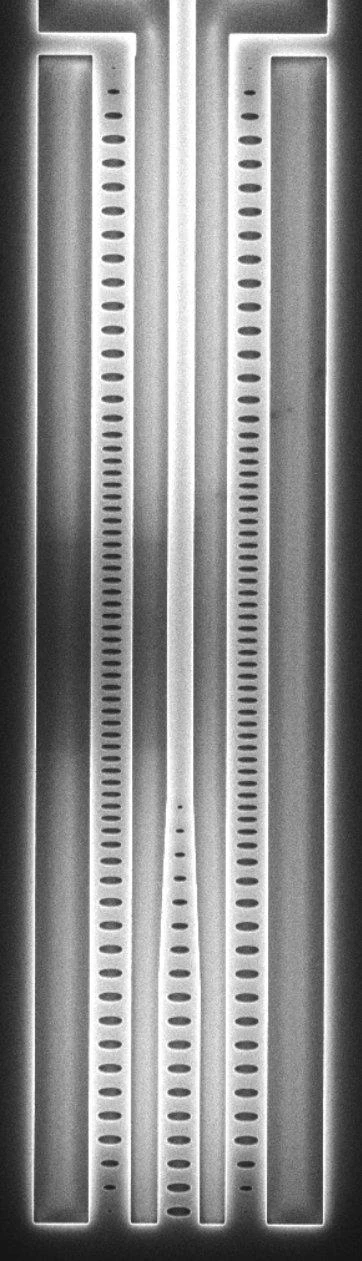
In the world of microchips, where streams of photons, quanta of light, carry information, a fundamental problem arises: light passing through matter inevitably heats it. This heating spawns thermal fluctuations — chaotic, unpredictable jostling of atoms that disrupts precise device operation. Imagine an ordinary musical instrument: a string stretched across a flimsy, thin frame. A slight rise in temperature and the frame warps, the string goes out of tune, the sound goes flat. That's how previous optomechanical systems behaved, where light and mechanical vibrations tried to work in tandem.
Engineers found an elegant solution, borrowing an idea from the piano. In a piano, strings are stretched over a massive cast-iron plate — a sturdy, stable structure that dampens parasitic vibrations and preserves tonal purity. By analogy, they created a chip where all optical and mechanical elements are anchored so firmly and rigidly that thermal fluctuations dissipate with efficiency 60 times greater than before. To put it in perspective, that difference is like going from a barely audible whisper to a loud, confident conversation.
How did scientists confirm such a breakthrough? Using precise light measurements, measuring the intensity and phase characteristics of laser radiation, and spectral analysis, which allowed them to decompose the signal into frequency components and see how much the unwanted noise level had dropped. It turned out that thermal noise fell so dramatically that a much more powerful laser beam could be fed into the system without fear of overheating. Meanwhile, the sound quanta (phonons, quanta of mechanical lattice vibrations) remain remarkably clean, undistorted by thermal jitter.
Such an optomechanical bridge, a device that converts signals between microwave and optical ranges, connects the worlds of microwaves and light, making the quantum internet a reality, where information is transmitted via quantum states. But the most unexpected discovery awaited researchers at extreme cooling. At temperatures close to that of liquid helium (just a few degrees above absolute zero), phonons change their behavior and become perfect carriers of quantum information — qubits. In this regime, they can operate without a single error, opening the path to ultra-stable quantum computing.
At temperatures near absolute zero, phonons become ideal qubits: you can already perform quantum computations on them without thermal noise.
These chips turn light into sound and back again, like bridges between worlds from science fiction, where information glides without loss.