A String That Never Goes Out of Tune: Higher Modes Hold Light in the Resonator ✛
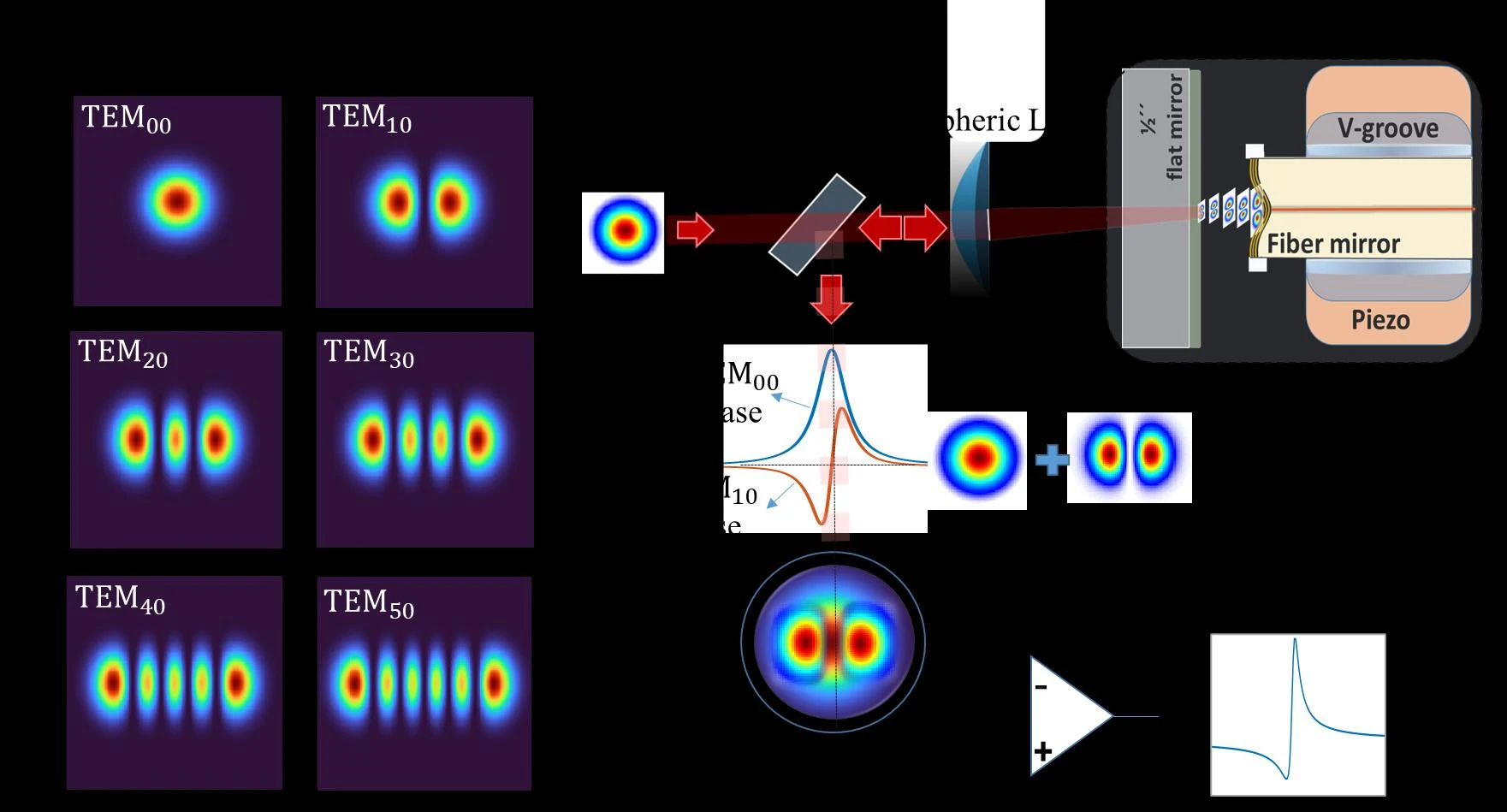
Tuning a string: higher harmonics help hold the pitch without drowning out the fundamental note. In an optical microcavity, a tiny resonator made of two mirrors, light bounces between the reflective surfaces, and any jitter in the spacing knocks it off resonance. Engineers at Lund University turned this problem into an advantage: instead of fighting higher-order spatial modes, they put them to work as stabilizers.
The Fabry–Pérot resonator, with a flat mirror and a concave fiber end, was suspended on three springs to isolate it from cryostat vibrations. Then two active stabilization methods were tested. The first, edge locking on the reflection dip, worked, but its precision degraded as the mode order increased: from 1.3 pm for the fundamental mode to 2.5 pm for TEM50. The cause is diffraction loss on the finite mirror with a radius of 10.5 μm, which reduced the finesse, that is, the number of light round trips between the mirrors.
The second method, tilt locking on odd Hermite–Gaussian modes TEM10, TEM30, and TEM50, proved more accurate. The error signal was extracted from the interference between the reflected fundamental mode and the resonant higher-order mode on a quadrant photodetector. On the TEM10 mode, with an intracavity power of 32 mW, they achieved 0.5 pm RMS stability, four times better than edge locking. Photon leakage from the locking beam into the single-mode fiber was 8 times lower for TEM10 than for TEM00, and 20 times lower for TEM30; combined with filtering, this gives suppression of more than 100 times.
Previously, it was unclear whether an open microcavity could be stabilized with high precision without contaminating the single-photon detector with locking beam light. Now it has been shown that tilt locking on higher-order modes solves both problems at once. The method is ready for use in experiments with single emitters in open cavities, especially at cryogenic temperatures. The next step is integrating the resonator with nanocrystals doped with rare-earth ions to test Purcell enhancement.
Back to the string: higher harmonics do not just sound along with the fundamental note; they hold its pitch when the instrument trembles. In optics, higher-order modes do the same for light, opening the way to quantum networks with single emitters.
A stability of 0.5 pm is roughly one fifty-thousandth of the diameter of a hydrogen atom. If the mirror spacing were one meter, this precision would correspond to controlling the gap with an error of half a percent of a human hair's thickness.
The idea of using higher-order modes for cavity stabilization echoes the concept of 'quantum damping' from Greg Egan's novel 'Quarantine', where precise tuning of optical cavities allows control over quantum states of single particles.