Stabilizing a Microcavity with Higher-Order Modes: Quieter Whisper, Brighter Light ✛
Context
High-finesse optical microcavities enhance light–matter interaction with single atoms, ions, or quantum dots via the Purcell effect. However, open resonators, which allow arbitrary materials and precise tuning, suffer from mechanical vibrations and thermal drift that shift the resonance frequency. Traditional stabilization on the fundamental TEM00 mode requires the locking beam to have the same wavelength as the fluorescence signal or to use complex optical filters. Nearby in the archive, methods for reading out quantum states via light, suppressing noise in quantum channels, and stabilizing resonators for gravitational-wave detectors have been described, but the task of simultaneously stabilizing and protecting the detector from stray light remained unsolved at the microscale.
Methods
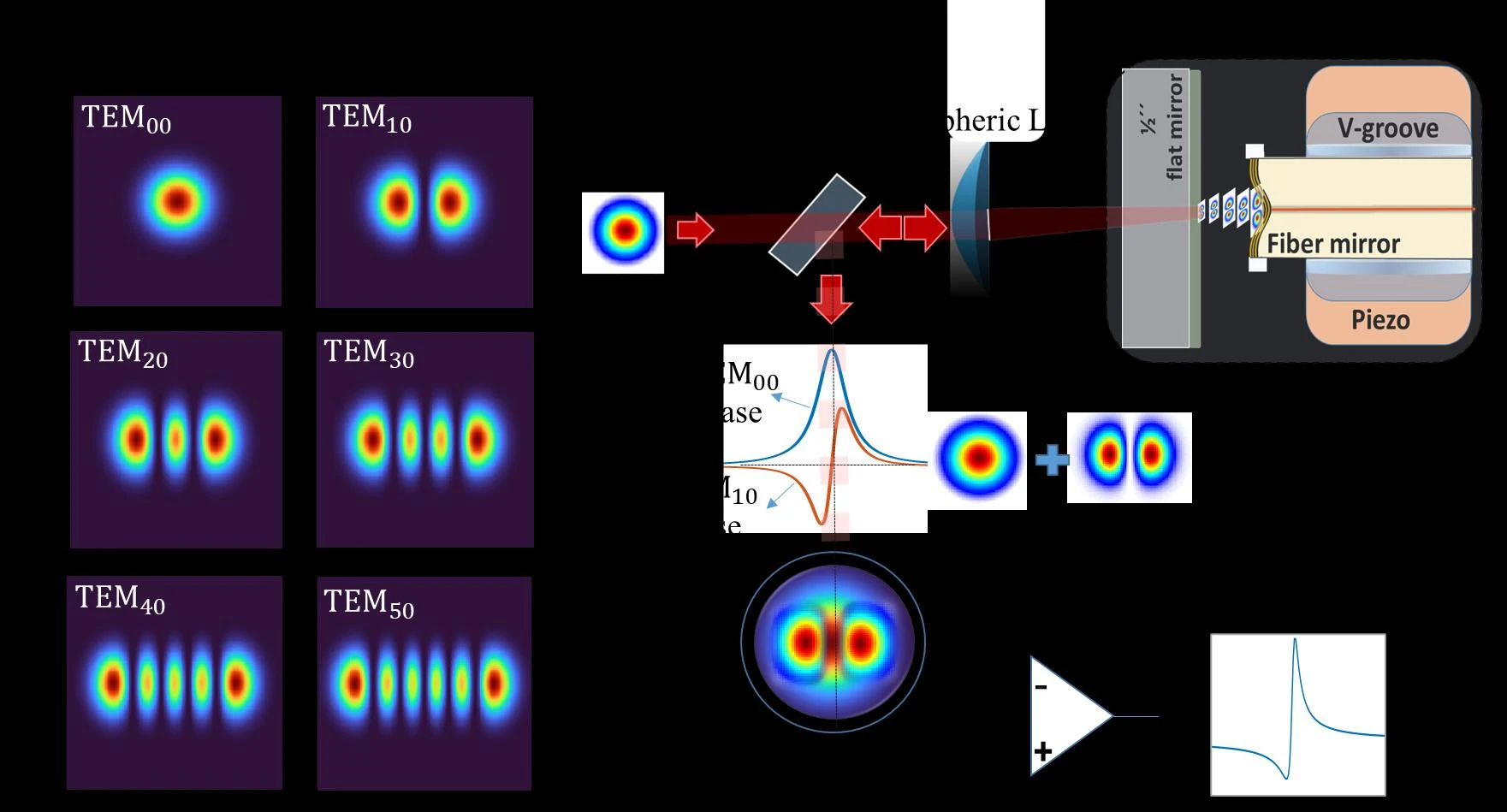
The experimental setup included a fiber Fabry–Perot resonator with a flat mirror and a concave end face of a single-mode fiber processed with a CO2 laser. All components were mounted in a single titanium block suspended on three springs with a frequency below 47 Hz to suppress cryostat vibrations. For active stabilization, two approaches were used: side-of-fringe locking on the reflection dip and tilt locking on odd Hermite–Gauss modes TEM10, TEM30, and TEM50. Tilt locking extracted an error signal from the interference between the reflected fundamental mode and the resonant higher-order mode on a quadrant photodetector in differential mode. The locking laser at 935 nm was introduced through the flat mirror, and the probe laser at 892 nm through the fiber, allowing measurement of cavity length fluctuations via probe transmission.
Results
A cavity length stability of 0.5 pm RMS was achieved using tilt locking on the TEM10 mode with an intracavity power of 32 mW. This is four times better than side-of-fringe locking on the same mode. For side-of-fringe, stability degraded with increasing mode order: from 1.3 pm for TEM00 to 2.5 pm for TEM50, due to reduced finesse caused by diffraction losses on the finite mirror (radius 10.5 μm). Transfer function modeling showed that the 0.5 pm limit is set by electronic noise in the piezo drivers and a feedback bandwidth of 3 kHz; with ideal electronics and an 80 kHz bandwidth, a level of 150 fm is possible, close to the Brownian noise of 15 fm. Photon leakage from the locking beam into the single-mode fiber for TEM10 was 8 times lower than for TEM00, and for TEM30 it was 20 times lower, which combined with filtering gives suppression of more than 100 times. At an intracavity power of 5 μW, the spurious photon rate was 365 counts/s for TEM10 and 77 counts/s for TEM30 after subtracting the dark count of 20 counts/s.
Implications
This work shows that higher-order transverse modes are not a nuisance but a tool: they allow separating the frequencies of the locking and signal beams without sacrificing stabilization accuracy. Unlike neighboring studies that focused either on passive vibration isolation or on optimizing feedback electronics, here two locking schemes on several modes were systematically compared for the first time, and the contribution of mirror diffraction losses was quantitatively assessed. This fills the gap between quantum optics and precision mechanics, offering a practical recipe for open microcavities.
Future development
Future prospects involve increasing the fiber mirror radius to three times the mode radius, which would eliminate truncation of higher-order modes and allow using TEM50 and above without loss of finesse. Another path is replacing piezo amplifiers with low-noise broadband models (e.g., ADHV4702-1 with 8 nV/√Hz noise) and implementing photothermal self-stabilization, which could raise the bandwidth to 500 kHz and reduce fluctuations to 20 fm. Then open microcavities would become competitive even for the most demanding quantum computing protocols.
Impact
The results are directly applicable to quantum networks with single emitters, resonator-based sensors, and cavity quantum electrodynamics experiments. Suppression of stray light simplifies single-photon detection and improves the signal-to-noise ratio in spectroscopy of rare-earth ions.
Next steps
The next step will be integrating the resonator with nanocrystals doped with rare-earth ions to test Purcell enhancement at cryogenic temperatures. Plans also include replacing mirrors with larger radius-of-curvature versions and testing stability on the TEM50 mode.
Key open problems
For quantum optics, a key unsolved problem remains achieving both high cavity finesse and low background light when working with single emitters. This work directly addresses that challenge by offering a method to separate the frequencies of the locking and signal beams without loss of accuracy, which is critical for scalable cavity-based quantum processors.
The knowledge machine's view
This section is addressed to the author of the paper and their colleagues. Neighbouring works were found by meaning-based search across our archive, not by word overlap. We do not review: we show the field around the work.
What the work does
The work demonstrates active stabilization of a tunable optical microcavity using tilt locking on odd higher-order modes. The authors compared two stabilization methods, achieved a length stability of 0.5 pm RMS, and reduced the leakage of locking-beam photons by more than a factor of 100.
Where its strength is
Using higher-order transverse modes for stabilization allows the locking beam to be separated from the fluorescence signal without complex filtering, paving the way for low-noise quantum interfaces.
Where it could go next
- It may be interesting to consider applying instability suppression methods from gravitational-wave detectors to further reduce noise in microcavities, especially in the context of Brownian noise.based on: Light Quenches Light: Suppressing Instabilities in Gravitational Wave Detectors arXiv:2606.27643
- Related work on quantum squeezing of molecules for improving sensor accuracy lies nearby; perhaps similar light-squeezing methods could help overcome shot noise in the stabilization system.based on: Quantum Squeezing of Molecules Improves Sensor Accuracy Threefold arXiv:2606.02500
Worth trying
- Test whether a mode of higher order than TEM10 can be used to further reduce photon leakage without compromising stability.
- Evaluate the impact of mirror shape (e.g., spherical aberration) on diffraction losses of higher-order modes and optimize it to reduce losses.
- Try combining tilt locking with noise suppression methods described in work on gravitational-wave detectors to approach the Brownian limit.
Nearby works in our archive
- Light Quenches Light: Suppressing Instabilities in Gravitational Wave Detectorssimilarity 0.52
- Chip Royal: How Optomechanics Tamed Thermal Noise and Turned Phonons into Error-Free Qubitssimilarity 0.52
- Quantum Microscope Sees What Ordinary Light Can'tsimilarity 0.52
- Quantum Squeezing of Molecules Improves Sensor Accuracy Threefoldsimilarity 0.52
- Light trapped in a ring so it won't fadesimilarity 0.51
- A Shivering Disk Cooled to Quantum Stillnesssimilarity 0.51
The archive is sparse around this work: the closest review is only 0.52, against a usual 0.64. It looks like few have drilled nearby.
A stability of 0.5 pm is roughly one fifty-thousandth of the diameter of a hydrogen atom. If the mirror spacing were one meter, this precision would correspond to controlling the gap with an error of half a percent of a human hair's thickness.
The idea of using higher-order modes for cavity stabilization echoes the concept of 'quantum damping' from Greg Egan's novel 'Quarantine', where precise tuning of optical cavities allows control over quantum states of single particles.
Key numbers
- length stability (tilt locking, TEM10): 0.5 pm RMS
- photon leakage suppression (TEM10 vs TEM00): >100 times
- finesse TEM00/TEM10 at 935 nm: 1600
- finesse TEM30 at 935 nm: 800
- finesse TEM50 at 935 nm: 400
- feedback bandwidth: 3 kHz