Symphony of Imaginary Frequencies: Quantum Decay of the Inverted Well ✛ ✎ ✦
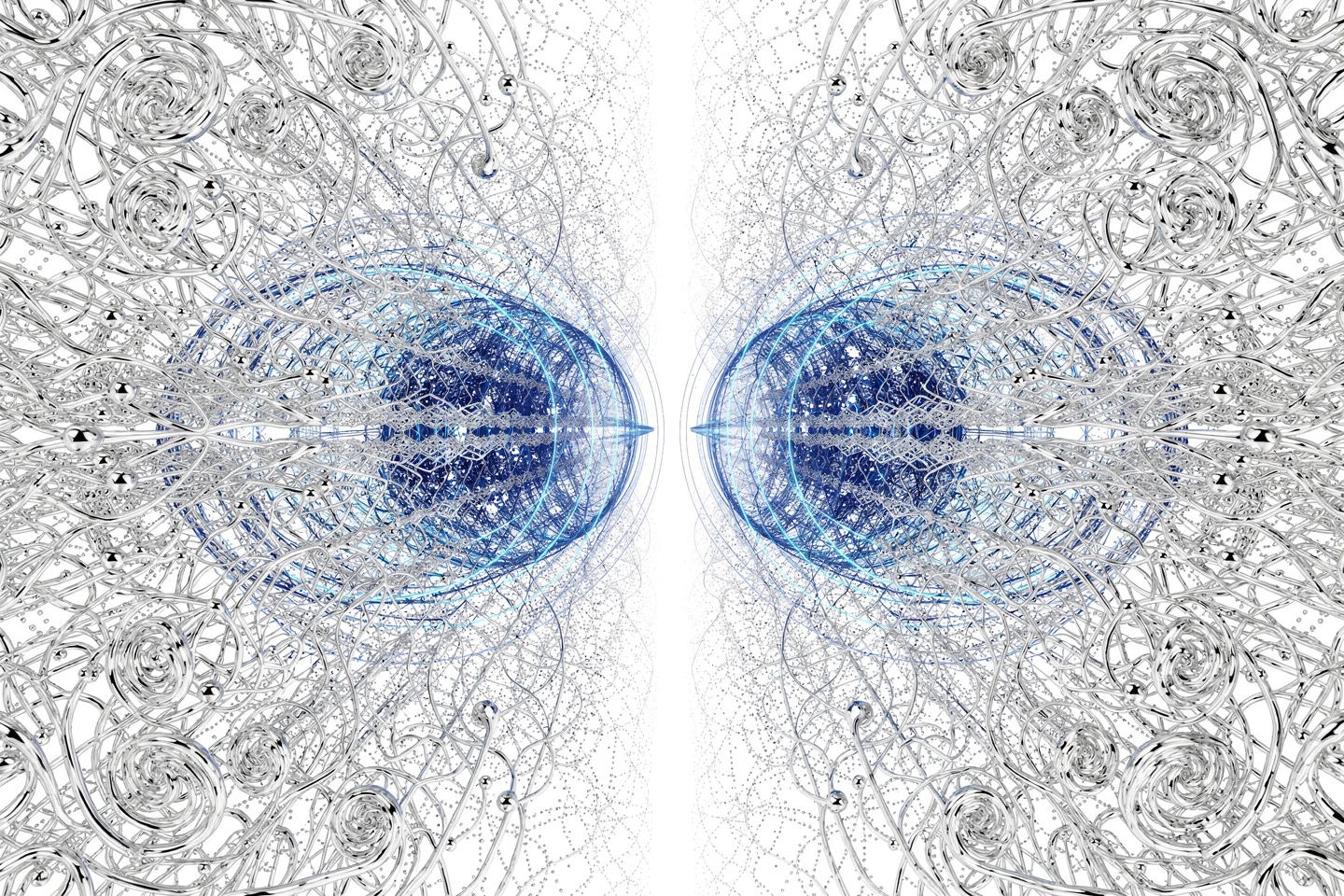
At the hilltop of classical physics, a particle is frozen in unstable equilibrium. The slightest nudge — and it rolls down with increasing speed. In the quantum universe, no nudge is needed: the uncertainty principle itself acts as an all-pervading wind, blowing the particle off the peak. Zero-point fluctuations refuse to let it rest, dooming the state to decay. For a long time, this plunge remained a mathematical puzzle. Now physicists have not only solved it but also heard harmony in the solution — energy resonating at imaginary frequencies.
Imagine a quantum system as a string instrument, its tuning set by the Hamiltonian. In the familiar oscillator, every note (energy level) is real. But the inverted well detunes the instrument: the notes become imaginary — Eₙ = iℏω(n+½). The imaginary part sets the tempo of decay: ket-states amplify, bra-states attenuate. This built-in quantum decoherence needs no external noise — instability is written into the score itself. The method employs 'imaginary' bosonic operators. They generate wavefunctions that — like an echo of Feynman path integrals — are normalized with an imaginary measure. This trick is familiar to anyone who has encountered quantum field theory.
But how can one hear the imaginary music? A duet was needed: orthonormal sets of ket- and bra-states, residing in two conjugate worlds. Individually, they violate probability conservation: one world flares up, the other fades away — a hint that conventional quantum measurements need rethinking. Together, they create a perfect balance — like stereo sound, where each channel alone is distorted, but the duet yields a pure picture. The culmination of this dualism is coherent states: an infinite superposition of imaginary Fock levels, first introduced by Schrödinger. Then a miracle happens: averaging the Heisenberg equation over such a state yields the exact classical equation of motion ẍ = ω²x with solution x(t) = ±(v/ω)sinh(ωt). The quantum instrument, tuned to imaginary frequencies, begins to play a classical melody — the particle rolls down the hill exactly as Newton would have it. All the while, minimal quantum blurring is maintained: Δx Δp = 1/2.
This result goes far beyond an academic exercise. The dual formalism with imaginary energies provides a rigorous tool for calculating decay rates without quasi-classical approximations — from the decay of the false vacuum in early-universe inflation to modeling noise in quantum information science. Imaginary bosonic operators are already being tried on multidimensional fields and PT-symmetric systems. Curiously, here the spectrum becomes imaginary without breaking PT-symmetry — a rare case that challenges conventional ideas about the link between symmetry and real energies. Experiments with Bose–Einstein condensates and quantum optics could test these ideas on real atoms. Moreover, the very nature of time gains an unexpected twist: the irreversible decay of ket-states resembles an arrow of time, while dual bra-worlds seem to move backward. Perhaps reality itself is a duet of worlds, whose quantum harmony gives birth to the classical symphony of being.
The ground state of the inverted well is 'omnipresent': the particle is smeared along the entire axis with constant probability density and a subtle interplay of phases. To normalize such a state, Feynman summoned the aid of an imaginary measure — a mathematical curiosity from his arsenal.
The instability of the inverted well resembles the problem of wormholes from science fiction: they too tend to collapse without exotic matter. In our case, the stabilizing role is played by dual bra-states — quantum 'exotic matter' that maintains balance.