Time Is Born from the Shape of the Universe ✛
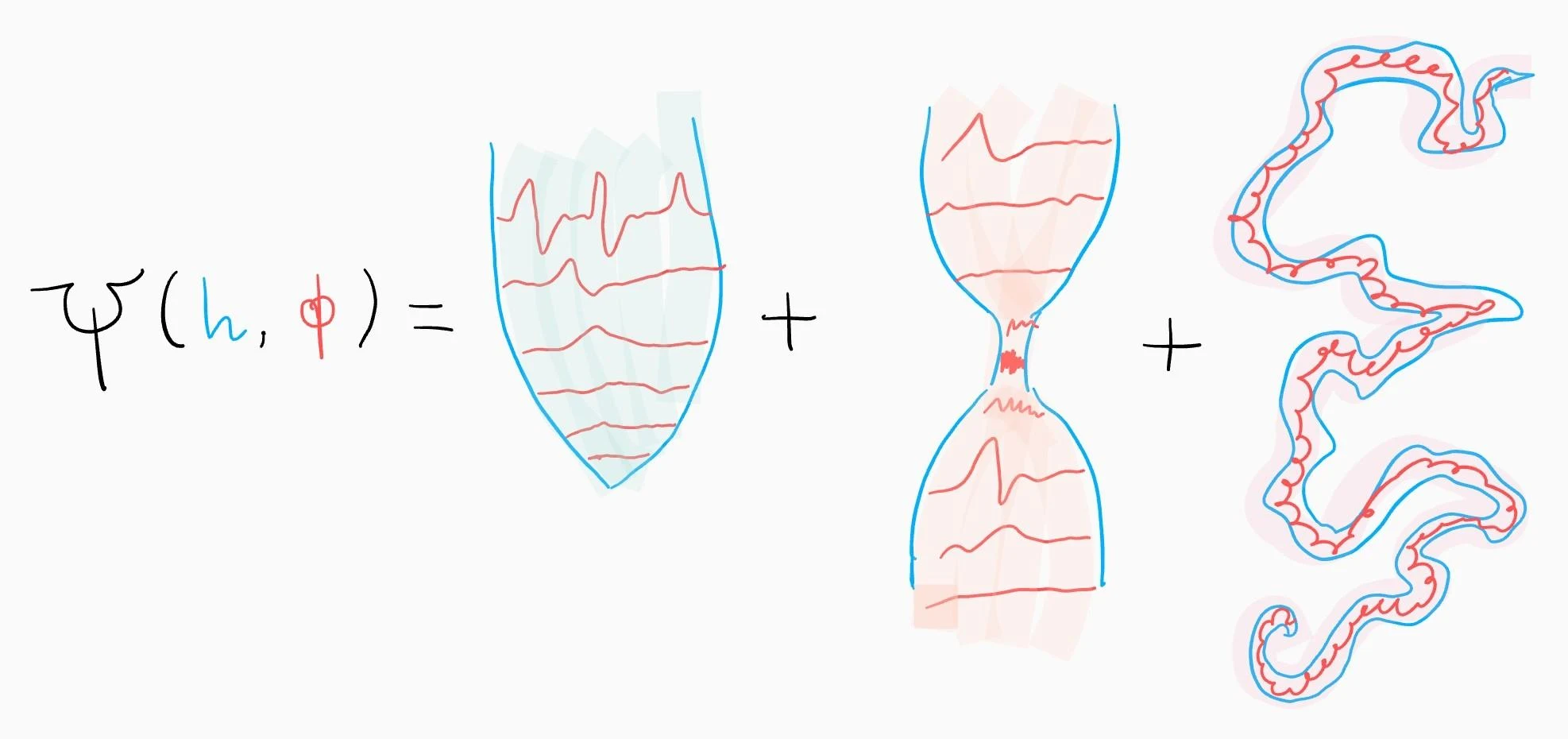
The clock on the kitchen wall ticks, and each tick relentlessly carries us from breakfast to lunch. This is so familiar that it seems like a law of nature, but physics says otherwise. In Einstein's equations, time is reversible: you can rewind the film, and no frame will give the trick away. The direction appears only when we look at the Universe as a whole, as a stage where thermodynamics plays the play of time.
The stage must be special. First, it is synchronous: all actors share a common rhythm, and particle worldlines do not twist around each other. Such a universe is called synchronous, with a single cosmic time. Second, it has no closed loops; otherwise, a hero walking around the stage would return to his own past. Third, at the beginning of the play, the stage is almost empty and orderly: the Weyl tensor, which describes tidal deformations, vanishes at the Big Bang. This is the past hypothesis: low entropy at the moment of birth.
Previously, these conditions were scattered across separate papers: some discussed the thermodynamic arrow, others temporal orientability, others the prohibition of loops. The author has assembled them into a single chain and shown how each step builds on the previous one. First, synchronicity: without it, you cannot even slice spacetime into moments of "now." Then, a regular initial singularity; otherwise, the play would lack a clean first act. Finally, global orientability and chronology, so that no route leads into the past.
But geometry only sets the stage; it does not perform the play. By itself, it does not create a direction: the arrow of time is born from the growth of entropy. Spacetime provides the suitable scenery, but the actor is thermodynamics. In quantum cosmology, the scenery disappears: the Wheeler–DeWitt equation, the fundamental equation of the quantum universe, contains no time at all. Time appears only in the semiclassical approximation, when the universe becomes large and classical. Thus, fundamental physics hints that time is not a primary given but an emergent property of the whole.
If time indeed depends on the global shape of the universe, then quantum gravity must explain why, from the quantum foam, the geometry that allows an arrow of time emerged. Perhaps future theories will not postulate initial conditions but derive them from deeper principles. Another path is to look for other phenomena as intimately tied to the shape of the universe as time is. For now, this is pure knowledge: no practical applications are in sight, but for selecting cosmological models and for philosophical debates about the nature of time, the work provides a clear checklist.
Gödel's universe is an exact solution to Einstein's equations that contains closed timelike curves: you can return to your own past. In such a universe, the arrow of time could not exist globally, although locally entropy could still increase.
In Kurt Vonnegut's novel Slaughterhouse-Five, the aliens from Tralfamadore see all time at once: past, present, and future exist simultaneously. This is a fictional illustration of the B-theory of time, which the article contrasts with the A-theory. If the universe did not satisfy the geometric conditions described, human experience of time would resemble the Tralfamadorian one, without a privileged "now" and without direction.