Time Is Born from the Shape of the Universe ✛
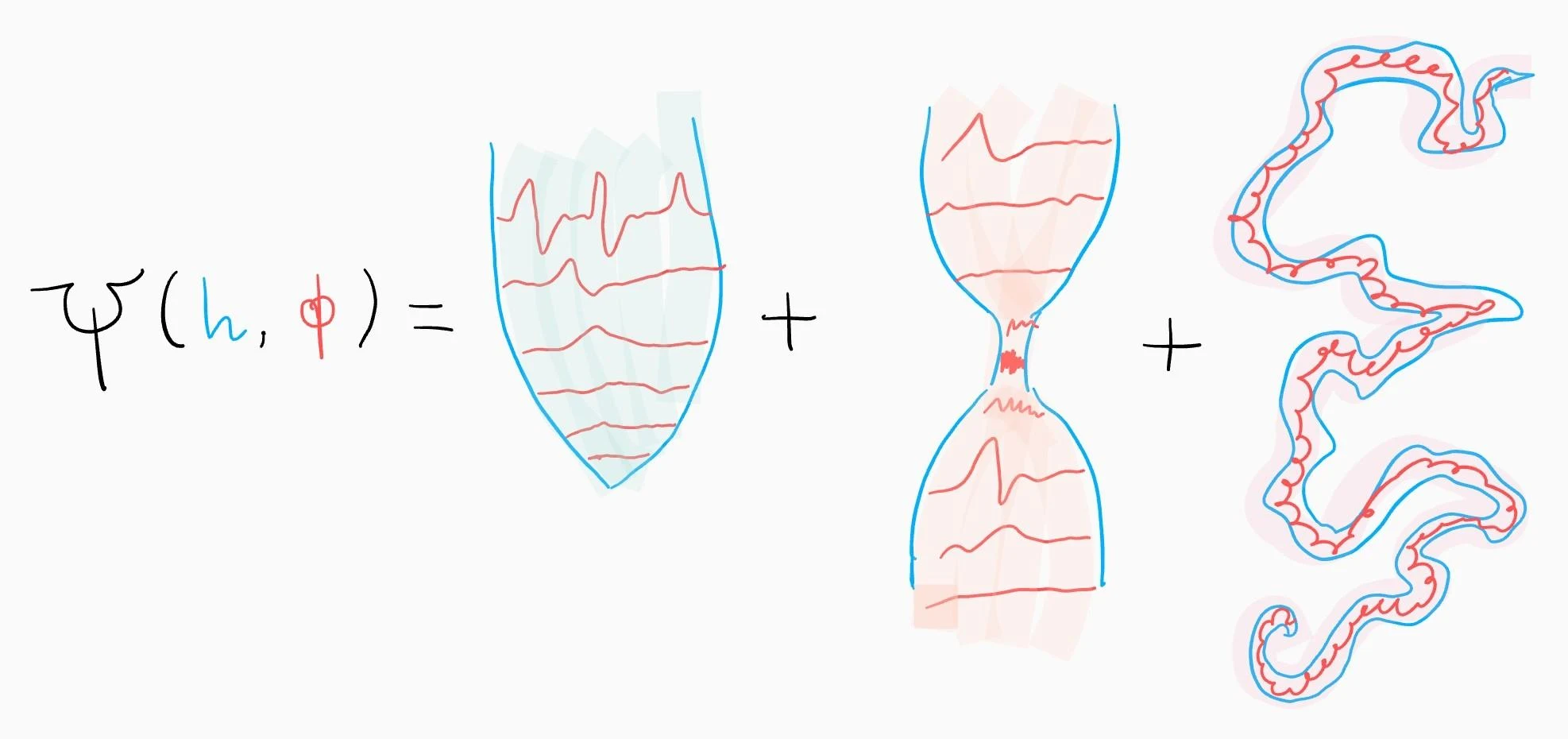
Context
Alongside this work in the archive are studies on two times in the quantum world, on time not disappearing after stars fade, and on how pocket watches coexist with an expanding universe. All of them move in the same direction: trying to understand how our everyday sense of directed flow arises from fundamental physics, where time is either absent or reversible. This article takes a step back and asks: what global properties of the universe are necessary at all for us to speak of 'before' and 'after'?
Methods
The author does not perform new calculations or process data. Instead, he assembles known geometric conditions: Weyl's postulate of non-crossing particle worldlines, the past hypothesis of low entropy at the Big Bang, temporal orientability of the manifold, and the absence of closed timelike curves. Each condition is analyzed in the language of differential geometry, from the kinematic decomposition of congruences to the Raychaudhuri focusing theorem and the Wheeler–DeWitt equation.
Results
It is shown that for even a local arrow of time to exist, the universe must be synchronous (particle worldlines orthogonal to spatial slices) and begin with a regular singularity where the Weyl tensor vanishes. A global arrow additionally requires temporal orientability and chronology, otherwise a traveler looping around the universe could return to the past. The key conclusion: temporal asymmetry of geometry is necessary but not sufficient; the arrow of time is set by entropy increase, with geometry merely providing a suitable stage. In quantum cosmology, the Wheeler–DeWitt equation contains no time, and the semiclassical approximation recovers it only for a universe that is already large and classical.
Implications
Unlike neighboring works that often seek the arrow of time in local processes or treat time as an illusion, this article insists that temporal directionality is a property of the entire universe, not its parts. It makes explicit the chain of necessary conditions and shows where thermodynamics enters geometry. For the philosophy of time, this is an argument that A-theory (real flow of time) is compatible with physics only under very strict cosmological assumptions.
Future development
If time truly depends on the global shape of the universe, then quantum gravity must explain why the geometry that allows an arrow of time emerged from the quantum foam. Perhaps future theories will not postulate initial conditions but derive them from deeper principles. Another path is to look for other phenomena as intimately tied to the shape of the universe as time is.
Impact
The results are important for cosmology, quantum gravity, and the philosophy of physics. They provide selection criteria for realistic universe models and point to a bottleneck in quantum cosmology: the problem of time.
Next steps
Investigate how specific quantum gravity models (loop quantum gravity, causal dynamical triangulations) reproduce or violate the highlighted geometric conditions. Search for observational signatures that could distinguish universes with a global arrow of time from others.
Key open problems
For cosmology, an open question remains: why was the initial state of the universe so special (low entropy, regular singularity)? This work does not solve the problem but shows that without an answer, the very existence of time cannot be explained. The connection to the measurement problem in quantum mechanics also remains unclear: wave function collapse could provide an independent source of irreversibility, but it is not considered in the article.
The knowledge machine's view
This section is addressed to the author of the paper and their colleagues. Neighbouring works were found by meaning-based search across our archive, not by word overlap. We do not review: we show the field around the work.
What the work does
The paper collects the known geometric conditions necessary for the existence of the arrow of time: the Weyl postulate, the past hypothesis, temporal orientability, and the absence of closed timelike curves. The author shows that temporal asymmetry of geometry is necessary but not sufficient, and that the arrow of time is set by the growth of entropy on a suitable geometric stage. It is also discussed how time emerges in the semiclassical approximation from the Wheeler–DeWitt equation.
Where its strength is
The article makes explicit the chain of necessary conditions and connects thermodynamics with the global structure of spacetime, insisting that temporal directionality is a property of the entire universe, not of its parts.
Where it could go next
- It might be interesting to see how the proposed global conditions fit with specific cosmological models, such as the quantum wave that generates the universe.based on: The Quantum Wave That Gives Birth to the Universe arXiv:2607.05020
- A related work argues that time will not disappear after the stars fade; its analysis of the universe's far future could test whether temporal orientability and chronology conditions hold in late epochs.based on: Twilight of Time: Why the Arrow Fades but Time Endures arXiv:2508.14312
- The question of time's birth from eternity is addressed in a companion paper; comparing with it may clarify how the global conditions of this work arise in models without an initial time.based on: Clock Without Hands: Can Time Emerge from Eternity? arXiv:2605.24970
Worth trying
- Test whether the conditions of synchrony and absence of closed timelike curves hold in specific solutions, for example in models with quantum birth of the universe.
- Compare the chain of necessary conditions with the thermodynamic evolution in the far future described in work 2508.14312.
- Consider how the semiclassical approximation, which recovers time from the Wheeler–DeWitt equation, aligns with the idea of two times in the quantum world.
Why this may matter
This approach may help identify which global properties of the universe are truly necessary for our experience of time, and link cosmology with philosophical questions about the nature of temporal flow.
Nearby works in our archive
- The Quantum Wave That Gives Birth to the Universesimilarity 0.59
- Clock Without Hands: Can Time Emerge from Eternity?similarity 0.58
- Clocks That Tick Quantumlysimilarity 0.57
- Twilight of Time: Why the Arrow Fades but Time Enduressimilarity 0.57
- The Universe as a Web of Quantum Connectionssimilarity 0.57
The archive is sparse around this work: the closest review is only 0.59, against a usual 0.64. It looks like few have drilled nearby.
Gödel's universe is an exact solution to Einstein's equations that contains closed timelike curves: you could return to your own past. In such a universe, a global arrow of time could not exist, although entropy might still increase locally. Gödel himself used this model to show that time in the sense of 'flow' is not a necessary consequence of general relativity.
In Kurt Vonnegut's novel Slaughterhouse-Five, the aliens from Tralfamadore see all time at once: past, present, and future exist simultaneously. This is a fictional illustration of the B-theory of time, which the article contrasts with A-theory. If the universe did not satisfy the described geometric conditions, human experience of time would resemble the Tralfamadorian one: without a privileged 'now' and without direction.
Key numbers
- radius beyond which closed timelike curves appear in Gödel's model: r > arcsinh(1) ≈ 0.88 in units of 1/(√2ω)
- maximum time to focusing in a contracting universe: t ≤ 3/|θ₀| for θ₀ < 0
- order of WKB expansion in the semiclassical approach: ħ⁰ (classical) and ħ¹ (quantum corrections)