Cosmic Necklace Reveals Secrets of Galaxy Birth ✛
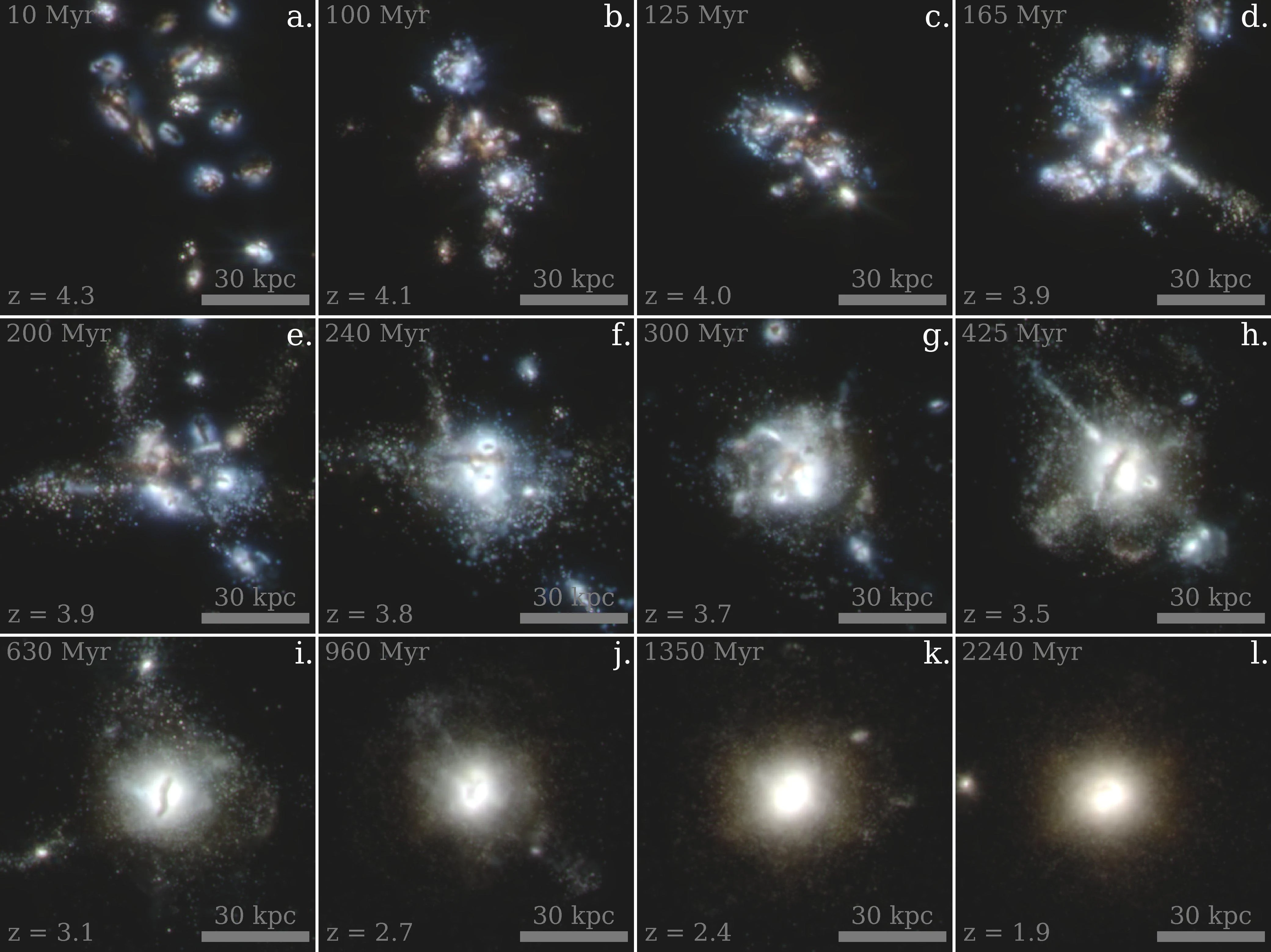
Three giant galaxies collide, and from the impact, gas flies away. But it does not disappear without a trace — it compresses into clumps resembling beads of a cosmic necklace, strung on an invisible thread spanning thousands of light-years. The light from these beads comes from atoms of carbon heated by shock waves — like the air in front of a supersonic jet, only on a galactic scale.
It's amazing that the gas remains colder than ice on Earth (minus 243°C), but glows due to intense heating from the collision. In this necklace, stars are born at a furious rate: thousands of new suns appear each year, while our Milky Way creates just a couple. Spectroscopy — breaking light into colors — allows us to peer into these processes, and observations are conducted at wavelengths where cold cosmic dust and gas shine.
Such a cataclysm is not chaos, but construction: from these beads, giant elliptical galaxies later form, the most massive in the Universe.
The gas 'beads' are heated only to -243°C — 20 degrees colder than Pluto's surface. But thanks to shock waves, they glow so brightly that they can be detected at a distance of billions of light-years.