Smoldering Embers of Black Holes ✛
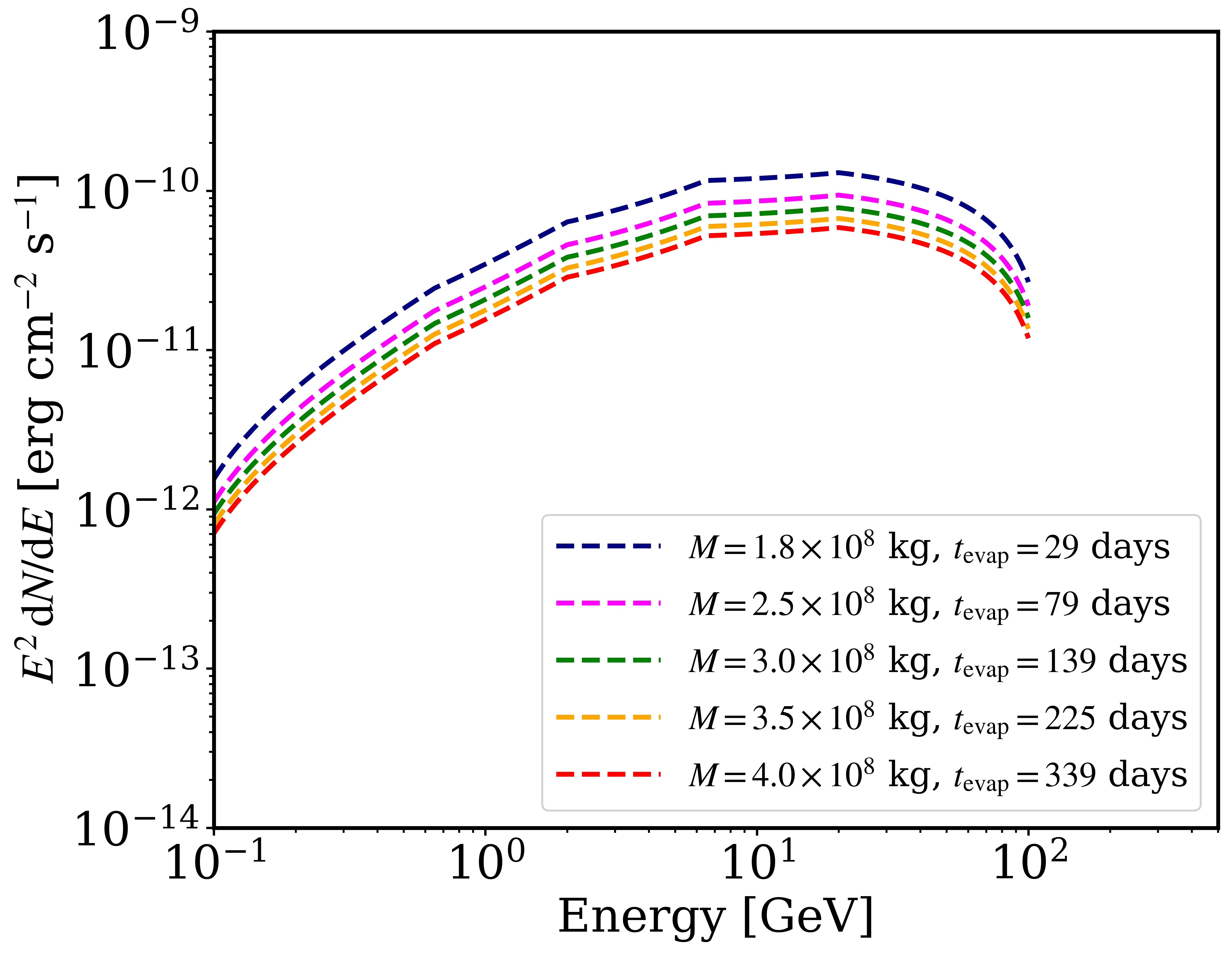
In 2017, the LIGO and Virgo gravitational detectors caught ripples in spacetime from the merger of two black holes 540 megaparsecs away. The event was named GW170814. But what remained after this cosmic collision? Besides distorted space, tiny black holes, or 'crumbs', might have been born. According to Hawking's calculations, such objects are not eternal: they evaporate, radiating energy.
Astrophysicists decided to check whether these embers are still smoldering after the merger's fire. They took data from the Fermi-LAT space gamma-ray telescope for 12 months after GW170814 and superimposed Hawking radiation models for crumbs of various masses, from 1.8×$10^8$ to 4.0×$10^8$ kg. Each mass has its own lifetime: from 29 to 339 days. If crumbs existed, the data would show an additional gamma-ray source that would brighten as it evaporated.
But the test statistic, a number indicating how much better the model with a source is than the model without, turned out to be negative for all months and all masses. This means that the additional source does not improve the description of the data. There is no signal. Comparing with the least negative case, scientists excluded crumbs of mass 4×$10^8$ kg at 95% confidence. For smaller masses, the constraints are weaker: crumbs could have evaporated earlier or later, and their flash would be easier to miss.
This result is not just 'nothing found'. Previously, it was unknown whether crumbs could be born in black hole mergers and whether they could be seen. Now, for GW170814, the scenario with mass 4×$10^8$ kg is closed. The methodology is universal: it can be applied to any event from the growing LIGO–Virgo–KAGRA catalog. And new telescopes, such as the Cherenkov Telescope Array Observatory, will expand the accessible parameter space and may one day catch the final flash of an evaporating black hole.
So the smoldering embers of black hole mergers remain invisible for now. But the very fact that we have learned to look for them is already a step forward. Each new observation narrows the region where these hypothetical objects could hide and brings us closer to understanding the quantum nature of the event horizon.
The evaporation time for a crumb of mass 4×$10^8$ kg is 339 days, which is roughly one Earth year. If such a crumb had been born in the GW170814 merger, its final gamma-ray flash would have occurred right within the Fermi-LAT observation period.
The idea of small black holes evaporating with a flash echoes Greg Egan's novel 'Schild's Ladder', where microscopic black holes are used as an energy source.