Gamma Rays from Black Hole Crumbs ✛
Context
Alongside this work on the archive are studies of black hole evaporation, wormholes, and luminosity anomalies. They all revolve around one question: how to observe the quantum nature of the event horizon. This article follows the same line but takes a step from theory to a concrete search in gamma-ray telescope data.
Methods
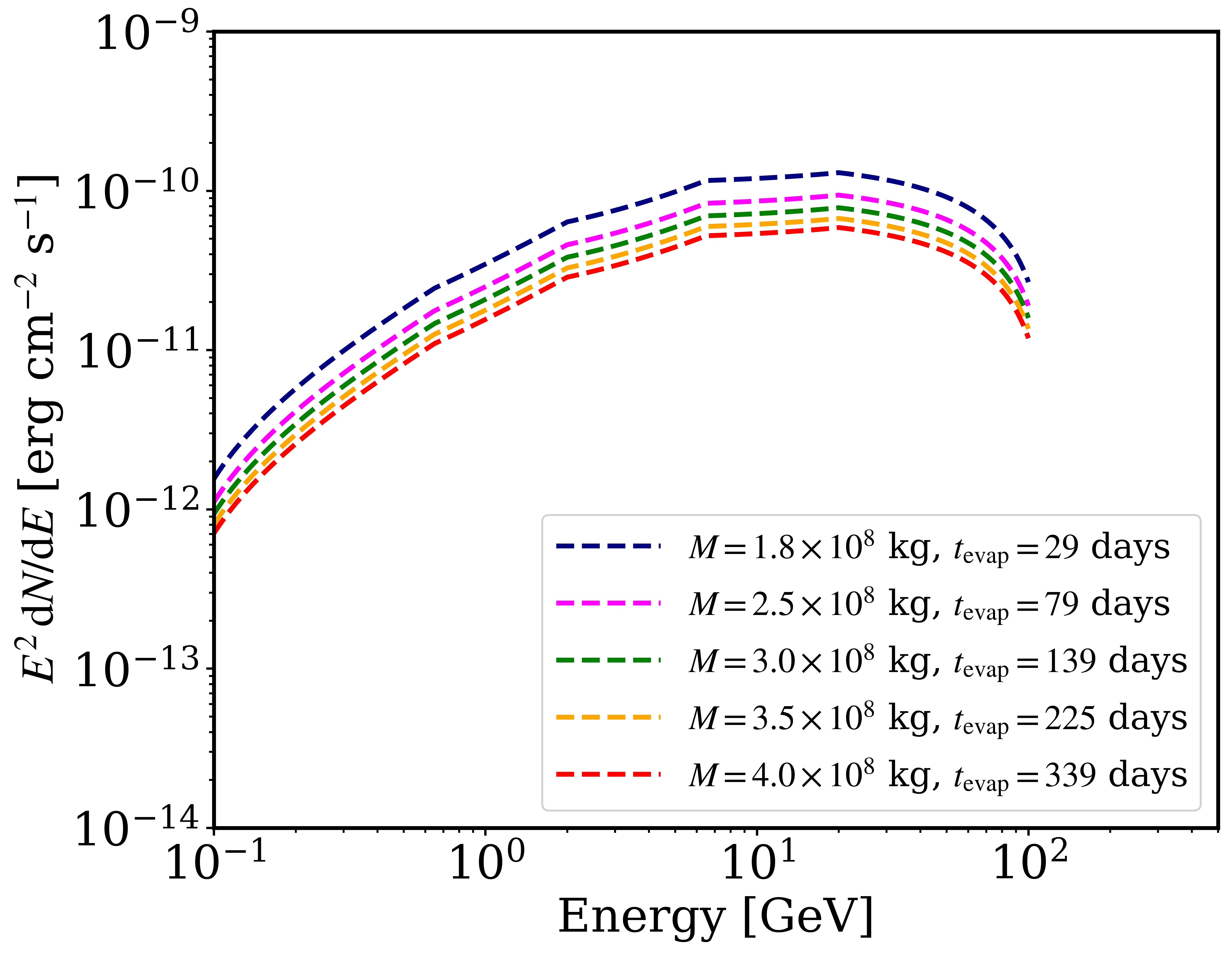
They took data from the Fermi-LAT space gamma-ray telescope for 12 months after the GW170814 event. At the best localization point of the merger, they added a model source—the Hawking radiation spectrum from crumbs, calculated with the BlackHawk code. They considered five crumb masses from 1.8×$10^8$ to 4.0×$10^8$ kg, each corresponding to an evaporation time from 29 to 339 days. They built monthly models and assessed the significance of the additional source using a test statistic.
Results
The test statistic was negative for all months and all masses. This means that the additional source does not improve the description of the data—there is no signal. Comparing with the least negative case, they excluded the crumb mass of 4×$10^8$ kg at the 95% confidence level. For smaller masses, the constraints are weaker.
Implications
This work differs from neighboring ones in that it applies, for the first time, the ready-made toolkit of gamma-ray astronomy to the crumb hypothesis after a real merger. Neighbors discuss evaporation mechanisms and theoretical models, while here it is a direct search in data. This is the first test of a specific prediction for the GW170814 event.
Future development
The method can be extended: add a late burst of radiation just before the final evaporation, explore a wider range of masses and mass distributions of crumbs. Systematic application to the growing catalog of LIGO–Virgo–KAGRA mergers will strengthen the constraints. New telescopes, such as the Cherenkov Telescope Array Observatory, will expand the accessible parameter space.
Impact
The result is important for black hole physics and quantum gravity, as well as for multi-messenger astronomy—the connection between gravitational waves and gamma-ray emission.
Next steps
Incorporate the late gamma-ray burst into templates and apply the analysis to other events from the gravitational wave catalog.
Key open problems
For high-energy astrophysics, the question of the existence of primordial black holes of small masses and their observational signatures remains open. This work does not resolve it, but it outlines the mass region where crumbs are already excluded and sets a methodology for further searches.
The knowledge machine's view
This section is addressed to the author of the paper and their colleagues. Neighbouring works were found by meaning-based search across our archive, not by word overlap. We do not review: we show the field around the work.
What the work does
The authors analyzed one year of Fermi-LAT data following the GW170814 event, searching for gamma-ray emission from evaporating low-mass primordial black holes, or "crumbs." For five masses in the range 1.8–4.0×10^8 kg, they modeled the Hawking spectra and assessed the significance of an additional source. No significant signal was found; based on the negative test statistic, a mass of 4×10^8 kg is excluded at the 95% confidence level.
Where its strength is
This is the first application of standard gamma-ray astronomy tools to test a specific prediction about the evaporation of crumbs after a real gravitational-wave event. The work demonstrates a practical methodology that can be scaled to future observations.
Where it could go next
- It might be interesting to compare the obtained constraints with predictions from cosmological models where primordial black holes affect the expansion rate of the Universe; this would link the local search to global effects.based on: Cosmic Hot Tap: How Primordial Black Holes Rewrite the Speed of the Universe arXiv:2607.18528v1
- A related approach uses gravitational-wave data to test the laws of black hole physics; one could consider a joint analysis of gamma-ray and gravitational-wave data for future events to enhance sensitivity to crumbs.based on: Echo of a Merger: How GW250114 Confirmed Hawking's Area Theorem arXiv:2509.08054
- There is work in the archive where a gamma-ray excess from the Galactic center is interpreted as a possible signal from dark matter particle annihilation or decay; a similar analysis of background gamma-ray data near merger sites could help distinguish crumbs from other sources.based on: Excess Gamma Light from the Galactic Center arXiv:2605.22913
Worth trying
- Repeat the analysis for other gravitational-wave events from the LIGO/Virgo catalog, especially those with larger remnant masses, where a greater number of crumbs is expected.
- Use a Bayesian approach to combine constraints from multiple events, thereby achieving cumulative sensitivity.
- Test the method's sensitivity to spectra with non-thermal corrections, as calculated in some black hole evaporation models.
Why this may matter
Such a search directly links quantum gravity with astrophysical observations and could lead to the first detection of evaporating black holes or to stringent constraints on their existence near Earth.
Nearby works in our archive
- Cosmic Hot Tap: How Primordial Black Holes Rewrite the Speed of the Universesimilarity 0.60
- Measuring Black Holes with Spacecraft Stopwatchessimilarity 0.55
- Echo of a Merger: How GW250114 Confirmed Hawking's Area Theoremsimilarity 0.55
- Gravitational Waves See No Split in Black Holessimilarity 0.55
- Excess Gamma Light from the Galactic Centersimilarity 0.55
- Cosmic Funhouse Mirror: The Mystery of Signal GW231123similarity 0.55
The archive is sparse around this work: the closest review is only 0.60, against a usual 0.64. It looks like few have drilled nearby.
The mass of a crumb, 4×$10^8$ kg, is roughly the mass of a small asteroid, but compressed into a volume smaller than an atom. Its evaporation time is about a year, and at the end it should flash with gamma radiation.
The idea of small black holes evaporating with a flash echoes Greg Egan's novel 'Schild's Ladder', where microscopic black holes are used as an energy source.
Key numbers
- mass of excluded crumb: 4×10⁸ kg
- evaporation time for this mass: 339 days
- distance to GW170814: 540 Mpc
- exclusion confidence level: 95%
- crumb mass range: 1.8–4.0×10⁸ kg