Stellar explosions puff up giant gamma-ray bubbles express
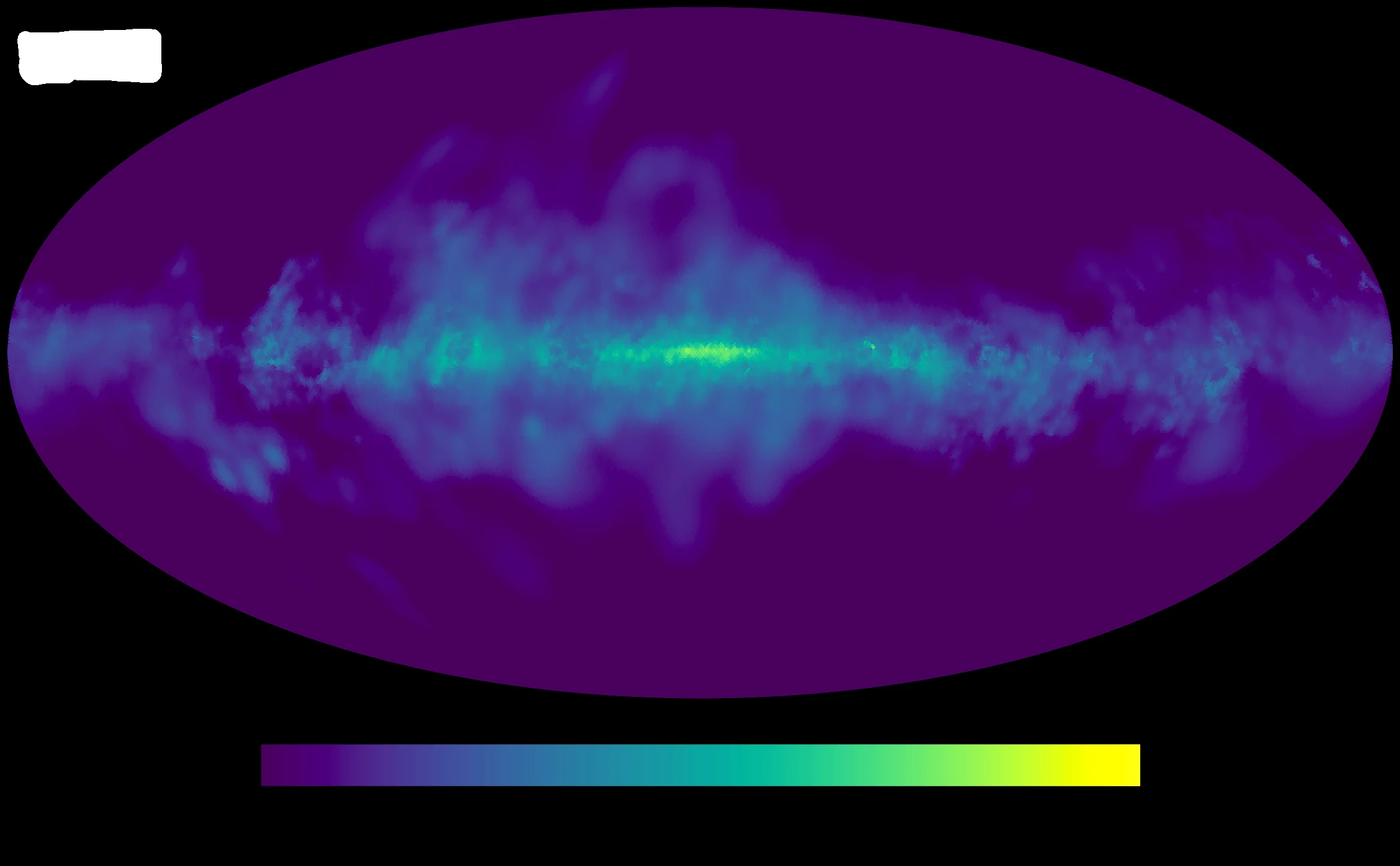
At the center of the Milky Way, a giant stellar cauldron boils. Massive stars are born and die there: each death is a supernova explosion, hurling clouds of charged particles into space. These particles, accelerated to nearly the speed of light, collide with gas and radiation, emitting gamma-ray light — the most energetic in nature. Thus, above the plane of the galaxy, two bubbles tens of thousands of light-years tall are puffed up, like steam bubbles above boiling water. The Fermi telescope spotted them back in 2010, but only now has a computer model shown that the black hole has nothing to do with it. The vigorous life of ordinary stars is enough. Moreover, different parts of the bubbles glow in their own way: it depends on how particles lose energy. This gamma-ray “rainbow” is called a spectrum. The biggest surprise: the bubbles are not hot gas, but the glow of particles accelerated to nearly light speed. And the simulation also predicted: wherever there is gamma-ray glow, there should be radio waves and X-rays as well. Now astronomers know where to point their telescopes.
Original abstract
as written by the authors arXiv:2510.14908
For the first time, we show in MHD simulations with cosmological initial conditions that bi-lobed gamma-ray outflows similar to the Fermi bubbles can form from star formation and supernova feedback, without involvement from active galactic nuclei (AGN). We use simulations run with full MHD and dynamical, on-the-fly multi-species cosmic ray transport in MeV-TeV energy bins to model gamma-ray emission in Milky Way-mass spiral galaxies from neutral pion decay, relativistic non-thermal Bremsstrahlung, and inverse Compton scattering. We find that these gamma-ray outflows are present in all three Milky-Way mass simulated galaxies. The amplitude, shape, and the composition of the gamma-ray spectrum of these bubbles fluctuates over time, with lepton-dominated and hadron-dominated phases. Spectra in which there is O(1) more gamma-ray flux from inverse Compton scattering than neutral pion decay are a good fit to the measured Fermi-LAT spectrum. Additionally, these simulations predict multi-wavelength features in soft x-rays and synchrotron radio, potentially providing new observational signatures that can connect the circumgalactic medium to cosmic ray physics and activity in the galactic center.
Contrary to intuition, the bubbles’ light isn’t born from heat, but from particles flying almost at light speed.