Light Gets Even Lighter: A New Upper Limit for the Photon’s Mass express
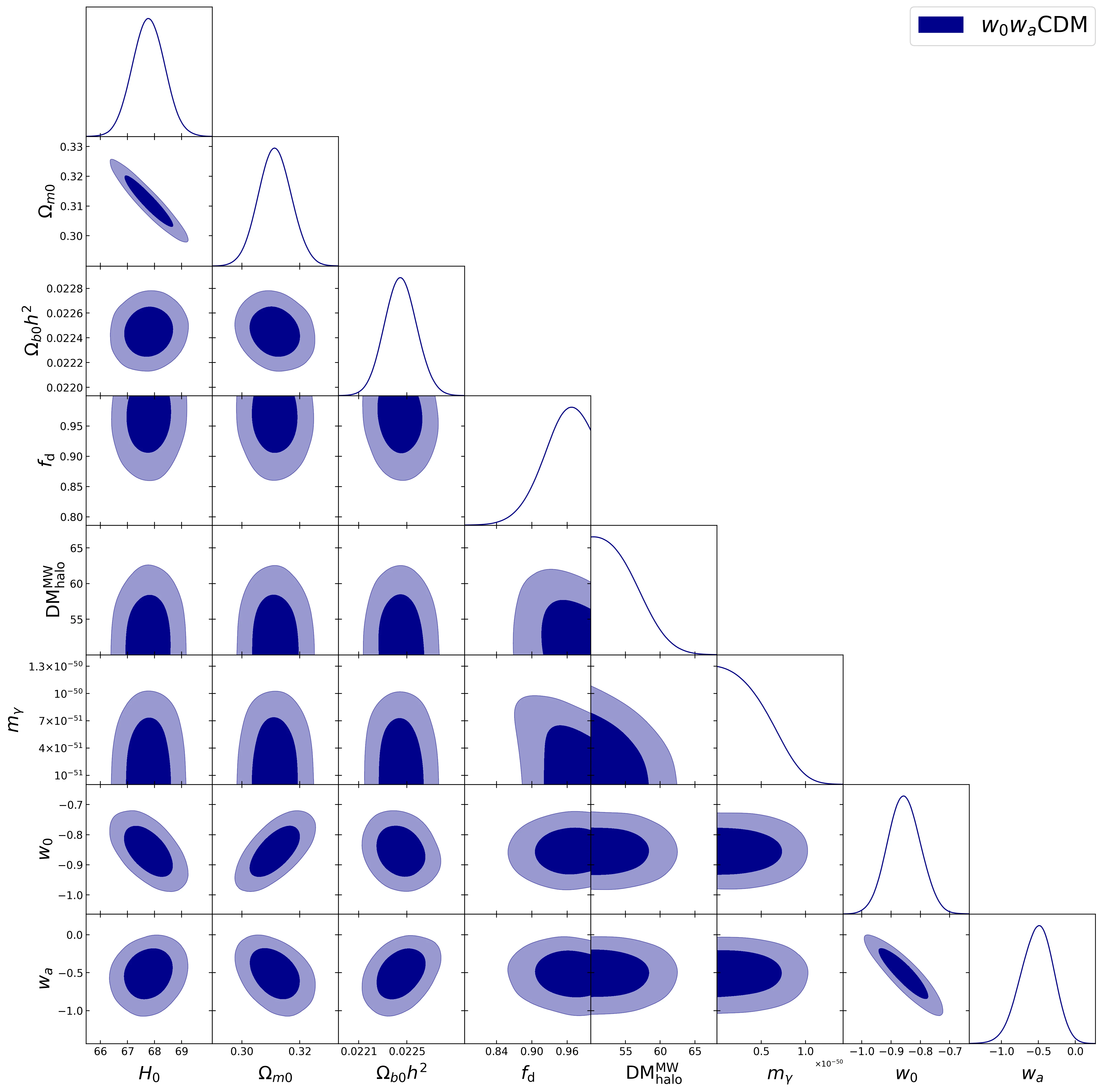
Fast radio bursts are bright cosmic flashes that, like a starting signal, launch a race of radio waves across the Universe. Astronomers used them to check whether the photon – the particle of light – has mass. If mass existed, the speed of light would depend on its color: blue rays, like heavier runners, would lag behind red ones. But observations show that any delay is fully explained by the drag of intergalactic hydrogen – a sparse gas that only slightly slows the waves.
Scientists considered various scenarios of Universe’s expansion, including the influence of dark energy, and set a new mass limit: the photon is lighter than 5×10⁻⁵¹ kg. This is billions of times less than the mass of the lightest known particle. The precision is astonishing: distant blue light would lead red by only a second – and that tiny shift would already have been noticed, but it’s not there.
The result strengthens the foundation of physics laid by Albert Einstein: light remains the fastest and massless racer.
Original abstract
as written by the authors arXiv:2511.14163
The assumption that photons are massless is a foundational postulate of modern physics, yet it remains subject to experimental verification. Fast radio bursts (FRBs), with their cosmological distances and precisely measured dispersion, offer an excellent laboratory for testing this hypothesis. In this work, we propose an improved distribution function for the dispersion measure arising from extragalactic gas and demonstrate that it provides an excellent fit to mock data. We then apply this distribution to constrain the photon rest mass under the $$\Lambda$$CDM, $$w$$CDM, and $$w_{0}w_{a}$$CDM cosmological models, the last of which is favored by recent DESI baryon acoustic oscillation observations. The corresponding 1$$\sigma$$ upper limits on the photon mass are found to be $$4.83\times10^{-51}\,\mathrm{kg}$$, $$4.71\times10^{-51}\,\mathrm{kg}$$, and $$4.86\times10^{-51}\,\mathrm{kg}$$, respectively, which are the most stringent constraints derived from FRBs to date. These results indicate that the choice of cosmological model has only a minor impact on photon-mass bounds, demonstrate that FRBs provide robust and reliable constraints, and offer strong empirical support for the massless nature of the photon.
If the photon had such mass, then over the distance to the Andromeda Galaxy, the blue ray would be late to the finish by a trillionth of a second.