An X-ray photon is a quantum of electromagnetic radiation in the X-ray portion of the spectrum, with energies typically ranging from about 100 electronvolts (eV) to several hundred kiloelectronvolts (keV). Like all photons, it is massless, travels at the speed of light, and carries both energy and momentum, but its high energy gives it the ability to penetrate matter and interact with inner-shell electrons of atoms. X-ray photons are produced by transitions of electrons between deep atomic energy levels, by deceleration of charged particles (bremsstrahlung), or by synchrotron radiation from relativistic electrons in magnetic fields.
History
X-rays were discovered by Wilhelm Röntgen in 1895, but their nature as photons was established later. The concept of the photon itself was introduced by Albert Einstein in 1905, and the specific quantum nature of X-rays was confirmed through experiments on X-ray scattering by Arthur Compton in 1923, which demonstrated that X-rays behave as particles with momentum.
How it works
X-ray photons interact with matter primarily through three processes: the photoelectric effect, where the photon is absorbed and ejects an inner-shell electron; Compton scattering, where the photon scatters off an electron, losing energy and changing direction; and pair production, which occurs at very high energies (>1.022 MeV) near a nucleus, where the photon converts into an electron-positron pair. The energy of an X-ray photon is directly proportional to its frequency (E = hν, where h is Planck's constant), and its momentum is p = h/λ, where λ is the wavelength. These properties make X-ray photons a powerful probe of atomic structure and dynamics.
In practice
X-ray photons are used in medical imaging (radiography and CT scans), crystallography to determine molecular structures, and in X-ray astronomy to study high-energy phenomena in the universe.
Fun fact
The momentum of an X-ray photon, though small, is enough to measurably push atoms—this effect is used in techniques like X-ray photon correlation spectroscopy to study atomic motion.
When a laser beam hits a gas, it tears electrons from atoms and accelerates them to nearly the speed of light. As these electrons fly through the plasma, they emit X-rays, like a glowing trail from a fast particle. In the new work, physicists made a single laser pulse create not one but two such trails in succession.
A laser hits an atom, and tears out an electron. The brighter the light, the stronger the kick, and the faster the electron flies away. That's how the familiar picture works, where light is a smooth wave. But what if the light isn't smooth but 'squeezed,' with quantum fluctuations, like the trembling of a string?
Two charged spheres collided and flew apart in different directions. You'd think it was all over — but the light from their farewell still wanders through space. In the ordinary world, this is a well-known effect: an accelerated charge always radiates.
An electron is not just a point. It is a probability cloud, smeared out in space. When such a cloud collides with a powerful laser pulse, it can emit a high-energy photon — a gamma quantum. And this photon can be not just ordinary but twisted, like a corkscrew, carrying orbital angular momentum.
The mystery of antimatter in space has long puzzled astrophysicists: where do positrons come from, settling like snowflakes into our detectors? The answer might lurk in the most ubiquitous gamma-ray background. The Universe is soaked in diffuse light — the cosmic photon background (CPB).
Imagine a green beam that, passing through an ingenious optical setup, twists into a three-dimensional funnel of light — an optical vortex. At its heart, like in the eye of a hurricane, the intensity drops to zero. It is there that photons disappear.
A pebble drops into a pond, and ripples spread across the water. But one wave suddenly doesn't spread out: it clings to an invisible fold on the surface and runs only along it.
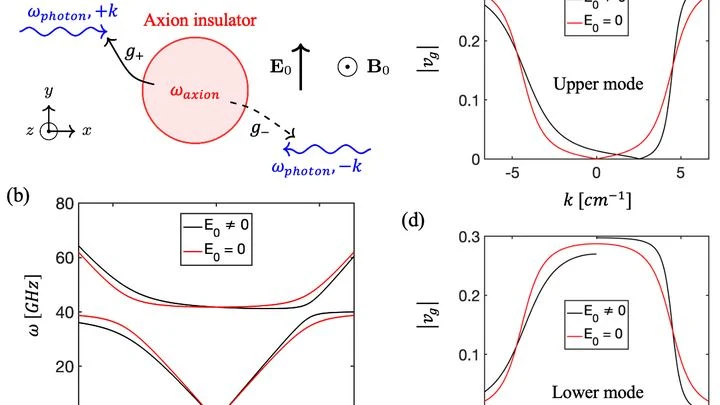
A regular flashlight shines equally forward and backward. But in magnetic crystals, a axion appears — a ghostly excitation, like a wave going around a stadium: atoms pass a magnetic impulse to each other. When light meets an axion, a hybrid forms, whose fate depends on electric and magnetic fields.
A black hole is a cosmic pocket into which everything, even light, falls. But the pioneering work of John Wheeler, Stephen Hawking, and Roger Penrose showed: sometimes, due to the colossal spacetime curvature, the pocket turns inside out.
A light carousel spins not people but electrons. Instead of wooden horses, there are invisible blades of light. This is exactly the kind of 'carousel' physicists built to give electrons a spin.
Usually, to twist an electron beam into a vortex, you need a tiny mask — a stencil with slits carved on the atomic scale. Fabricating it is extremely challenging.
A swing only gets going if you push it in rhythm. Miss the beat, and your effort is wasted. Light interacts with an atomic nucleus in much the same way: a photon is usually absorbed only when its energy exactly matches the gap between nuclear levels. But what if the photon's energy doesn't fit? The authors of a new study have found a workaround.
A tiny ring of superconductor, cooled to near absolute zero, could feel the touch of a particle billions of times lighter than an electron. We're talking about the axion — a hypothetical particle that might make up the dark matter filling the universe.
When a massive star dies, a supernova explosion occurs, so powerful that a single flash outshines an entire galaxy. In this fire, billions of axions are born — invisible particles that leave almost no trace. Every second, trillions of these tiny things fly right through each of us, completely unnoticed.
In the binary system Cygnus X-3, right here in our Galaxy, a black hole and a giant star whirl so tightly together that the star loses matter: it's swept away by a powerful wind. Jets blast out from near the black hole; recently, a telescope caught photons from them, each carrying the energy of a flying mosquito.
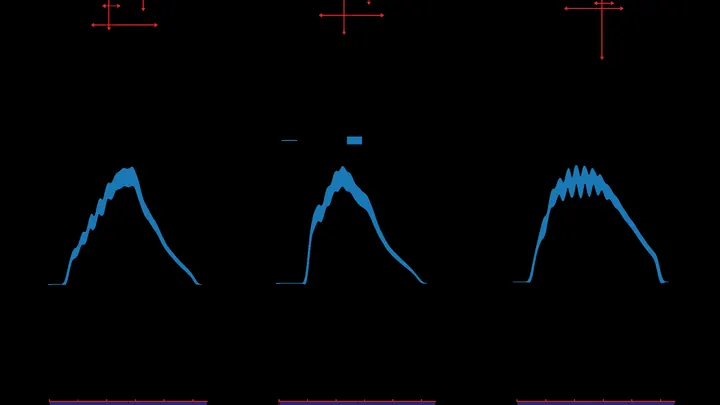
A typical accelerator is like an assembly line where electrons are the workpieces. To get the desired X-ray pulse, the workpiece is fine-tuned after it's already on the line: squeezed, filtered, corrected. In the new work, engineers decided to take a different approach — shaping the workpiece before it even hits the conveyor.
At LCLS-II, electrons are knocked out of a metal by a short laser pulse.
A solar flare is like an explosion in the atmosphere: bright, fast, with different 'voices.' X-rays come from electrons that have been accelerated and then abruptly slowed down, losing energy. But in 2017, detectors on the Fermi satellite caught a different signal — gamma rays that didn't fit this picture.
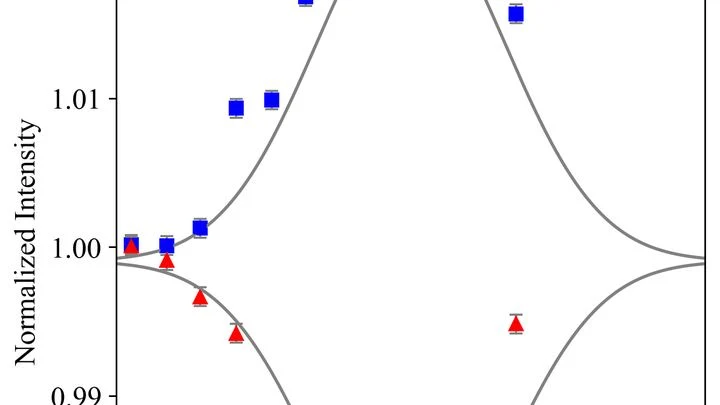
In a dark room, two flashlights shine on a wall. Usually, their beams simply add up, and the spot becomes brighter. But if the flashlights emit light in special packets, photons, then under certain conditions they can behave differently. Instead of independently hitting different spots, two photons 'agree' and only come out together, as a pair, from a single output.
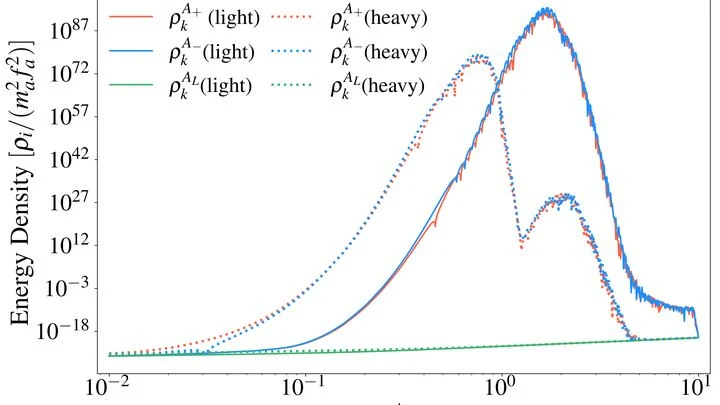
Supermassive black holes at the centers of galaxies appeared so quickly after the Big Bang that astronomers are scratching their heads. The solution lies in the trembling of an invisible axion field.
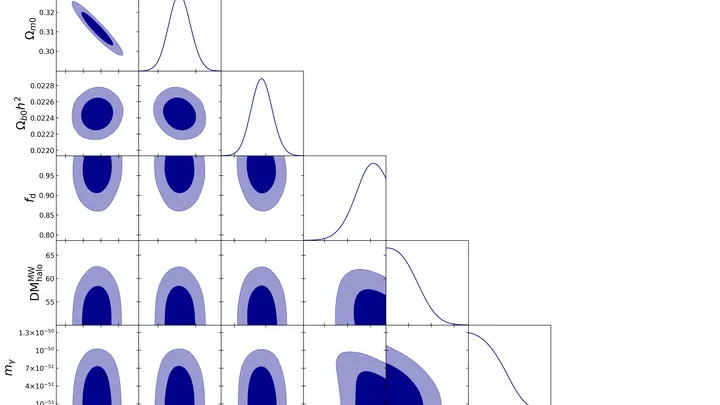
Fast radio bursts are brilliant cosmic flashes that, like a starting signal, set off a race of radio waves across the universe. Astronomers used them as a natural laboratory to test whether the photon, the quantum of light and the carrier particle of the electromagnetic interaction, has mass.
The ARCADE2 radiometer on a high-altitude balloon detected an excess radio emission, while the ground-based EDGES experiment found an anomalously deep trough in the hydrogen spectrum at 21 cm. Both signals do not fit the standard cosmological model and point to an unknown source of soft photons.