The Z boson is an electrically neutral, extremely heavy elementary particle (about 91 GeV/c², nearly 100 times the proton mass) that, along with the charged W bosons, mediates the weak nuclear force — the interaction responsible for radioactive beta decay and the nuclear reactions that power the Sun. Unlike the photon, which is massless and mediates electromagnetism, the Z boson's large mass makes the weak force extremely short-ranged and feeble at everyday energies. The Z boson is a cornerstone of the Standard Model of particle physics, and its precise properties have been measured with extraordinary accuracy, providing stringent tests of the theory.
History
The Z boson was predicted in the late 1960s by Sheldon Glashow, Abdus Salam, and Steven Weinberg as part of the electroweak unification theory. It was discovered in 1983 at CERN by the UA1 and UA2 collaborations, led by Carlo Rubbia and Simon van der Meer, who were awarded the Nobel Prize in Physics in 1984.
How it works
The Z boson is exchanged between particles during weak interactions, but unlike the W bosons, it does not change the flavor of the particles involved — it simply transfers energy, momentum, and spin. Because it is so heavy, its exchange is suppressed unless the interacting particles have energies comparable to its mass, which is why the weak force appears 'weak' at low energies. In particle colliders, Z bosons are produced copiously in electron-positron annihilations, and their decay patterns (into quarks, leptons, and neutrinos) reveal the number of neutrino families and the coupling strengths of the weak force.
In practice
The Z boson's precise mass and decay width are used to calibrate particle detectors and to search for new physics beyond the Standard Model, such as additional Z' bosons or dark matter candidates.
Fun fact
The number of light neutrino species was determined to be exactly three by measuring the invisible decay width of the Z boson at the LEP collider in the 1990s.
In a tank holding three tons of liquid xenon, buried deep underground, something stirred one day. Not the xenon itself, but one of its atomic nuclei: it received a kick with an energy of 248 thousand electronvolts and recoiled like a billiard ball struck by an invisible cue ball.
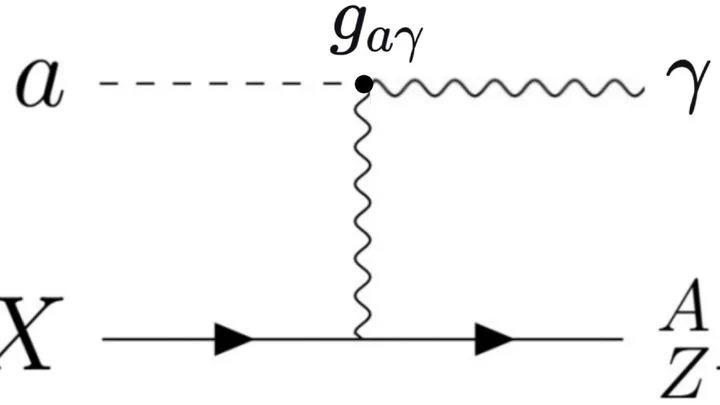
Inside the Sun, reactions can produce light, almost undetectable particles called axions. One such reaction yields axions with an energy of 5.49 MeV, as if each one carried the energy of a tennis ball moving at 100 km/h. These particles pass freely through Earth, but occasionally they might collide with a xenon atom.
In nuclear physics, a puzzle has long been nagging: why among elements lighter than bismuth, only technetium (No. 43) and promethium (No. 61) have no stable isotope at all? All their neighbors in the periodic table can boast at least one long-lived variant, but these two seem to fall out of the general pattern.
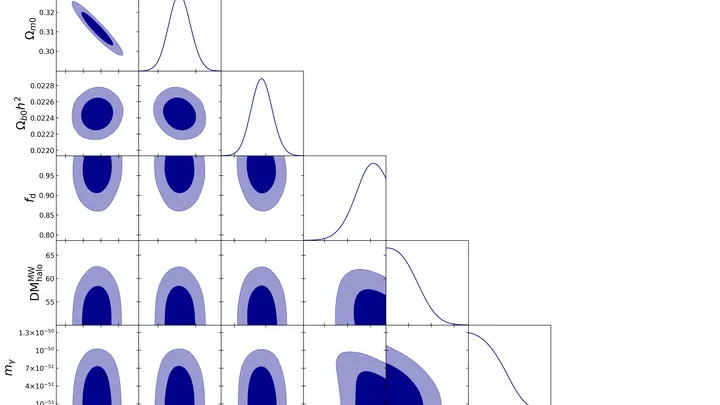
In a quiet room, you can hear the faintest whisper. Likewise, in the hydrogen atom, the lightest of all, an uninvited guest is easier to spot. That guest could be the Z' boson, a mediator particle of a new force predicted by many unification theories. The Standard Model already has its own mediator — the Z boson.
A firework bursts, and one point explodes into four sparks at once. That's how the Z boson, the particle that carries the weak force, behaves when it decays into four charged leptons (electrons or muons). The process is extremely rare: for every million Z bosons produced, only about five decay this way.
Two tin nuclei collide at about two-thirds the speed of light. For an instant, a hot, dense cloud forms, and protons fly out in all directions. If you catch pairs of protons and measure how often they fly off in the same direction, you can work out the size of that cloud. This method is called femtoscopy: it works like a microscope for nuclear scales.
In the CMS detector at the Large Hadron Collider, protons accelerated to nearly the speed of light collided. Among billions of such collisions, physicists searched for a rare signature: the production of a single heavy particle that immediately decays into a W boson and a b quark.
In a dark room, an invisible lamp flashes. Its light is unlike anything familiar: it has no steady brightness, only rare but powerful bursts. This is bright squeezed vacuum — a state of light with no ordinary wave but strong quantum fluctuations. It is with such light that physicists bombarded xenon atoms.
Colliding two lead nuclei at the Large Hadron Collider is like throwing two hefty bags of marbles at each other. Usually, the marbles scatter in all directions, but sometimes one bag passes so close that the marbles don't collide: they just exchange glances.
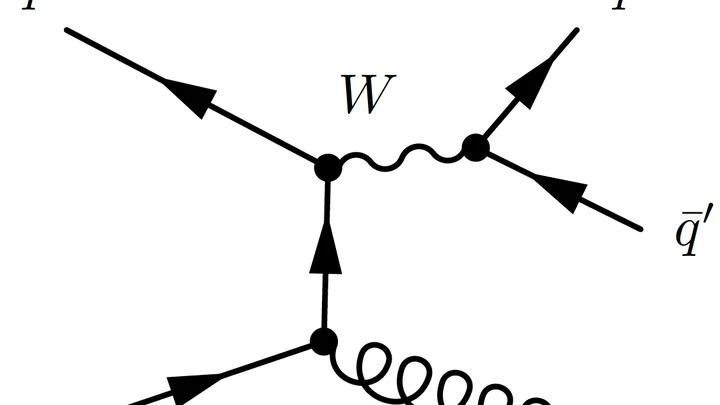
When a W boson, the particle that carries the weak force, decays into a quark and an antiquark, these two fragments fly off in nearly the same direction at the collider's immense speeds.
In an underground ring 27 kilometers in circumference, protons are accelerated to nearly the speed of light and smashed head-on. At the collision point, conditions briefly recreate those of the first trillionth of a second after the birth of the universe.
In the ATLAS detector at the Large Hadron Collider, protons collide billions of times per second. From this stream, physicists fished out eight events in which the collision produced two Z particles and one photon.
The atomic nucleus is not a solid ball but a drop of liquid that can be squeezed. To understand how elastic it is, physicists accelerate gold nuclei and smash them into each other. On impact, the matter compresses to densities like those in a neutron star, then flies apart. The shape of this debris tells us about the properties of the matter inside.
Accelerators sometimes produce particles that don't fit the usual two- or three-quark scheme. Two such particles, Zb(10610) and Zb(10650), have been puzzling physicists for over a decade. They look like heavy cousins of pions, but with a clear sign of a four-quark composition. The question is how those four quarks are packed.
At the Large Hadron Collider, physicists accelerate protons to nearly the speed of light and smash them together. Usually, the protons themselves take part in such collisions, but sometimes they pass close by without touching, and it is their electric fields that interact.
In the stream of charged particles that constantly blows from the Sun, radio bursts sometimes occur — short, powerful signals at frequencies you can pick up on an ordinary radio. Until now, it was unclear how exactly these signals are born in that stream.
An electron beam strikes a proton like a billiard ball hitting another ball. But between them is no empty space: the particles exchange virtual photons and Z bosons, like players passing a ball behind their backs. This exchange slightly alters the scattering trajectory, and hidden within it is a hint of new physics.
Fast radio bursts are brilliant cosmic flashes that, like a starting signal, set off a race of radio waves across the universe. Astronomers used them as a natural laboratory to test whether the photon, the quantum of light and the carrier particle of the electromagnetic interaction, has mass.