A masslimit is an upper bound on the possible mass of a particle, typically derived from experimental searches that find no evidence for the particle's existence. In particle physics, mass limits are crucial for constrainingtheories beyond the Standard Model, such as supersymmetry, dark matter candidates, or exotic heavy neutrinos. When an experiment fails to observe a predicted particle, physicists set a limit — for example, 'the mass of the hypothetical X particle must be greater than 5 TeV' — which guides theorists in refining their models.
History
The concept of setting masslimits became central to particle physics with the rise of colliderexperiments in the 1970s and 1980s, particularly at CERN and Fermilab, where searches for new particles routinely pushed mass bounds higher.
How it works
Masslimits are established by searching for the particle's decay products or interaction signatures in collider data, cosmic-ray observations, or precision measurements. If no excess of events is found above the expected background, a statistical analysis sets an upper limit on the production cross-section, which translates into a lower bound on the particle's mass. The limit depends on the assumed coupling strengths and the integrated luminosity of the experiment.
The masslimit for the electron neutrino is currently less than 0.8 eV, making it one of the lightest known massive particles, yet its exact mass remains unknown.
The cosmological standard model is like a recipe for a cake where everything is strictly measured: dark matter is like flour without a single lump (zero pressure), and dark energy is like the perfect leavening agent (equation of state exactly minus one). But what if the flour is a bit damp and the leavening agent has lost its oomph?
A hunter sets snares in the woods. They know the animal's habits but not whether it will ever show up. In much the same way, physicists set up detectors in hopes of catching particles of dark matter — the invisible substance thought to make up most of the Universe's mass.
A new study offers hunters an unusual tool: not a trap, but a measuring tape.
In the first moments after the Big Bang, the universe was a searing 'soup' of particles. As it cooled, phase transitions occurred — much like water turning to ice. At one such moment, magnetic monopoles of dark matter could have been born: tiny clumps of field with a single magnetic pole.
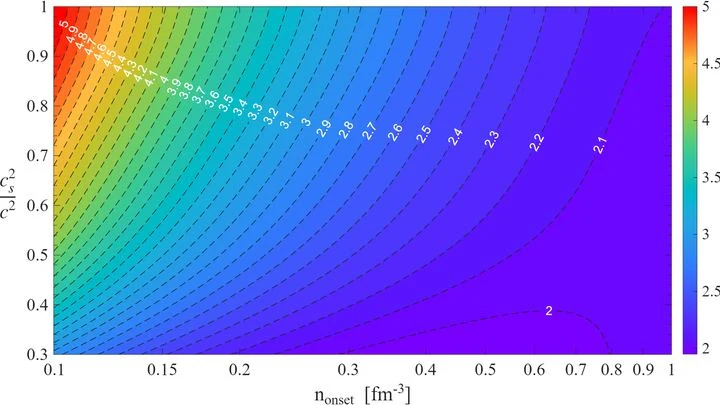
An engineering blueprint of a skyscraper always includes a number: the maximum load on the foundation — say, 500 kilopascals. Einstein's field equations in curved spacetime impose a similar limit on the 'force load' inside stars, planets, and any other clumps of matter.
A billiard ball clicks against another in complete darkness. The sound of the impact and the clatter of balls dropping into pockets: that's all you hear. This is roughly how physicists study the interactions of elementary particles at energies that no terrestrial accelerator can reproduce.
Dark matter is invisible to telescopes, but its gravity was revealed half a century ago by Vera Rubin. Since then, physicists have explored dozens of hypotheses, and one of the most elegant is primordial black holes, formed in the first moments after the Big Bang.
At the center of the Milky Way, shrouded in dust and glare, lurks a supermassive black hole — Sagittarius A*. Around it, like moths around a flame, swarm dozens of guide stars. Two of them, S2 and S38, with eccentric orbits and periods of just a few years, have become the protagonists in testing the fundamental laws of the cosmos.
A Tesla coil crackles, and a beam of light begins to rotate around it. The medium it passes through is still stable, but the field grows, and the rotation intensifies. This is not a trick but the behavior of special materials that couple electricity and magnetism. For such coupling, there is a fundamental limit — the Tellegen limit.
Dark matter is an invisible substance that reveals itself only through gravitational effects: it bends the light of distant galaxies, much like an unseen window that alters the path of light rays.
In the 1930s, Fritz Zwicky first noticed that galaxies in clusters were moving too fast — something invisible was holding them. Later, Vera Rubin measured the rotation of spiral galaxies, confirming that space is permeated by dark matter.
The universe is permeated by an invisible substance, dark matter, whose gravitational influence is obvious, but whose composition remains a mystery. One hypothesis suggests it consists of ultralight particles so light that they exhibit wave-like behavior, forming a kind of cosmic ripple.
The density at the center of a neutron star is so extreme that a teaspoon of its material would weigh as much as a mountain. Physicists have long tried to figure out how massive such a star can get before it collapses into a black hole.
The trace of a short-lived particle is like a signature left in the detector. The particle is born and decays in an instant, but from its trace you can reconstruct its character — whether it's compact like a stone or fluffy like a snowball. That's exactly what this work is about: the authors propose a new way to read such signatures.
They noticed that each particle has an angle that links its mass and lifetime.
Just as in a crowded room each new person sharply increases the pressure on the walls, in a neutron star increasing density leads to a rise in internal resistance. But even this resistance has an absolute ceiling.
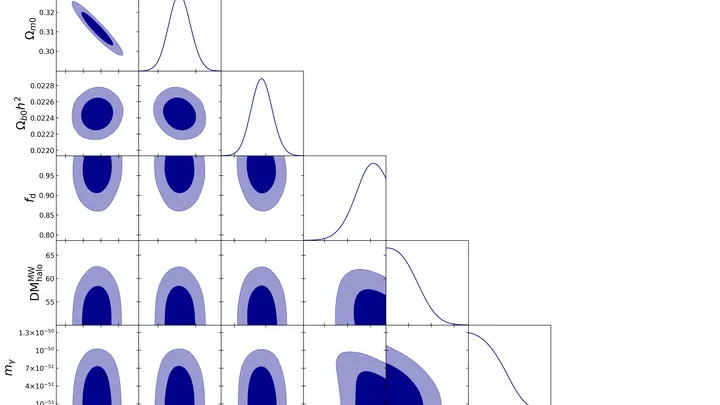
Fast radio bursts are brilliant cosmic flashes that, like a starting signal, set off a race of radio waves across the universe. Astronomers used them as a natural laboratory to test whether the photon, the quantum of light and the carrier particle of the electromagnetic interaction, has mass.