Neural-Network Climate: When the Emulator Repeats the Tropics' Whisper Too Loudly ✛
Imagine an interpreter in a negotiation room who hears the tropics whisper and repeats it too loudly. That is how the neural-network climate model DLESyM behaves when forced with real Pacific sea surface temperatures. The ocean whispers "El Niño," and the atmosphere shouts back as if being shaken by the shoulders. For the first time, scientists applied the pacemaker technique to a climate emulator, a method previously used only with traditional models. The result is twofold: the response pattern is correct, but the volume is turned up too high.
In the DLESyM-PACE experiment, sea surface temperatures in the tropical Pacific were nudged every 48 hours toward ERSSTv5 observations. The model was compared with the reference dynamical model CESM2 under the same forcing. It turned out that, for the same tropical heating, the neural-network emulator produces deeper negative anomalies over the North Pacific and higher positive ones over the Arctic and Canada. The difference reaches about 50 meters of geopotential height (the height at which pressure equals 500 hPa). That is substantial: such anomalies determine where cyclones will go and where an anticyclone will stall.
A free run of DLESyM without the nudged ocean showed a much weaker response, because the model's own El Niño was weak. This means the amplification arises specifically from the learned sensitivity of the atmospheric neural network to tropical heating, not from random noise. The internal atmospheric variability in the emulator turned out to be close to observations: confidence interval maps nearly matched ERA-20C reanalysis data. This is an important finding: realistic noise does not guarantee a correct response to an external signal.
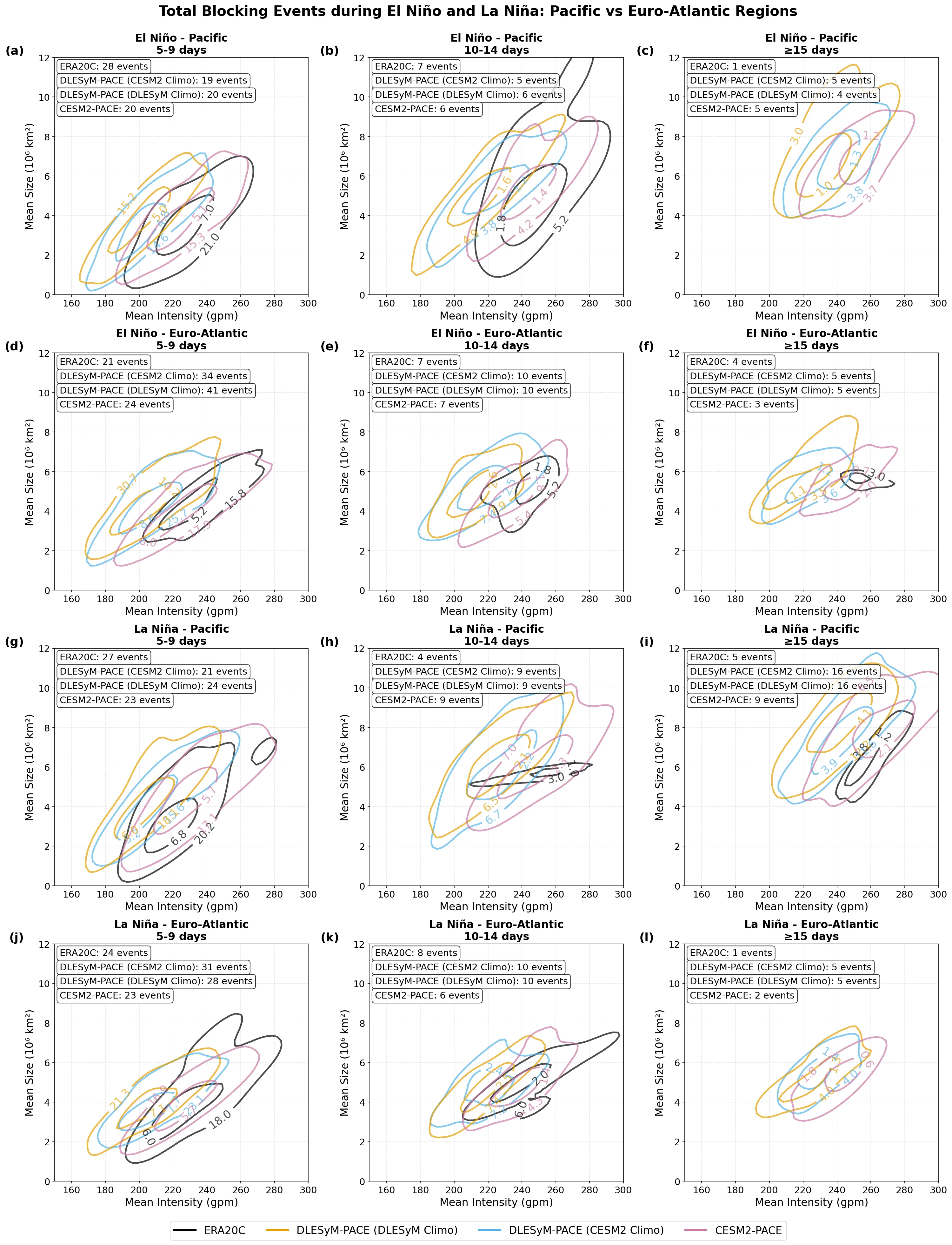
The distortion is especially noticeable in atmospheric blockings, which are persistent anticyclones that hold weather in place for weeks. DLESyM-PACE overestimates their frequency and duration, especially during La Niña, when anomalies exceed 20% over the North Pacific. However, the model underestimates peak blocking intensity by 30–40 meters of geopotential height. The interpreter struggles with rare and strong utterances: it inserts pauses too often but does not reach the volume.
The pacemaker technique could become a standard test for all new coupled AI climate emulators, just as runs with prescribed ocean temperatures are mandatory for atmospheric models. The next step is to determine which architectural features or training data lead to the exaggerated sensitivity. Regularization, adding physical constraints to the loss function, or training on longer time series might help. For now, one thing is clear: before trusting a neural network for seasonal weather forecasts, we need to check whether it shouts where the original whispers.
DLESyM was trained on ERA5 data from 1983 to 2016, which likely caused a warm bias in the equatorial Pacific: the training period was on average warmer than the entire 20th century.
In Kim Stanley Robinson's novel 'The Ministry for the Future', AI-based climate models are used to guide economic and political decisions. This work shows how cautious one must be with such models: even accurate statistics do not guarantee correct physics when it comes to rare and extreme events.