Neural-Network Climate: How an AI Emulator Responded to El Niño ✛
Context
Neural-network climate emulators are trained on reanalyses and reproduce many features of atmospheric circulation at a fraction of the computational cost. However, coupled models, where the atmosphere and ocean interact, often suffer from weak El Niño variability, which hinders assessing how accurately they convey tropical influences on extratropical latitudes. Nearby in the archive are works on predicting El Niño a year and a half ahead, on accelerating molecular collision calculations with neural networks, and on a quantum computer that spotted hidden pairs in materials. This article stands apart: it is the first to transfer the pacemaker technique, developed for traditional models, to deep learning, in order to separate learned physics from statistical associations.
Methods
The DLESyM model was used, in which a deep neural network for the atmosphere is coupled to a simplified dynamical ocean. In the main experiment, DLESyM-PACE, the sea surface temperature in the tropical Pacific (10°S–10°N with a smooth extension to 20°) was nudged toward ERSSTv5 observations every 48 hours within a 96-hour coupling cycle. Two variants were run with different background climatologies: DLESyM's own and one borrowed from CESM2. For comparison, ensembles of 10 members were performed: a free run, an atmospheric control without interannual ocean variability, and an AMIP-like run with prescribed global sea surface temperatures. The response was assessed using winter composites of 500 hPa geopotential height (Z500) for El Niño and La Niña events identified by the Niño-3.4 index. Statistical significance was determined by bootstrap with 2000 synthetic composites.
Results
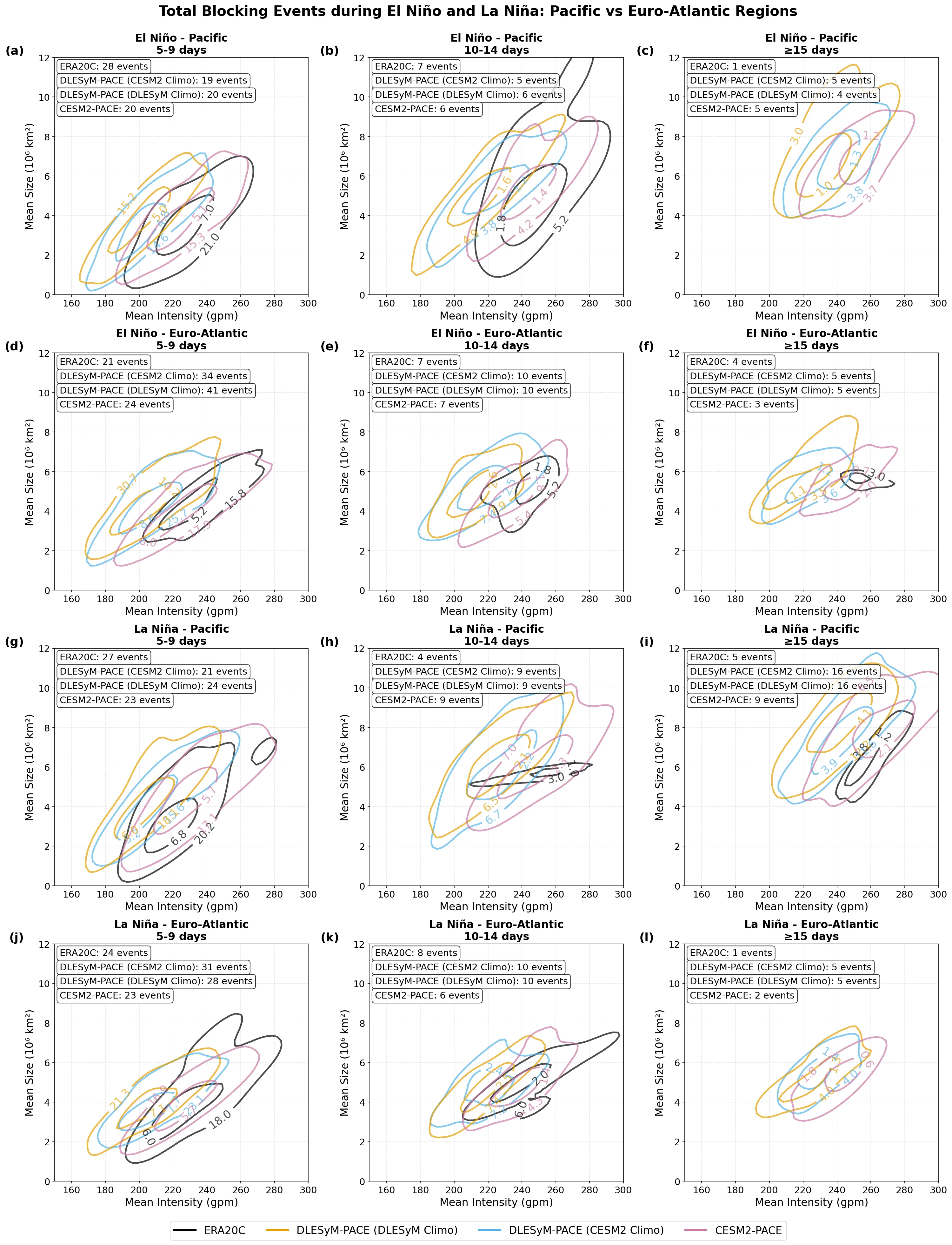
Under identical tropical forcing, DLESyM-PACE produces a spatially realistic but notably amplified teleconnection compared with CESM2-PACE. Negative anomalies over the North Pacific are deeper by about 50 meters, and positive anomalies over the Arctic and Canada are higher by the same 50 meters. The free run of DLESyM shows a much weaker response due to its weak own El Niño, underscoring the role of the pacemaker forcing. Comparison with the AMIP run shows that the amplification is an intrinsic property of the atmospheric neural network, not an artifact of the coupled ocean dynamics. Internal atmospheric variability in DLESyM-PACE is close to observations: maps of 90% confidence intervals nearly coincide with ERA-20C. Different background climatologies alter regional sources of Rossby waves: enhanced cooling in the Kuroshio region and the South Pacific Convergence Zone in the variant with DLESyM's own climatology leads to a deeper trough over the western Pacific. Blocking: DLESyM-PACE overestimates the frequency and duration of atmospheric blockings, especially during La Niña (anomalies exceeding 20% over the North Pacific), but underestimates their peak intensity by 30–40 meters of geopotential height.
Implications
This work shows for the first time that a coupled neural-network climate emulator can be diagnosed with the same pacemaker tool used for traditional models. Unlike neighboring works, where neural networks accelerate individual calculations or predict a single phenomenon, here the holistic physics of teleconnections is tested. The main conclusion: realistic internal variability does not guarantee correct sensitivity to external forcing. The amplified response to the tropics means that the AI model has learned a statistical relationship stronger than physics dictates. This changes the approach to validation: comparing spectra and patterns of free runs is not enough; controlled experiments with imposed forcing are needed.
Future development
The pacemaker technique could become a standard test for all new coupled AI climate emulators, much as AMIP runs are mandatory for atmospheric models. The next step is to determine which architectural features or training data lead to the exaggerated sensitivity. Possible remedies include regularization, adding physical constraints to the loss function, or training on longer time series. A separate direction is improving the reproduction of rare extremes, such as prolonged blockings, which currently fall outside the training distribution.
Impact
The results directly affect the use of AI emulators in seasonal forecasting and climate risk assessment, especially for extratropical regions sensitive to El Niño. They are also useful for developers of hybrid models that combine neural networks with dynamical cores.
Next steps
Conduct similar pacemaker experiments for other coupled AI emulators, such as SamudrACE, to assess the universality of the found bias. Investigate the influence of architecture and training data on the amplitude of teleconnections.
Key open problems
The article directly relates to a long-standing problem in climate modeling: the systematic underestimation of El Niño amplitude and its teleconnections in models. It shows that neural-network emulators inherit and even amplify this problem, but now it can be isolated and possibly corrected faster than in traditional models.
The knowledge machine's view
This section is addressed to the author of the paper and their colleagues. Neighbouring works were found by meaning-based search across our archive, not by word overlap. We do not review: we show the field around the work.
What the work does
This study applies the Pacific pacemaker method to the neural-network climate model DLESyM for the first time. The authors imposed observed sea surface temperatures from the tropical Pacific onto the model and compared the atmospheric response with that of the reference dynamical model CESM2. They found that the AI emulator reproduces the spatial structure of teleconnections but amplifies their amplitude by about 50 meters of geopotential height, while the internal atmospheric variability remains realistic.
Where its strength is
The strength of this work lies in transferring the pacemaker diagnostic tool to neural-network models, allowing researchers to separate learned physics from statistical associations. This enables targeted identification and correction of systematic errors in climate emulators.
Where it could go next
- It might be interesting to see how the El Niño prediction methods over a year and a half, described in a neighboring paper, could be used to assess the quality of DLESyM's long-term forecasts under pacemaker forcing.based on: El Niño Can Be Predicted a Year and a Half in Advance arXiv:2601.12251
- A related paper discusses weather forecasting on a single graphics card; perhaps its approaches to efficient training and inference could help speed up DLESyM experiments and expand ensembles.based on: Weather forecast on a single GPU arXiv:2603.21284
- The archive contains a full analysis of a paper on neutrino tomography of the Earth; although the topic is distant, it discusses methods for analyzing model sensitivity to external forcings, which could be useful for diagnosing the atmospheric response in DLESyM.based on: The Earth’s Neutrino Confession: IceCube Reads the Planet in the Language of Weak Interactions arXiv:2607.02644
Worth trying
- Test whether the amplification of teleconnections persists when using other observational datasets for the pacemaker, such as HadISST.
- Pilot a technique to correct the sensitivity of the atmospheric neural network by incorporating ensembles with varying tropical temperatures into training.
- Compare the response of DLESyM-PACE with that of other neural-network emulators, if available, to understand the generality of the issue.
Why this may matter
This line of research could help make neural-network climate models more reliable for studying regional impacts of El Niño, which is important for predicting extreme weather events.
Nearby works in our archive
- El Niño Can Be Predicted a Year and a Half in Advancesimilarity 0.51
- Martian Weather, Earthly Playbooksimilarity 0.50
- Neural Network Learns to Feel the Earthsimilarity 0.50
- How to Peer into the Depths of Distant Planetssimilarity 0.49
- An Underwater Hunter for Earth's Heatsimilarity 0.49
- How a Neural Network Speeded Up Molecular Collision Calculationssimilarity 0.48
- Weather forecast on a single GPUsimilarity 0.48
- The Earth’s Neutrino Confession: IceCube Reads the Planet in the Language of Weak Interactionssimilarity 0.47
The archive is sparse around this work: the closest review is only 0.51, against a usual 0.64. It looks like few have drilled nearby.
DLESyM was trained on ERA5 data from 1983 to 2016, which likely caused a warm bias in the equatorial Pacific: the training period was on average warmer than the entire 20th century.
In Kim Stanley Robinson's novel 'The Ministry for the Future', AI-based climate models are used to guide economic and political decisions. This work shows how cautious one must be with such models: even accurate statistics do not guarantee correct physics when it comes to rare and extreme events.
Key numbers
- response amplification: ≈50 m geopotential height
- blocking anomaly during La Niña: >20%
- underestimation of blocking intensity: 30–40 gpm
- analysis period: 1900–2009 (110 years)
- number of bootstrap samples: 2000