Dust Storms on a Rogue Planet express
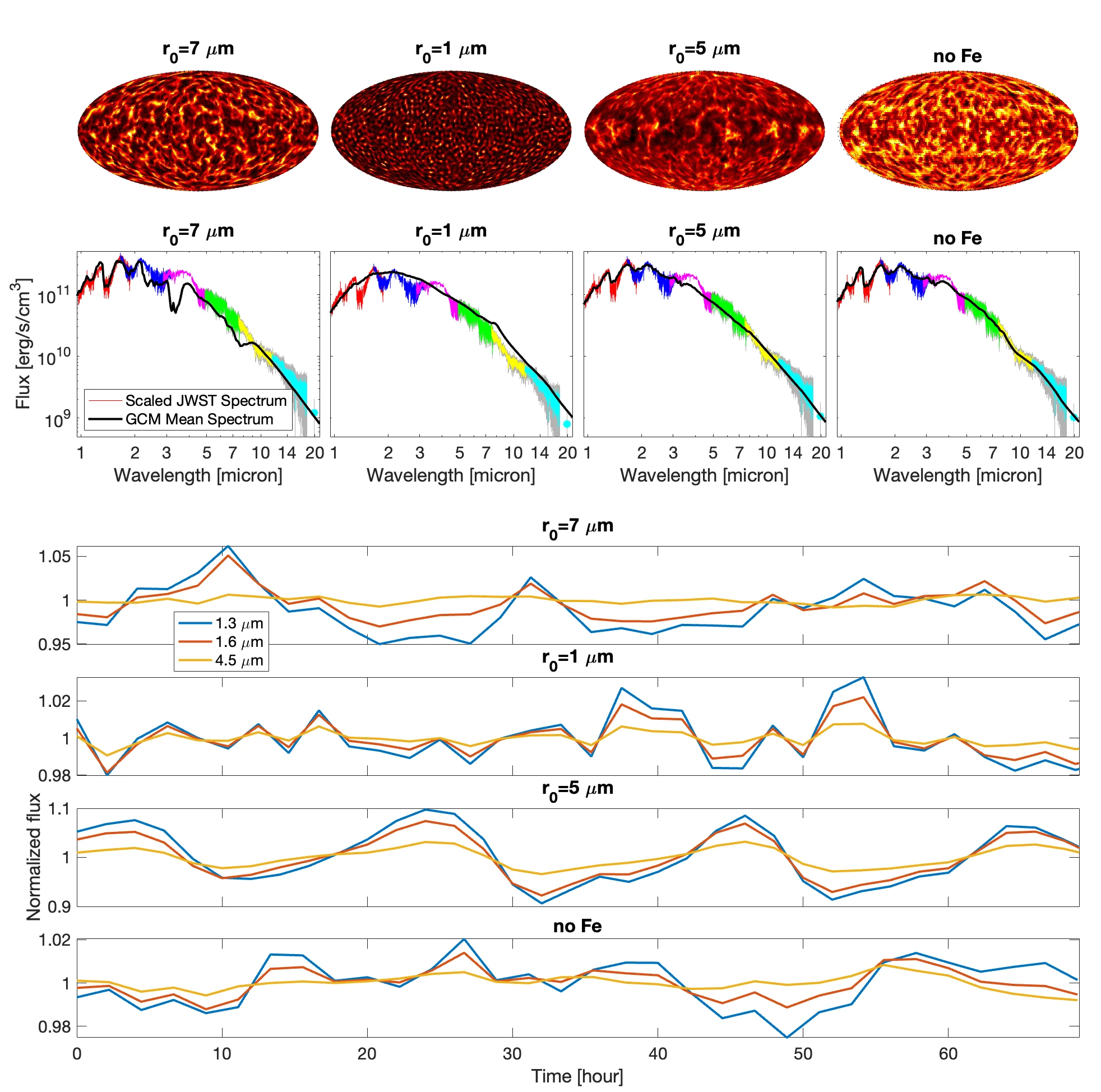
Far beyond the Solar System, a world called VHS 1256B wanders — a giant planet without a star. For a long time, astronomers couldn’t figure out why its brightness jumped by nearly 40% in just a few days. The answer came with the James Webb telescope: it turns out, colossal storms of silicate dust engulf the entire planet. These aren’t isolated clouds, but a continuous veil of scorching sand that either tightly swaddles the globe or tears apart under the force of supersonic winds. Computer simulations showed how the sand ripples in waves from the equator to the poles, causing chaos for weeks. At 1000°C, the dust doesn’t melt but remains solid quartz crystals — a glittering suspension. They also give the planet a reddish tint, visible in color spectra. Now scientists are searching for similar dust veils on billions of other rogue worlds to understand what weather prevails in the eternal cosmic night.
Original abstract
as written by the authors arXiv:2511.23163
Large-amplitude variations are commonly observed in the atmospheres of directly imaged exoplanets and brown dwarfs. VHS 1256B, the most variable known planet-mass object, exhibits a near-infrared flux change of nearly 40%, with red color and silicate features revealed in recent JWST spectra, challenging current theories. Using a general circulation model, we demonstrate that VHS 1256B's atmosphere is dominated by planetary-scale dust storms persisting for tens of days, with large patchy clouds propagating with equatorial waves. This weather pattern, distinct from the banded structures seen on solar system giants, simultaneously explains the observed spectra and critical features in the rotational light curves, including the large amplitude, irregular evolution, and wavelength dependence, as well as the variability trends observed in near-infrared color-magnitude diagrams of dusty substellar atmospheres.
The dust doesn’t melt at 1000°C because silicates melt above 1700°C, so the sand sparkles like glass beads.
These storms are like an eternal Arrakis from Dune, only planet-wide and without the giant worms.