Popular

Dust Storms on a Rogue Planet ⚡ экспресс

Original: "Large-amplitude Variability Driven by Giant Dust Storms on a Planetary-mass Companion"
arXiv:2511.23163 · 2025-11-28 · CC BY 4.0 · ⏱ 1 min · Exoplanets Stellar
The rogue planet VHS 1256B's brightness swings by 40% thanks to week-long storms of scorching sand.
Abstract

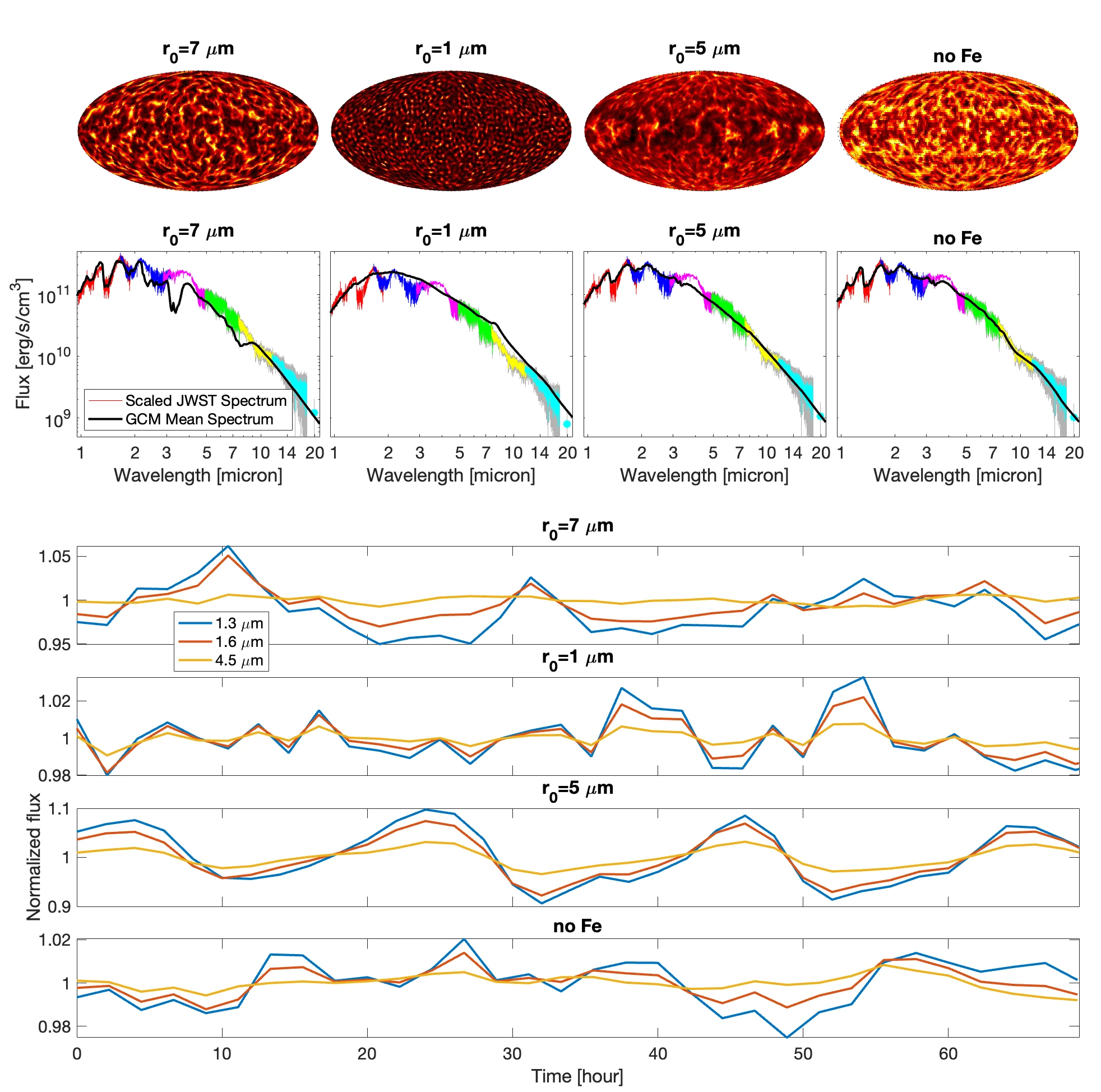
The giant planet VHS 1256B is a record-breaker in variability: its infrared brightness changes by almost 40%. Through atmospheric modeling, scientists found this is caused by giant dust storms (planet-sized), lasting tens of days, and 'clumpy' clouds moving with equatorial waves. This weather, unlike Jupiter's banded structures, explains both the JWST telescope data and the chaotic brightness changes. Curiously, such 'alien dust devils' may turn out to be typical for many brown dwarfs.

Links in the knowledge graph 1

📄 Showing the "Simple" version — "Popular" is not ready yet. Add it to favorites to help prioritize it.

Far beyond the Solar System, a world called VHS 1256B wanders—a giant planet without a star. For a long time, astronomers couldn’t figure out why its brightness jumped by nearly 40% in just a few days. The answer came with the James Webb telescope: it turns out, colossal storms of silicate dust engulf the entire planet. These aren’t isolated clouds, but a continuous veil of scorching sand that either tightly swaddles the globe or tears apart under the force of supersonic winds. Computer simulations showed how the sand ripples in waves from the equator to the poles, causing chaos for weeks. At 1000°C, the dust doesn’t melt but remains solid quartz crystals—a glittering suspension. They also give the planet a reddish tint, visible in color spectra. Now scientists are searching for similar dust veils on billions of other rogue worlds to understand what weather prevails in the eternal cosmic night.

🎯 The dust doesn’t melt at 1000°C because silicates melt above 1700°C—so the sand sparkles like glass beads.

🎬 These storms are like an eternal Arrakis from Dune, only planet-wide and without the giant worms.

Scientists
Christian DopplerD. B. McLaughlinDidier QuelozMichel MayorR. A. RossiterAlbert Einstein
Tags
exoplanet JWST cosmic dust photometry spectroscopy
Laws
Doppler effectgravitational lensingKepler's third lawMaxwell's equationsPlanck's lawPlanck–Einstein relation
Original: arXiv:2511.23163 · CC BY 4.0 · bridge42worlds