Xi Zhang

4 articles · 30 co-authors · latest: 2026-02-09
157 citations · h-index 7 · 17 papersData: Semantic Scholar

We have retold 4 papers by this author. 1 of them with a full read. most often about: large-scale structure, exoplanet, exoplanet atmosphere. 30 co-authors across our retellings.

Links in the knowledge graph
The Invisible Conductor of the Super-Puff Planet System
The three planets in the Kepler-51 system have long intrigued astronomers: they are Saturn-sized but less dense than water. These 'super-puff' worlds, with masses no more than ten Earths, are like cosmic dandelions — massive yet almost weightless. Their orbits are arranged like musicians in an orchestra, each playing its part, beating the rhythm with transits.
Exoplanets2025-10-061 minarXiv:2510.04863express
The Invisible Planet in a Carbon Cocoon: How a Hot Neptune Cheated Death
Astronomers couldn't understand why the 'hot Neptune desert' — a region right next to stars — has almost no Neptune-sized planets. It was thought that there they are doomed: the star's proximity boils off the atmosphere, leaving a bare rocky core. But the exoplanet LTT-9779 b, 29 times heavier than Earth and with a 19-hour orbit, survived.
Exoplanets2025-11-281 minarXiv:2511.23163express
Dust Storms on a Rogue Planet
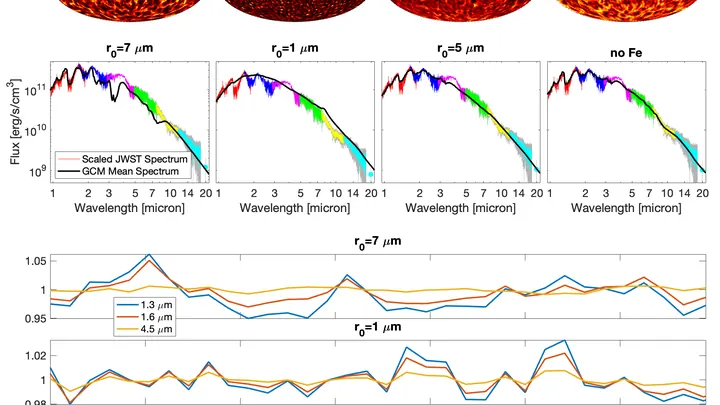
Far beyond the Solar System, a world called VHS 1256B wanders — a giant planet without a star. For a long time, astronomers couldn’t figure out why its brightness jumped by nearly 40% in just a few days. The answer came with the James Webb telescope: it turns out, colossal storms of silicate dust engulf the entire planet.
Medical Physics2026-02-091 minarXiv:2602.12298express
Funnel-Shaped Pixels: How Gamma Rays Are Caught More Precisely
In the dark, a tiny spark flashes. A gamma ray born inside a patient's body strikes a crystal and knocks out a shower of light. The detector's job is to figure out exactly where that happened. The more precise the answer, the sharper the image on the tomograph screen. The new detector resembles a honeycomb, but not a flat one — the cells narrow toward the bottom.