The dusttransparency anomaly refers to the unexpected observation that some early galaxies appear much brighter in ultraviolet and optical light than models predict, given the large amounts of interstellar dust they should contain. Dust normally absorbs and scatters starlight, making galaxies appear dimmer and redder. Yet certain galaxies from the universe's first few billion years seem to let a surprising fraction of their starlight escape unimpeded, as if the dust were partially 'transparent' to their own radiation.
History
The term gained prominence in the 2010s when deep surveys like Hubble's CANDELS and later JWST observations revealed an excess of bright, blue galaxies at high redshift that contradicted simple dust extinction models.
How it works
The leading explanation involves the spatial distribution of dust relative to young stars. In these compact, actively star-forming galaxies, intense radiation from massive stars may carve out channels or blow dust away from the immediate vicinity of the stars, creating low-dust 'windows' through which light escapes. Additionally, the clumpiness of the interstellar medium means that some lines of sight are relatively dust-free, so the integrated light from the galaxy is less attenuated than a uniform dust screen would predict.
The same effect may explain why some extremely distant galaxies appear unexpectedly bright in JWST's first deep-field images, making them look more massive than they actually are.
In active galactic nuclei, supermassive black holes are surrounded by a dense ring of dust that acts like a curtain: it hides everything happening at the center. If a star ventures too close to the black hole, tidal forces tear it apart, and the resulting flare is usually visible in optical and X-ray light.
The night forest is full of fireflies, but before, we only saw those that happened to be in the beam of a flashlight. That was the case with ultraluminous X-ray sources: points in other galaxies that shine in X-rays more brightly than a stellar-mass black hole can steadily emit. Telescopes looked at galaxies chosen for other purposes, missing most of the fireflies.
A star wrapped in an invisible blanket warms up more than it should. That's exactly how ten red dwarfs look, which astronomers from the Hephaistos project have been monitoring. These stars lie within 300 parsecs (about 1000 light-years) of us and emit far more infrared energy than their modest sizes can explain.
Galaxy NGC 4254 lies 1.5 million light-years from the center of the Virgo cluster. It drags a long stream of cooling hydrogen — a sign that it's plowing headlong into the hot gas. Losing cold fuel quenches the birth of new stars.
In 1,433 pairs of galaxies scattered across the sky, astronomers noticed an unusual pattern. Neighbors located 'above' or 'below' a massive stellar system contain up to a quarter more oxygen than those lying in the plane of its disk.
The JWST spectrograph caught a barely perceptible dip in the spectrum of a distant galaxy — two lines, like shadows cast by cold gas. These are the sodium lines, the very yellow light of streetlamps. Here, at the edge of the visible Universe, they betray the slow exhalation of a galaxy returning matter to space.
Two cities endure a series of fires. In one, the wind carries ash far beyond the outskirts, leaving the sky clear. In the other, ash settles as a dense veil, painting sunsets crimson. Roughly the same thing, just on a galactic scale, happens with supernova explosions, the final flares of massive stars.
Ten billion years ago, the universe was speckled with strange crimson sparks. The JWST spotted them in images at distant redshifts — compact sources blazing like entire galaxies yet no larger than a tiny central region. Astronomers nicknamed them “little red dots.” Their nature long defied explanation.
Dwarf galaxies orbiting the Milky Way look as if they’ve survived a gravitational storm. Their stellar bodies are stretched, scattered by tidal tails, and heated from within.
In the boundless night of space, galaxies come together in a slow gravitational dance, merging into one. Such collisions are not head-on impacts but rather like fingers moving slowly through water, leaving swirls and tails behind.
The early universe underwent a rapid expansion — inflation. In a tiny fraction of a second, minuscule quantum jitters were stretched to galactic scales and became the seeds of all large-scale structure.
Moments before totality, swift shadow bands glide across the ground, like ripples from pebbles tossed into water. For centuries, this phenomenon baffled scientists. It turns out the key is that light is a wave.
The Sun isn't a pinpoint lamp but a vast disk. When the Moon nearly covers it, a thin glowing crescent remains.
The Universe is singing. Not in the usual sense: its symphony is recorded in tiny density variations from which galaxies and ourselves grew. After the Big Bang, space was almost uniform, but quantum fluctuations during inflation left a faint pattern — slightly more matter here, slightly less there.
Images from the James Webb Space Telescope have revealed unexpectedly intense light from the first galaxies — colossal star systems that formed shortly after the Big Bang. Imagine a toaster browning a slice of bread in a minute, while an oven takes an hour to bake a loaf — the result is essentially the same.
A bonfire that no one sees, but everyone feels the warmth: that's how astronomers found a flare in a distant galaxy. Not by its light, but by the infrared radiation of heated dust. The galaxy SDSS J010320.39+140152.5 caught attention when its center suddenly blazed in the infrared, as if someone had thrown logs onto an invisible fire.
A street where houses have just been built. Some shine with clean windows, others are covered in construction dust. That's roughly what galaxies looked like when the universe was only a few hundred million years old. The new James Webb telescope peered into that era and saw dozens of bright star islands.
The JWST telescope has spotted a multitude of bright galaxies in the young universe. Their ultraviolet light was barely absorbed by cosmic dust — defying previous expectations.
The smell of fresh bread unmistakably signals a nearby bakery. But to know if baking is happening right now, it's better to catch not the aroma itself but its intensification — the continuous stream of hot air from the oven. This everyday analogy helps grasp a revolution in the search for extraterrestrial life on exoplanets — planets beyond our solar system.
A glowing cloud in a telescope looks like a wisp of fog about to dissipate. Planetary nebulae are gas shells cast off by dying stars. Young nebulae are bright and compact, but as they age, they expand, cool, and become increasingly transparent until they vanish into the interstellar medium.
During a thunderstorm, the sky acts like a giant battery: charge builds up in the cloud, and a lightning bolt discharges it. That charge is invisible, but cosmic particles (muons, which constantly rain down on Earth from space) can sense it. As a muon flies through a charged cloud, it speeds up or slows down slightly, and these changes reveal the voltage inside the cloud.
Ancient stars, nearly devoid of heavy elements, are like fossilized remnants of the first cosmic flashes. For a long time, the odd ratio of carbon, hydrogen, and helium in three such stars was thought to require a hypernova — an ultra-bright supernova with hundreds of times more energy than a regular one.
If a supermassive black hole lives at the center of a galaxy, it heats the infalling gas to incredible temperatures. That gas glows, and we see it as a quasar — the brightest beacon in the universe. But how do you measure the size of the light source itself?
In 2015, astronomers were examining the Coma galaxy cluster and noticed something odd: huge, almost invisible "fluff balls." These galaxies are as large as our Milky Way but shine hundreds of times fainter.
The young star RY Tau is like a finicky spinning top. Around it whirls a flat disk of gas and dust — the leftovers of the cloud from which the star was born. The star pulls some of the disk's matter toward itself like a vacuum cleaner, and flings some back out in a narrow wind cone like a fountain.
In the dense Virgo galaxy cluster, astronomers have spotted six strange clouds of neutral hydrogen — gas that emits no light and is therefore invisible to ordinary telescopes. Radio telescopes can pick it up, but where it came from was unclear.
Toss a handful of peas into a pot of semolina porridge — the peas quickly sink, pushing the grains aside. But if you make the porridge very thick and sticky, the peas get stuck. That's roughly how light lithium atoms behaved in a cloud of heavy potassium atoms at temperatures just a few millionths of a degree above absolute zero.
Light from distant galaxies carries a hidden recipe — a color barcode revealing the elements inside. For decades, astronomers used familiar tricks to decode it, but the James Webb Space Telescope shows these tricks fail for the earliest galaxies.
The galaxy is like a city at night: most windows shine steadily, but sometimes a skyscraper lights up all its lights and then goes dark. Just like that, according to a new hypothesis about planets around alien stars (exoplanet), we might first notice another civilization — by a short but blinding flash that could mark its demise.
The James Webb Space Telescope looked back to a time when the universe, just after the Big Bang, was only a billion years old, and found the 'Sleepy' galaxy. Unlike its neighbors, which shone with young stars, it looked tired and dim.
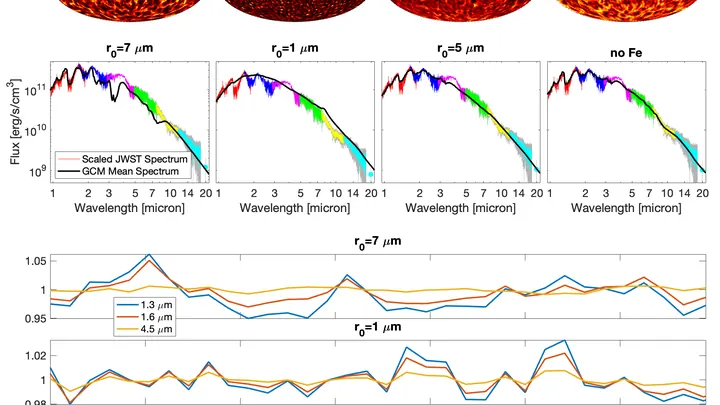
Far beyond the Solar System, a world called VHS 1256B wanders — a giant planet without a star. For a long time, astronomers couldn’t figure out why its brightness jumped by nearly 40% in just a few days. The answer came with the James Webb telescope: it turns out, colossal storms of silicate dust engulf the entire planet.
Every day, particles with colossal energy enter Earth's atmosphere, like unsigned letters. Their source long remained a mystery. New research shows: these 'visitors' point to nearby galaxies, where from time to time catastrophes occur — collisions of neutron stars, ultra-dense spheres the size of a city but with the mass of the Sun.
Two houses with identical facades but different interior layouts: from the outside the V-shaped spectrum looks the same, but inside there are different light sources and different amounts of dust. That is exactly how the two populations of distant galaxies that astronomers have long confused appear.
Someone has thrown an invisible stone into the stellar pond of the Milky Way. The ripples spread not through water but through the motion of stars: in a region 200 by 50 parsecs across, their average vertical velocity is 7 km/s lower than that of their neighbors. The deviation is statistically significant at the 6σ level, so chance cannot explain it.