When the Sun Dived into a Cloud express
As it travels through the Galaxy, the Solar System occasionally dives into thick interstellar clouds — clumps of tenuous hydrogen and dust. Normally, the Sun shields us:
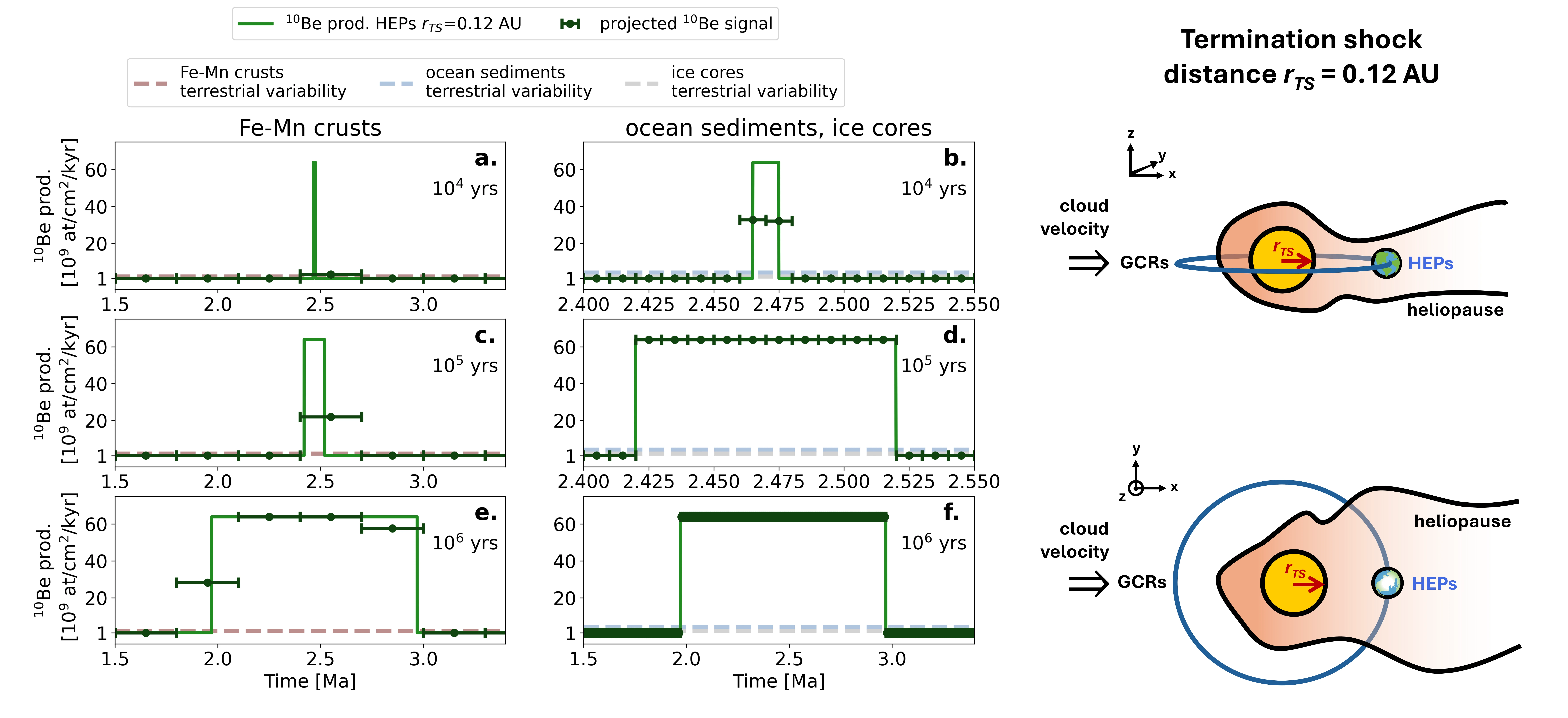
But a massive cloud squeezes the bubble — it shrinks, sometimes to a size smaller than Earth's orbit — and the planet gets pelted by a shower of particles from space. In the air, beryllium-10 is born — a radioactive isotope of beryllium. It settles in ocean sediments and ice layers, like a mark of the event. Scientists measured this marker and found: tiny clouds are almost invisible in the seafloor crust, but ice cores hold their memory with precise measurements. And the beryllium spike 10 million years ago was caused not by a supernova, but by passing through a cloud.
Original abstract
as written by the authors arXiv:2601.07983v2
Recent works suggest there are periods when the Sun encountered massive interstellar cold clouds which compressed the heliosphere to within Earth's orbit. This would expose Earth to increased galactic cosmic rays (GCRs) and energetic particles of heliospheric origin (HEPs). We model 10Be production in Earth's atmosphere during possible interstellar cloud encounters and supernovae, and estimate their detectability in marine and ice records of variable temporal resolution. We find that encounters with sub-parsec-scale clouds cannot be detected via 10Be measurements in iron-manganese crusts. GCR signal is not detectable in ocean sediments; only parsec-scale clouds can be detected in iron-manganese crusts. Encounters with sub-parsec-scale clouds can be detected if Earth is exposed to HEPs, or by measuring ice cores with less than or equal to 10 kyr temporal resolution. We find that the peak observed by Koll et al. (2025) 10 Ma cannot be attributed to a supernova, but could be attributed to an interstellar cloud crossing.
Beryllium-10 is a cosmic timekeeper: its slow decay preserves the memory of solar storms and cloud encounters over tens of millions of years.