When the Sun Dived into a Cloud express
Original: "Cosmogenic 10Be as a Tracer for Recent Heliospheric Encounters with Interstellar Cold Clouds"
arXiv:2601.07983v2 · 2026-01-12 · CC BY 4.0 · 1 min
Beryllium-10 traces from cosmic showers reveal when the Solar System trekked through dense clouds.

📄 Showing the "Simple" version — "Popular" is not ready yet. Add it to favorites to help prioritize it.

As it travels through the Galaxy, the Solar System occasionally dives into thick interstellar clouds — clumps of tenuous hydrogen and dust. Normally, the Sun shields us:

A flow of particles from the Sun inflates the heliosphere — an invisible bubble that repels cosmic rays.

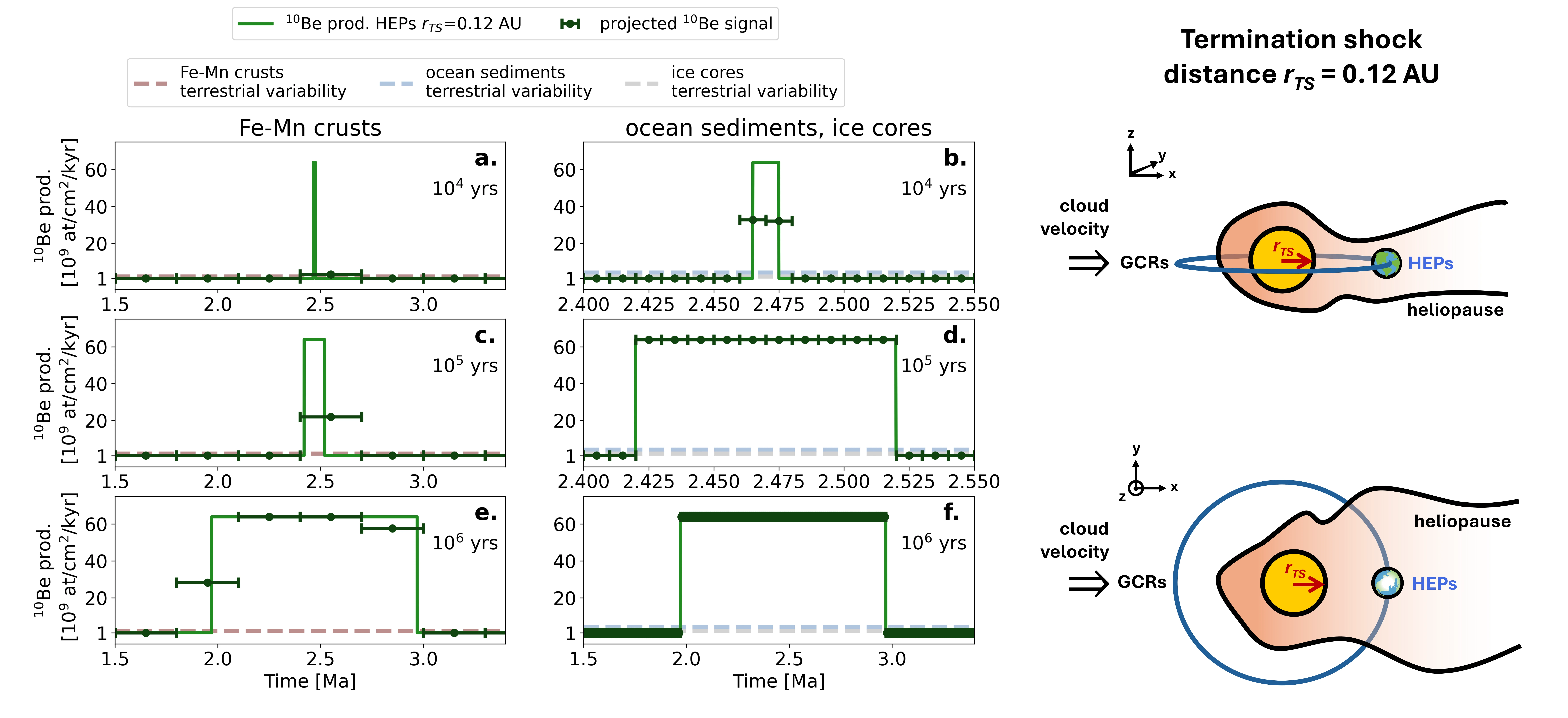
But a massive cloud squeezes the bubble — it shrinks, sometimes to a size smaller than Earth's orbit — and the planet gets pelted by a shower of particles from space. In the air, beryllium-10 is born — a radioactive isotope of beryllium. It settles in ocean sediments and ice layers, like a mark of the event. Scientists measured this marker and found: tiny clouds are almost invisible in the seafloor crust, but ice cores hold their memory with precise measurements. And the beryllium spike 10 million years ago was caused not by a supernova, but by passing through a cloud.

Ice and silt work as natural sensors of galactic weather.

Beryllium-10 is a cosmic timekeeper: its slow decay preserves the memory of solar storms and cloud encounters over tens of millions of years.

Scientists
Ludwig BoltzmannEnrico FermiJames JeansMichael FaradayHendrik LorentzEmile Clapeyron
Concepts
crab nebula supernova 1987a solar storm gas cloud cold gas super earth molecular cloud subsurface ocean ultra high energy cosmic ray source solar corona observation sub neptune formation hydrogen atmosphere intertropical convergence zone iron hot jupiter atmospheres aurora lhaaso chromosphere pulsar wind nebula chandra