When the Sun Dived into a Cloud express
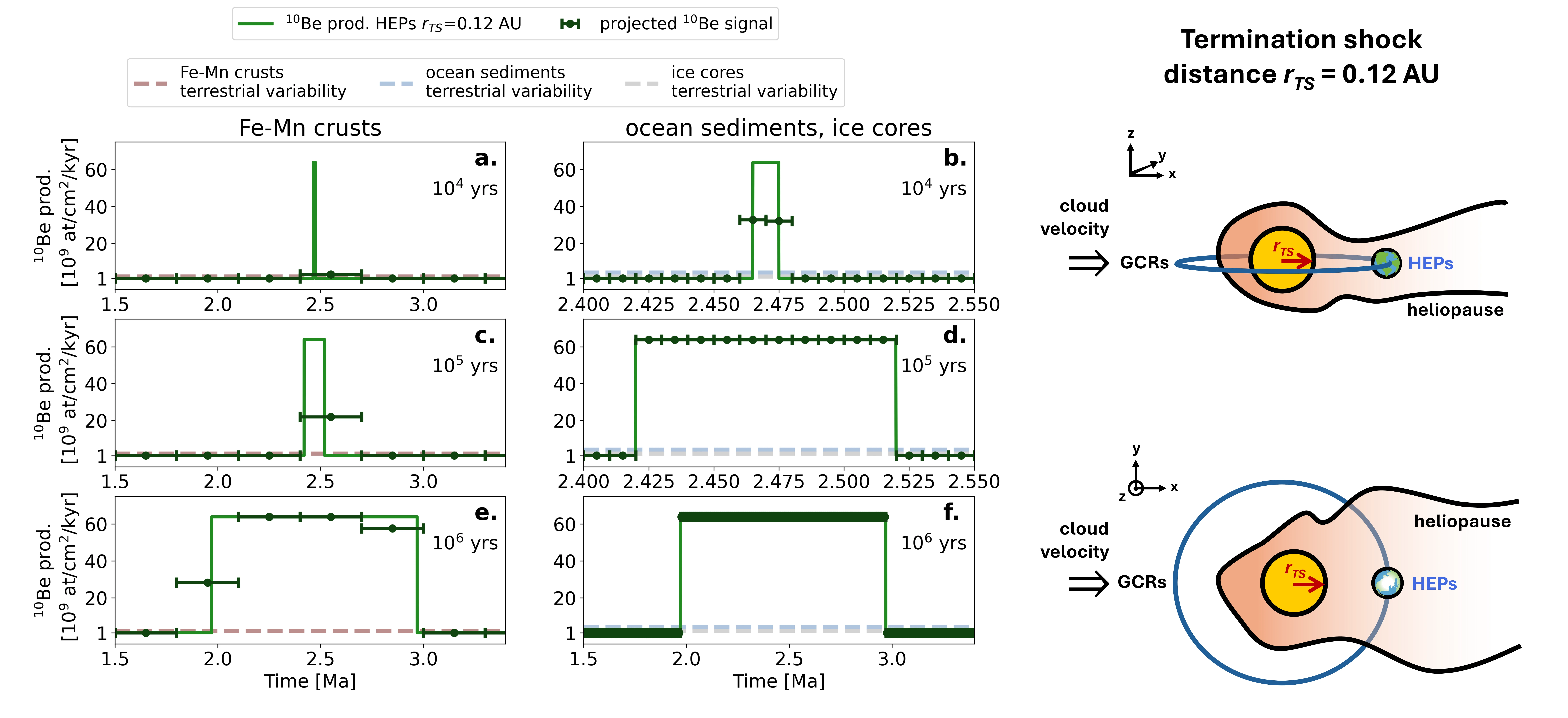
As it travels through the Galaxy, the Solar System occasionally dives into thick interstellar clouds — clumps of tenuous hydrogen and dust. Normally, the Sun shields us:
But a massive cloud squeezes the bubble — it shrinks, sometimes to a size smaller than Earth's orbit — and the planet gets pelted by a shower of particles from space. In the air, beryllium-10 is born — a radioactive isotope of beryllium. It settles in ocean sediments and ice layers, like a mark of the event. Scientists measured this marker and found: tiny clouds are almost invisible in the seafloor crust, but ice cores hold their memory with precise measurements. And the beryllium spike 10 million years ago was caused not by a supernova, but by passing through a cloud.
Beryllium-10 is a cosmic timekeeper: its slow decay preserves the memory of solar storms and cloud encounters over tens of millions of years.