Popular

Atom in a Mirror Trap: A Step Toward the Quantum Internet ⚡ экспресс

Original: "Efficient and compact quantum network node based on a parabolic mirror on an optical chip"
arXiv:2601.13420 · 2026-01-19 · CC BY 4.0 · ⏱ 1 min · Quantum Physics Atomic Physics
A tiny mirror-dish catches an atom's light and entangles it in a quantum link — an engineering breakthrough toward a secure internet.
Abstract

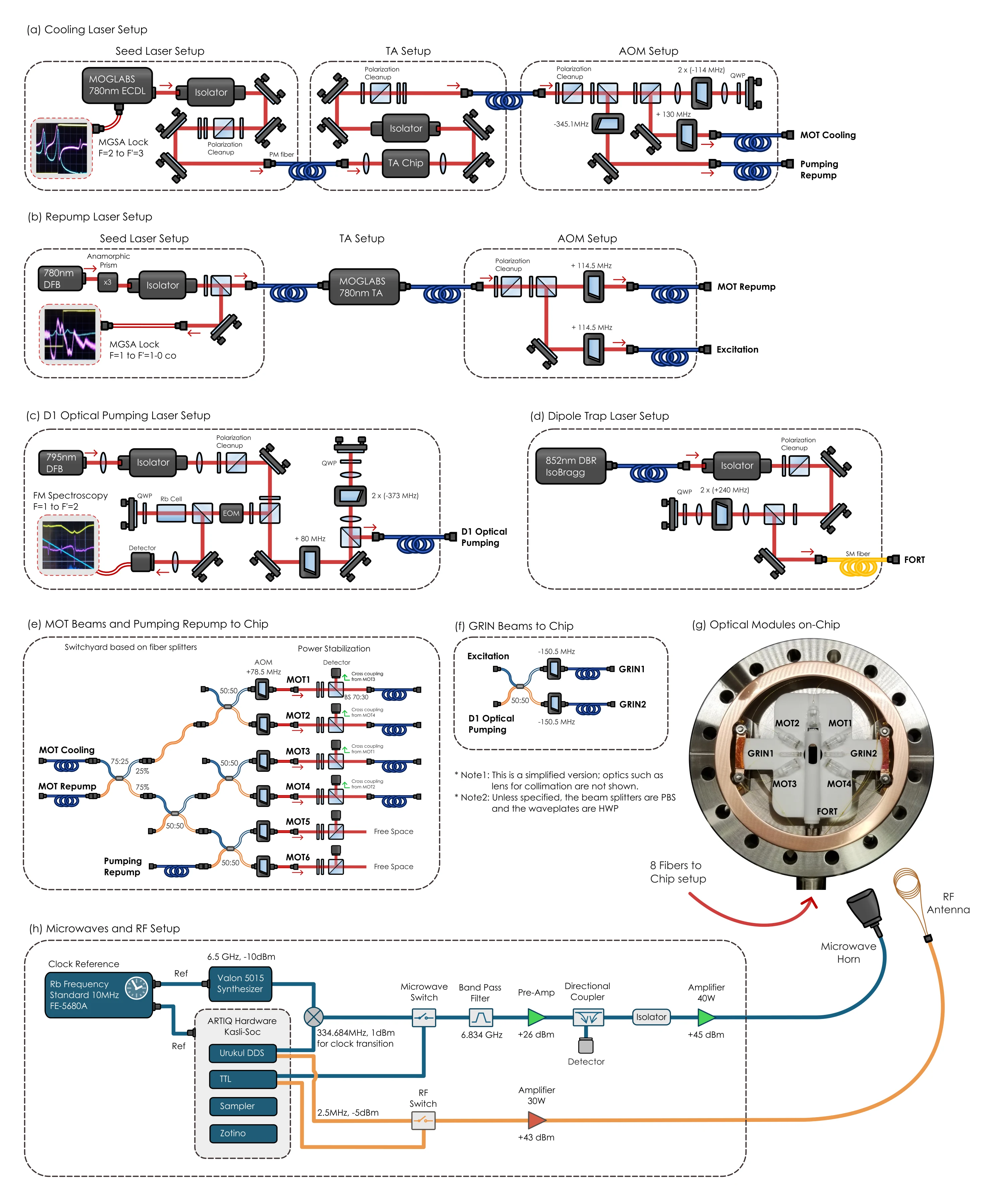
Researchers have presented a compact quantum network node based on a single rubidium atom. They used a parabolic mirror that simultaneously traps the atom and collects the photons it emits, directing them into an optical fiber with an efficiency of about 9%. This allowed them to create entangled states of the atom and photon with an accuracy of up to 98% (after correction for readout errors). The entire optics is assembled from miniature parts and requires no active adjustment, making the node reliable and easy to scale. This approach is reminiscent of a LEGO set for quantum networks — simple blocks from which complex systems can be built.

Links in the knowledge graph 1

📄 Showing the "Simple" version — "Popular" is not ready yet. Add it to favorites to help prioritize it.

A grain-of-sand-sized device: a tiny mirror-dish holds a single rubidium atom and collects the glow it emits under a laser beam. The trapped light particles are sent into an optical fiber — the whole setup is precise and stays aligned even when shaken.

The key achievement is reliable entanglement between the atom and a quantum of light. Entanglement means: measuring one particle instantly tells you the state of the other, no matter where it is. The fidelity of this link reached 93%, and with correction for readout errors — 98%. The foundation was laid by Nobel laureates Alain Aspect, John Clauser, and Anton Zeilinger.

Ironic: the parabolic mirror — an ancient invention, Archimedes' legendary weapon for setting enemy ships on fire — today catches light from individual atoms with 5% efficiency (and 9% after coupling to an optical fiber). This design was replicated in two labs, proving its modularity. Such nodes can be mass-produced, assembling a quantum internet from ready-made blocks.

🎯 Parabolic mirrors are ancient: legend has it Archimedes used them to set Roman ships on fire. Now they catch single particles of light.

🎬 The idea of entanglement inspired the ansible — the instant interstellar communicator from Ursula K. Le Guin's novels.

Scientists
Christian DopplerD. B. McLaughlinDidier QuelozMichel MayorR. A. RossiterAlbert Einstein
Tags
photometry spectroscopy speed of light
Laws
Doppler effectprinciple of constancy of the speed of lightmass–energy equivalenceMaxwell's equationsPlanck's lawLorentz transformations
Original: arXiv:2601.13420 · CC BY 4.0 · bridge42worlds