Hunting Light Dark Matter with a Silicon Detector express
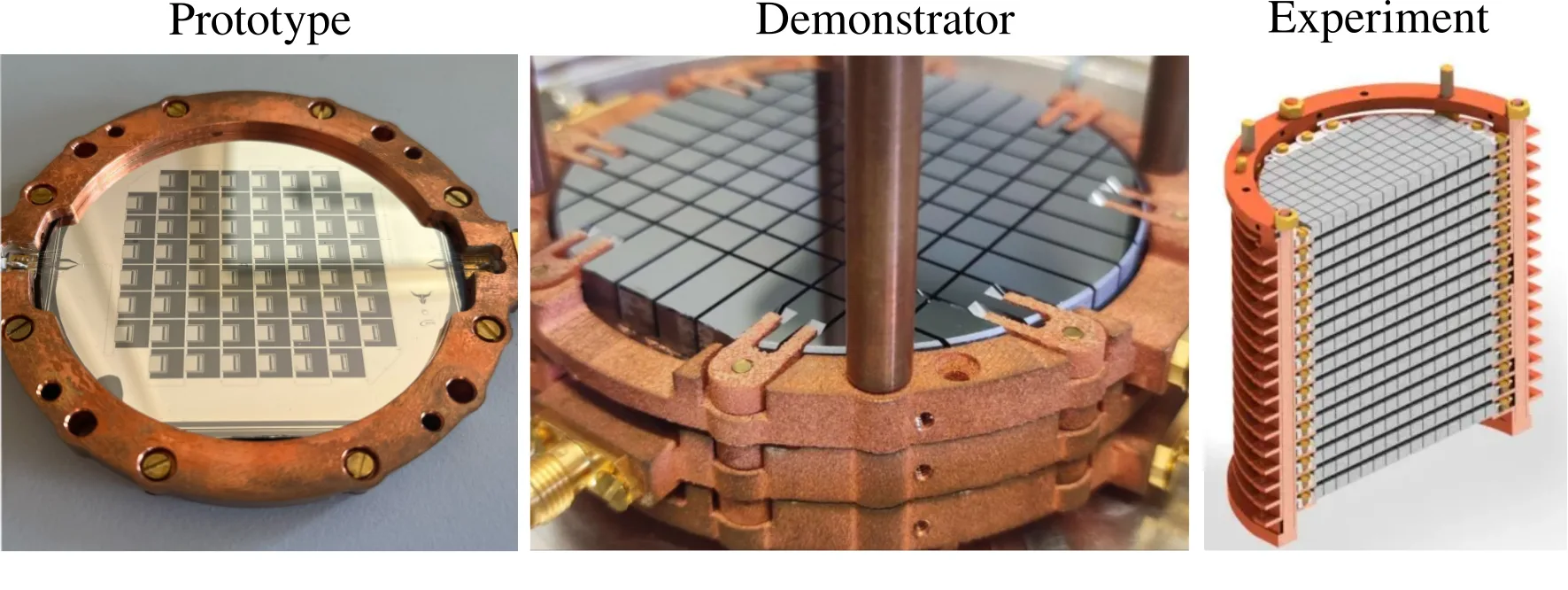
Dark matter is the invisible substance that holds galaxies together, yet it has so far escaped direct detection. The BULLKID-DM detector is designed to catch candidate particles with a mass around 1 GeV (roughly that of a proton) and an extremely weak interaction with ordinary matter — a cross-section below $10^{-40}$ cm². It's like trying to hear a whisper in a noisy city.
The detector is assembled from a stack of diced silicon wafers — more than 2000 cubes with a total mass of 800 grams. Each cube acts as an individual absorber: when a dark matter particle hits a silicon nucleus, heat is released in the crystal. This heat is registered by ultra-sensitive kinetic inductance detectors, which can sense even a temperature rise of a few thousandths of a degree.
Thanks to this design, BULLKID-DM promises to surpass the sensitivity of other future experiments in the search for light dark matter particles. If a particle does fly through a silicon cube, the detector won't just notice it: it will show exactly where it happened and filter out false triggers.
Original abstract
as written by the authors arXiv:2601.13766
BULLKID-DM is an experiment designed for the direct searches of particle dark matter candidates with mass around 1 GeV, or below, and cross-section with nucleons smaller than $$10^{-40}$$ cm$$^2$$. The detector consists of a stack of diced silicon wafers, acting as arrays of particle absorbers, sensed by multiplexed Kinetic Inductance Detectors. The target will amount to 800 g subdivided in more than 2000 silicon dice, with the aim of controlling the background from natural radioactivity by creating a fully active structure and by applying fiducialization techniques. In this work we present the projected sensitivity of BULLKID-DM to light WIMP-like particles considering also the other future experiments in the field.
To visualize a cross-section of $10^{-40}$ cm², imagine a target the size of an atom that you need to hit from a distance of a hundred billion kilometers.