Spin Waves Running Backward express
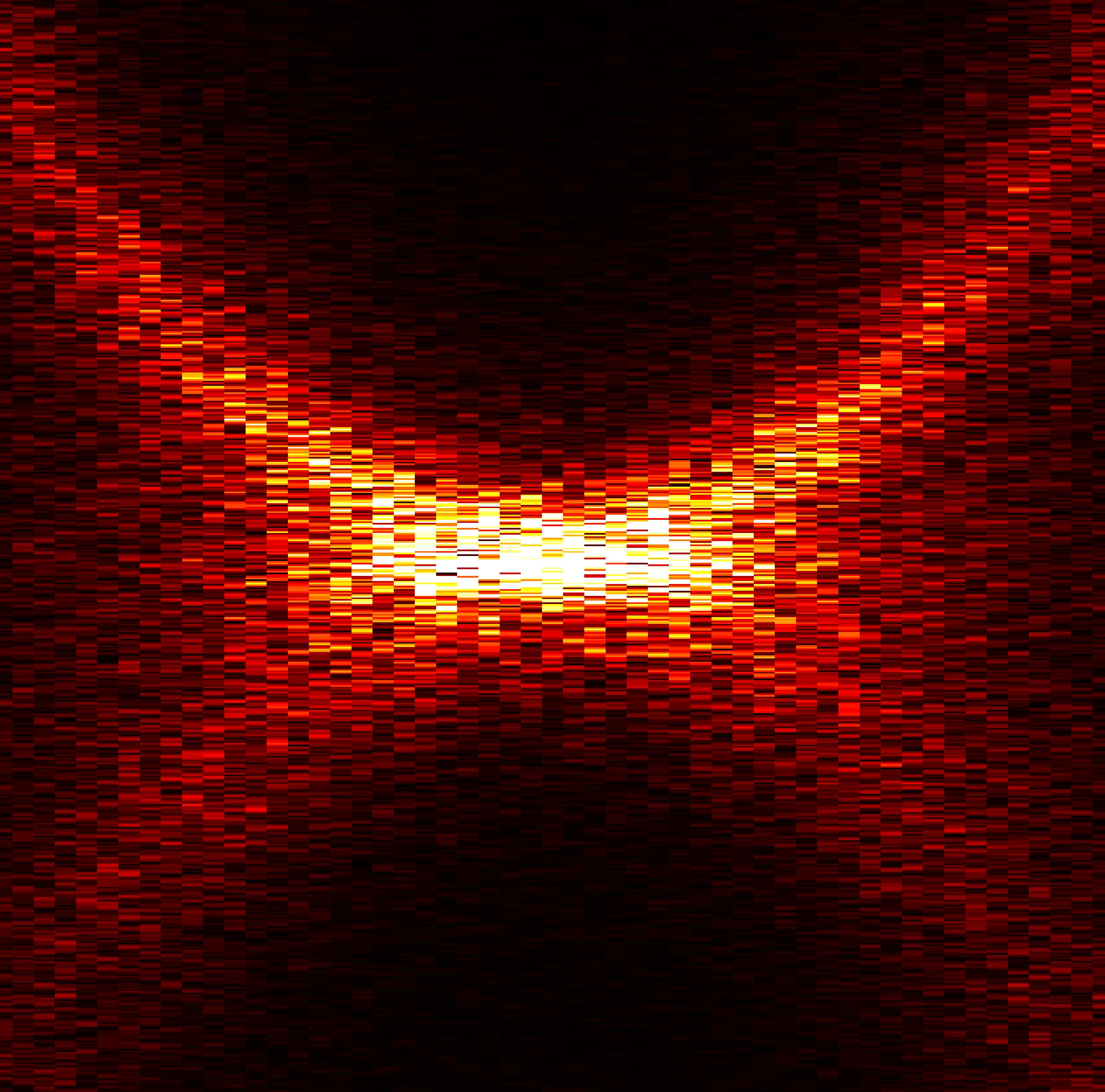
An ordinary wave in a magnet is like ripples on water: the shorter the wavelength, the higher the energy. Physicists call such waves magnons. But in a thin film of bismuth yttrium iron garnet, they managed to create waves with the opposite behavior: their energy decreases as the wavelength gets shorter. These are antimagnons.
The film was placed in a setup where light scatters off magnetization waves. First, a current was passed through the film, causing the magnetization to oscillate on its own. At a current of about 12 million amperes per square centimeter, the film's state changed abruptly, and the spectrum of scattered light showed an inverted dispersion — a clear sign of antimagnons.
This is the first direct experiment where antimagnons were observed via their characteristic signature in light scattering. Next, physicists want to use magnon–antimagnon pairs to amplify waves and for quantum communication. It's as if in a pond, waves ran both forward and backward simultaneously, yet helped each other along.
Original abstract
as written by the authors arXiv:2601.15231
We report direct spectroscopic evidence of antimagnons, i.e., negative-energy spin waves identified by their signature inverted dispersion with Brillouin light scattering (BLS) spectroscopy. We investigate an ultrathin BiYIG film with a perpendicular magnetized anisotropy that compensates the demagnetizing field. By injecting a spin-orbit torque, the magnetization is driven into auto-oscillation and eventually into a non-equilibrium reversed state above a secondary current threshold ($$\sim$$1.2$$\times$$10$$^7$$~A/cm$$^2$$). The dispersion is measured by wavevector-resolved BLS and exhibits a sharp change from an upward dispersion to a downward one, in agreement with theoretical predictions and micromagnetic simulations. Around the threshold current, we observe the coexistence of conventional magnons and antimagnons. Our work establishes antimagnons with inverted dispersion and is a first step towards exploring novel phenomena and applications due to magnon-antimagnon coupling, such as magnon amplification and magnon-antimagnon entanglement, which are part of the emerging field of antimagnonics.
Antimagnons were predicted long before the experiment: back in the 1960s, theorists discussed 'negative' spin waves, but it took until now to see them in the lab.