The inverse square law describes how a physical quantity — such as the intensity of light, gravity, or electrostatic force — diminishes with distance from its source. Specifically, the quantity is inversely proportional to the square of the distance. This means that if you double the distance from a point source, the intensity drops to one-quarter; triple it, and it drops to one-ninth. The law arises naturally for phenomena that spread out uniformly in three-dimensional space from a point source.
History
The inverse square law for gravity was formulated by Isaac Newton in his 1687 'Principia', and for electrostatic force by Charles-Augustin de Coulomb in the 1780s. The law for light intensity was recognized earlier, with Johannes Kepler and others noting the geometric dilution.
How it works
Imagine a point source emitting energy or force equally in all directions. At a distance r, that energy is spread over the surface of a sphere with area 4πr². Since the total energy is conserved, the intensity per unit area must be the total divided by the surface area, which is proportional to 1/r². This geometric dilution is the essence of the law.
In practice
It is fundamental to designing lighting systems, calculating radiation doses in medical physics, determining satellite communication link budgets, and understanding gravitational and electrostatic interactions in astrophysics and atomic physics.
Fun fact
The inverse square law is why the sky is dark at night: if the universe were infinite and static, every line of sight would end on a star, and the sky would be as bright as the sun's surface.
A camera looks at two distant sparks. They're so close together that they merge into a single fuzzy blob. It seems impossible to tell them apart — the classic limit of optical microscopy has been reached.
But quantum mechanics hints that the light field still holds a secret about where each spark sits.
A lead sphere hangs above another lead sphere. According to the usual laws of gravitation, they attract each other exactly along the vertical — along the line connecting their centers.
An ocean current hundreds of kilometers wide lives its own life, fed by energy from tiny eddies. Something similar happens in the atmosphere: small swirls pass their power on to huge air currents. This process, the inverse energy cascade, has been known for a long time.
A stone falls into a pond, and ripples spread evenly in all directions. But some media behave as if the wave knows which way to turn, like water that only swirls clockwise. This asymmetry comes from odd viscosity and odd elasticity — properties of media with broken mirror symmetry.
The universe sometimes resembles a pot of boiling water. With enough heat, liquid turns to vapor: that's a phase transition. Something similar could have happened in the early universe: a field filling space suddenly changed its state, like water becoming gas.
Gravity is the curvature of spacetime, not just an attraction, as Einstein showed. On such a curved "dance floor", even the hypothetical carriers of gravity — gravitons — move oddly.
Toss a dozen coins on a table. The number of heads-and-tails combinations is just over a thousand. For two dozen coins, it's already a million. The number grows as 2 to the power of the number of coins, and that's fast. But quantum systems are far richer.
Each particle here is not a coin with two sides but an arrow that can point in any direction.
Tiny magnets on a lattice, the classic Ising model, are usually described by how neighbors influence each other. But what happens when the system is closely watched? Each measurement of a coupling energy is like a gaze that forces the magnets to 'decide' their state.
A thin film is like a taut sheet: the thinner it is, the harder it is to push through. Scientists have noticed that films made of very different materials (graphene, graphene oxide, polymers) resist projectile penetration surprisingly well under high-speed impact. And the thinner the film, the more energy it absorbs per unit mass.
The familiar picture: gravity always attracts. But if a mass is in quantum superposition (that is, in two places at once, like an object in a double-exposure photograph) everything flips. Quantum theory allows a particle to be both here and there in a literal sense: its position is described by a wave function smeared across space.
An ordinary wave in a magnet is like ripples on water: the shorter the wavelength, the higher the energy. Physicists call such waves magnons. But in a thin film of bismuth yttrium iron garnet, they managed to create waves with the opposite behavior: their energy decreases as the wavelength gets shorter. These are antimagnons.
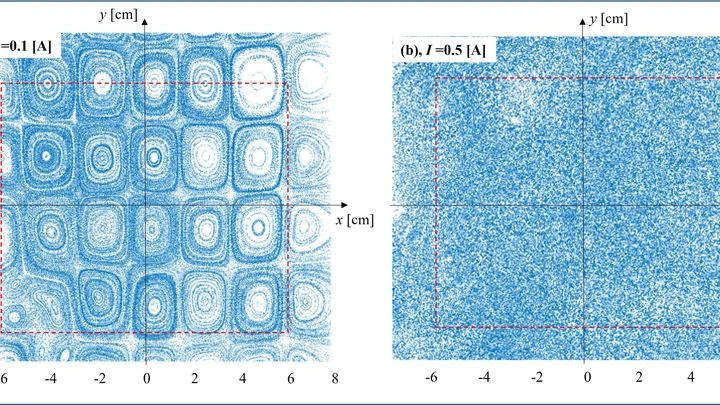
Water in a puddle after rain swirls differently than in a deep lake. A thin layer of fluid feels the bottom, and that changes the nature of its vortices. Scientists created such a layer in the lab: they poured in an electrolyte, ran a current and a magnetic field, and the fluid began to move.
In the quantum world, an object can be in several places at once. Yet in everyday life we see things strictly in their places. The reason is gravity. A massive star under its own weight inevitably collapses into a black hole or a neutron star, but it can't be both at the same time.