Quantum Strings Resonate in a Rydberg Chain express
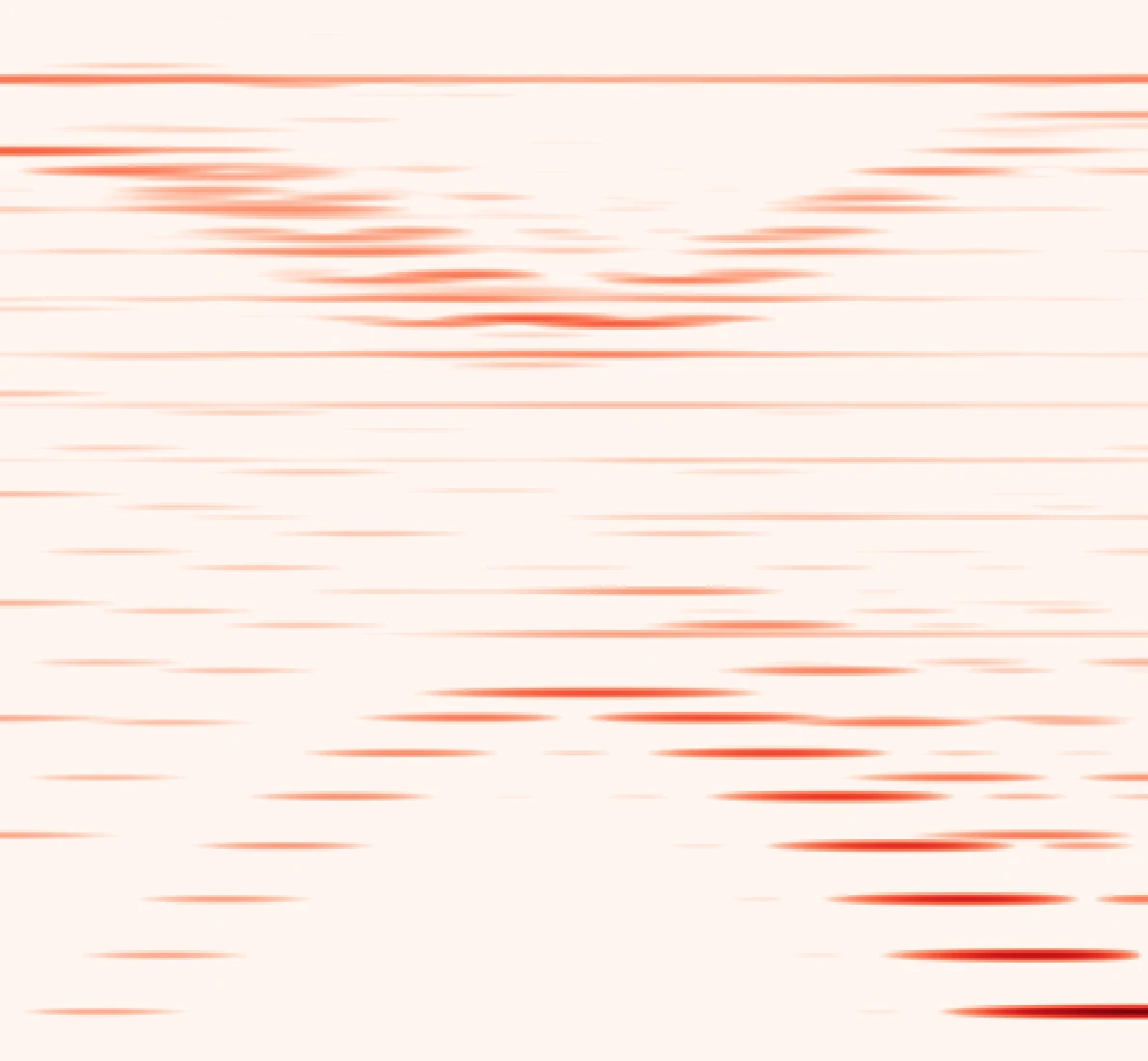
Physicists built a chain of Rydberg atoms — atoms with electrons in enormous orbits, comparable to planetary paths. These giant atoms feel their neighbors intensely, turning the chain into a quantum analog of a string. Using lasers, they tuned the system to a critical point where all scales vanish — much like a stretched guitar string ready to produce pure overtones regardless of its length.
Then they used spectroscopy with a gentle shake: they slightly modulated the light and listened for the resonant response. The resulting oscillation energies lined up in strict numerical proportions, exactly as conformal field theory predicts.
Surprise: the same proportions govern black hole horizons — a connection demonstrated by Juan Maldacena, Edward Witten, and Leonard Susskind. The measurements also directly linked the spectrum to entanglement entropy — a measure of quantum complexity. Such a quantum musical instrument will allow testing new materials and hasten the arrival of quantum technologies.
Original abstract
as written by the authors arXiv:2601.16275
Conformal field theories (CFTs) feature prominently in high-energy physics, statistical mechanics, and condensed matter. For example, CFTs govern emergent universal properties of systems tuned to quantum phase transitions, including their entanglement, correlations, and low-energy excitation spectra. Much of the rich structure predicted by CFTs nevertheless remains unobserved in experiment. Here we directly observe the energy excitation spectra of emergent CFTs at quantum phase transitions -- recovering universal energy ratios characteristic of the underlying field theories. Specifically, we develop and implement a modulation technique to resolve a Rydberg chain's finite-size spectra, variably tuned to quantum phase transitions described by either Ising or tricritical Ising CFTs. We also employ local control to distinguish parities of excitations under reflection and, in the tricritical Ising chain, to induce transitions between distinct CFT spectra associated with changing boundary conditions. By utilizing a variant of the modulation technique, we furthermore study the dynamical structure factor of the critical system, which is closely related to the correlation of an underlying Ising conformal field. Our work not only probes the emergence of CFT features in a quantum simulator, but also provides a technique for diagnosing a priori unknown universality classes in future experiments.
Rydberg atoms are atoms where an electron orbits like a planet around a star. These giants interact strongly over large distances, making them ideal for quantum simulations.