Tiny Magnets with a Fiery Core express
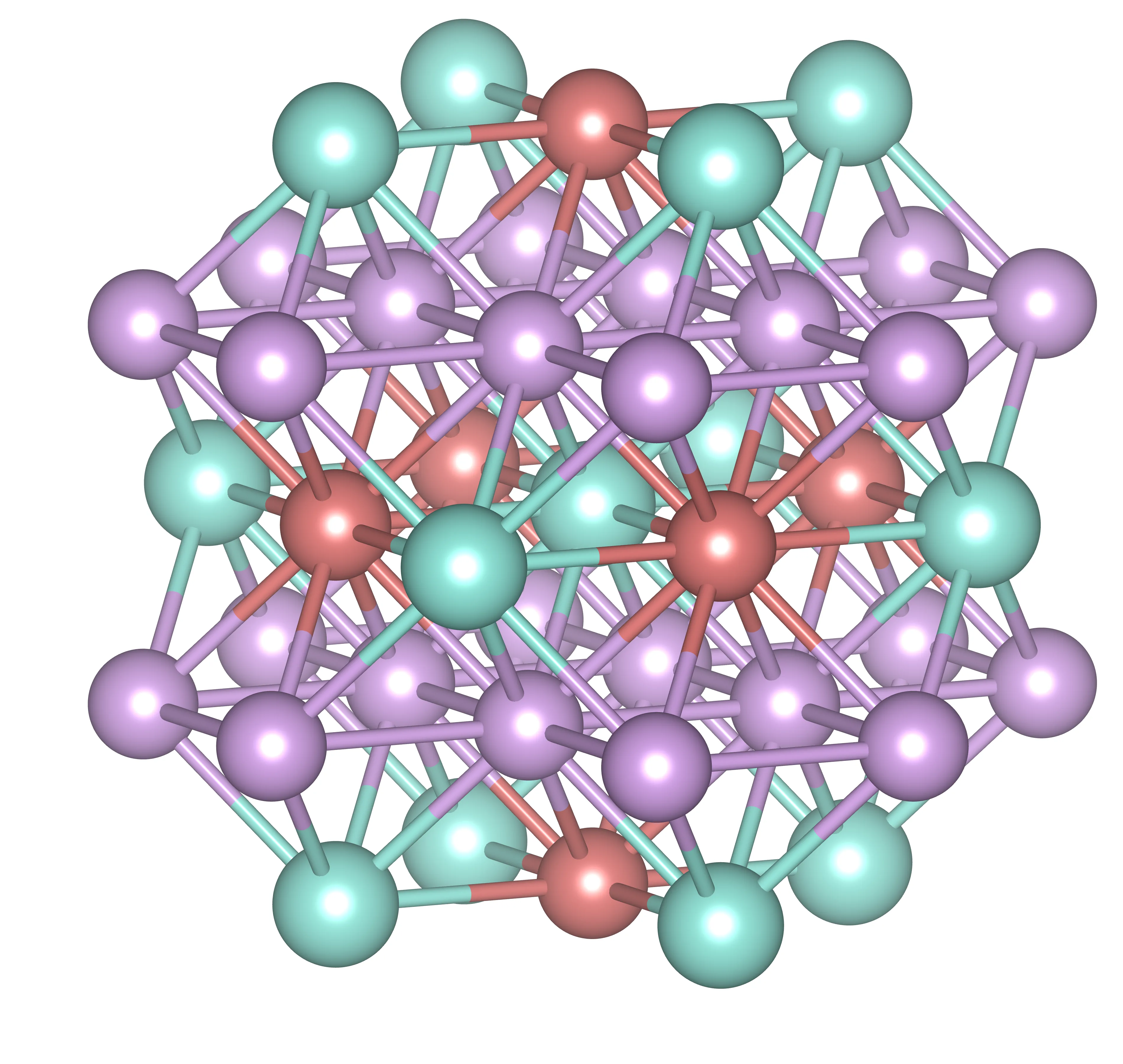
Tiny particles, smaller than a hundredth of the thickness of a human hair, can be magnets that don't lose their strength even at 600 degrees Celsius. These particular particles were made from a nickel-iron-aluminum alloy. The alloy has been known for a long time, but in nanoparticle form it was produced without templates — simply by mixing solutions of metal salts.
The magnetic properties turned out to be strong: at very low temperatures, each particle behaves like 3 separate tiny magnets aligned in the same direction. And crucially, when heated or cooled, the particles noticeably change their magnetization. This effect could be used for cooling without refrigerants: a magnetic field causes the particles to change temperature, like a sponge absorbing and releasing water.
Another feature: the particles don't like to change the direction of their magnetization: it takes a significant effort to do so. This property is called magnetic anisotropy. Thanks to it, nanoparticles can store information: the magnetization direction of each particle is like a tiny arrow that is hard to turn accidentally.
When an electric current is passed through, the resistance of the particles slightly increases as the temperature drops. This is unusual and suggests that disorder in the arrangement of atoms affects the movement of electrons. Such details are important for future electronic devices.
In summary, Ni₂FeAl nanoparticles combine heat resistance, strong magnetism, and the ability to change temperature under a magnetic field. This makes them candidates for magnetic refrigerators and ultra-dense memory.
Original abstract
as written by the authors arXiv:2602.01300
We present a comprehensive investigation of structural, magnetic and transport properties of Ni$$_2$$FeAl Heusler alloy nanoparticles (NPs) synthesized via template-less chemical route. The NPs exhibit high saturation magnetization of 3.02 $$\mu_ {\rm B}$$/f.u. at 5~K, large magnetic anisotropy of 0.238 MJ/m$$^3$$, and a Curie temperature of 874~K. Magnetocaloric analysis reveals a magnetic entropy change of 3.1 J.kg$$^{-1}$$K$$^{-1}$$ at 70 kOe. Low-temperature transport measurements show a weak resistivity upturn, following a $$-T^{1/2}$$ dependence, indicative of disorder-enhanced electron-electron interactions. First-principles calculations based on density functional theory yield a magneto-crystalline anisotropy energy of 0.987 MJ/m$$^3$$, consistent with experiment and demonstrate pronounced surface and finite-size effects through comparison of bulk and nanocluster geometries. The combination of high Curie temperature, sizable perpendicular magnetic anisotropy, and moderate spin polarization and magnetic entropy change make the Ni$$_2$$FeAl as promising candidate for various applications.
A magnetic refrigerator based on such particles could work without a compressor or Freon, just a magnetic field and the alloy.