How a Dwarf Galaxy Shook the Milky Way express
The Sagittarius galaxy plunged into the disk of the Milky Way and passed through again and again, like a stone thrown into a still pond. Each strike left ripples: waves and warps in the star field. Once, Sagittarius brimmed with invisible mass (dark matter), but the collisions stripped away its gas and stars, turning it into a faint trail.
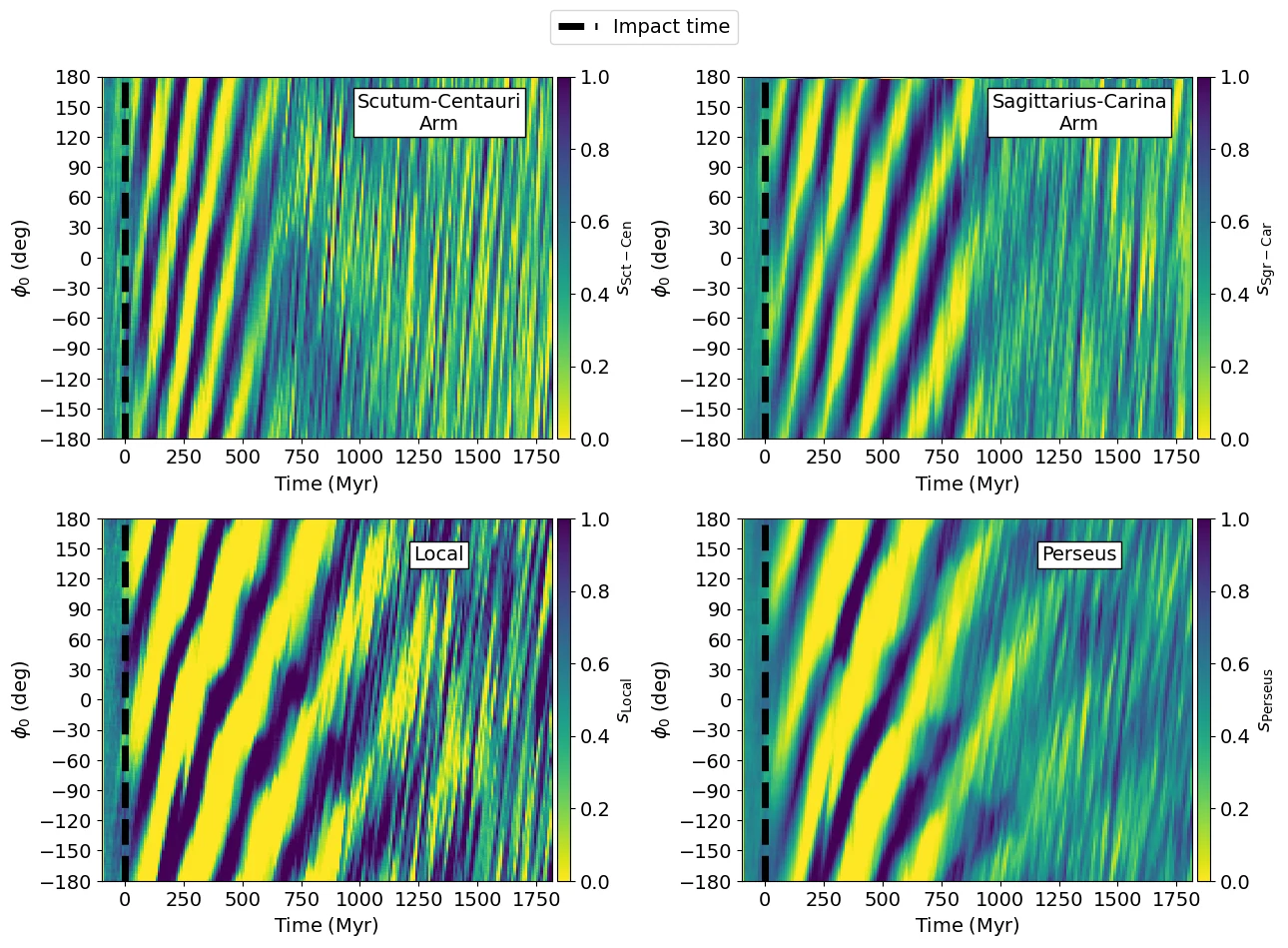
Astronomers simulated the last major impact about a billion years ago to see if it could spawn spiral arms, a warped disk, and subtle oscillations in star velocities. Motion measurements via spectroscopy confirmed: the impact explains the arms and warp, but more complex wave patterns aren’t fully reproduced. So our Galaxy remembers other shoves — from the dense central bar or other dwarf companions.
The most surprising part: Sagittarius itself has nearly vanished, but its dark matter likely still permeates the Milky Way, invisibly swaying stellar orbits. Like cosmic detectives, scientists piece together the Galaxy’s violent past.
Original abstract
as written by the authors arXiv:2602.05296
Prior to its infall, the Sagittarius (Sgr) dwarf galaxy was a major satellite with a mass of $$M_{\rm sgr}\sim 10^{11}$$ M$$_\odot$$. For the past $$5-6~\mathrm{Gyr}$$ , it has been heavily stripped by the Milky Way (MW), losing most of its mass while crossing the MW disc multiple times. Recent models of Milky Way disc perturbations $$-$$ including the spiral arms, the stellar bar, the Gaia phase spiral, and stellar and gaseous disc corrugations $$-$$ have identified these crossings as possible formation triggers, but have generally treated each perturbation in isolation. Here, we adopt a holistic perspective and ask whether a single disc-crossing impulse can simultaneously account for these features as observed today. We focus on simulations of single disc-crossing events by a Sgr-like perturber, and present a forensic analysis of the role of the powerful impulse in forming spiral arms, disc corrugations, the phase spiral and the `$$L_{z}-\bar{V}_{R}$$ wave', determined from a star's angular momentum and radial velocity, respectively. We find that a single disc crossing can reproduce reasonably well (e.g. structure, amplitude, phase) the observed local disc corrugation, and the Outer, Local and Sagittarius-Carina arm segments, implying that the last significant impulse due to a transit took place $$700-1200~\mathrm{Myr}$$ ago. Moreover, the $$L_{z}-\bar{V}_{R}$$ wave and phase spiral appear within the simulations over the same epoch and their general structure is reasonably well replicated, but not in detail. We conclude that Sgr's last significant crossing roughly a Gyr ago could be the primary cause of large-scale MW disc perturbations, but it cannot fully account for the $$L_{z}-\bar{V}_{R}$$ wave. Consequently, other triggers, possibly the Galactic bar or interactions with other satellites, must be considered in order to fully explain the current dynamical state of the MW's disc.
The Sagittarius dwarf galaxy is still visible in the sky as a faint ribbon of stars, stretched thin by the Milky Way's gravity.