Ytterbium's Narrow Lines: New Frequencies for Quantum Clocks express
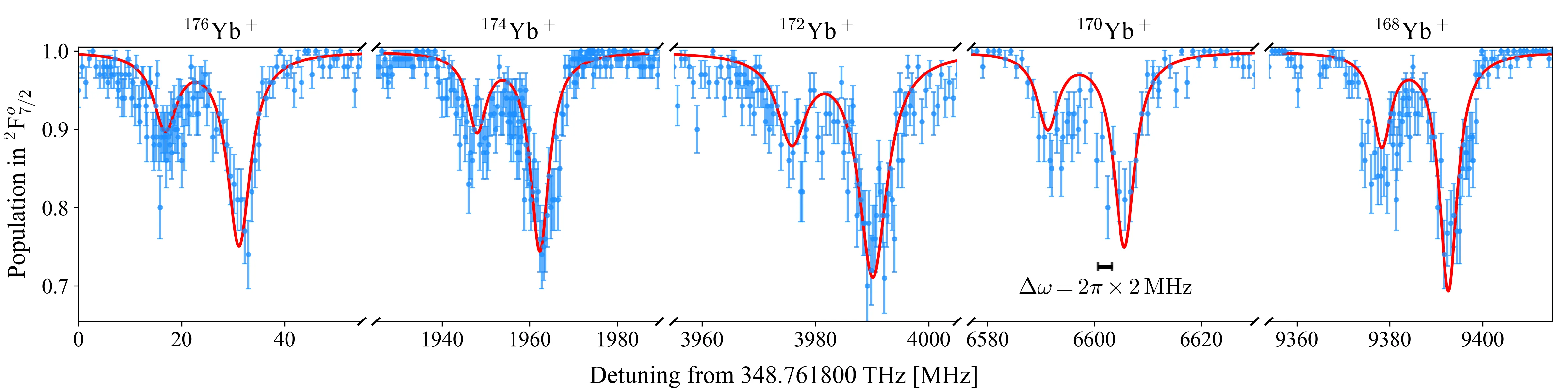
The light an atom emits or absorbs is like a fingerprint: each element has its own pattern of lines. In an ytterbium ion (an atom that has lost one electron), researchers have found three new lines that were previously unused. These lines are very narrow, like thin slits in a fence that let you see far and clearly.
The narrowness of the lines comes from the fact that both the upper and lower states live unusually long. Normally, an excited atom quickly sheds its energy, like a ball rolling down a hill. Here, the ball gets stuck on a shelf and can stay there for milliseconds — an eternity by atomic standards. Such long-lived states are handy for storing quantum information: a qubit won't be destroyed by a random jolt.
The scientists measured the absolute frequencies of these transitions with high precision. It's like knowing the exact address of a house so you can return to it without fail. They also measured frequency shifts for different isotopes (atoms with different numbers of neutrons) and the hyperfine structure — tiny splittings of the lines due to the interaction between the electron and the nucleus.
One of the new states turned out to be especially attractive: it can be excited by a laser and lives long because it decays via slow magnetic radiation. This makes it an ideal candidate for a long-lived qubit — a cell of a quantum computer. The new narrow lines will complement the known ones and help build more accurate clocks and search for deviations from the Standard Model of physics.
Ytterbium is named after the Swedish village of Ytterby, where a mineral containing this element was found. The same quarry yielded three other elements: yttrium, terbium, and erbium.