A Muon Telescope That Doesn't Throw Tantrums express
A storm is brewing somewhere far away, and the Geiger counter is already clicking more often. That's how cosmic rays, a stream of charged particles from deep space, make themselves known. When they slam into the atmosphere, they create showers of secondary particles, including muons: heavy cousins of electrons that can reach the ground. Catching them means seeing how space breathes.
Cosmic dust has nothing to do with it, but the principle is like catching fireflies in a jar. In the new module, a muon hits a plastic scintillator — a material that flashes with a brief burst of light when struck by a particle. The light travels through optical fibers to silicon photomultipliers, which turn the faint glimmer into an electrical signal. That's how one line in the observation log is born.
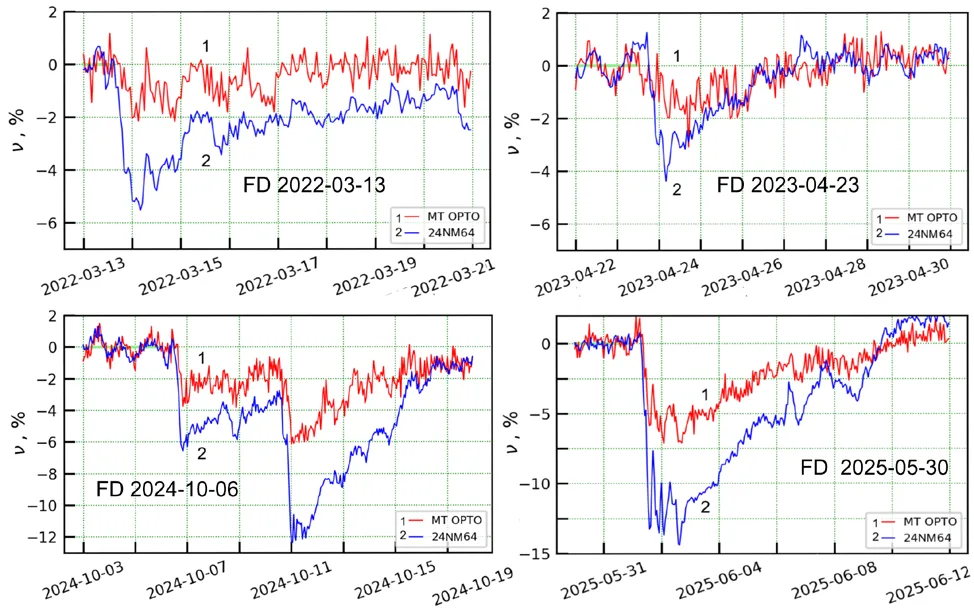
The hardest part is keeping the detector from lying over time. Usually, you'd put it in a thermostat, like wine in a cellar. Here, they did without: internal calibration and comparison with other detectors showed that readings drift by less than 0.1% per year. That's like a store scale being off by no more than a gram per kilogram after a year of continuous use.
Such a stable, low-maintenance module is a building block for a future network of muon telescopes. By placing detectors at different locations, scientists could see how the cosmic ray flux changes in different directions. And that's not just a counter anymore: it's a true barometer of space weather.
Muons are so ubiquitous that about one muon passes through your palm every second.