Light Instead of Wires: How to Send a Signal Out of a Freezer express
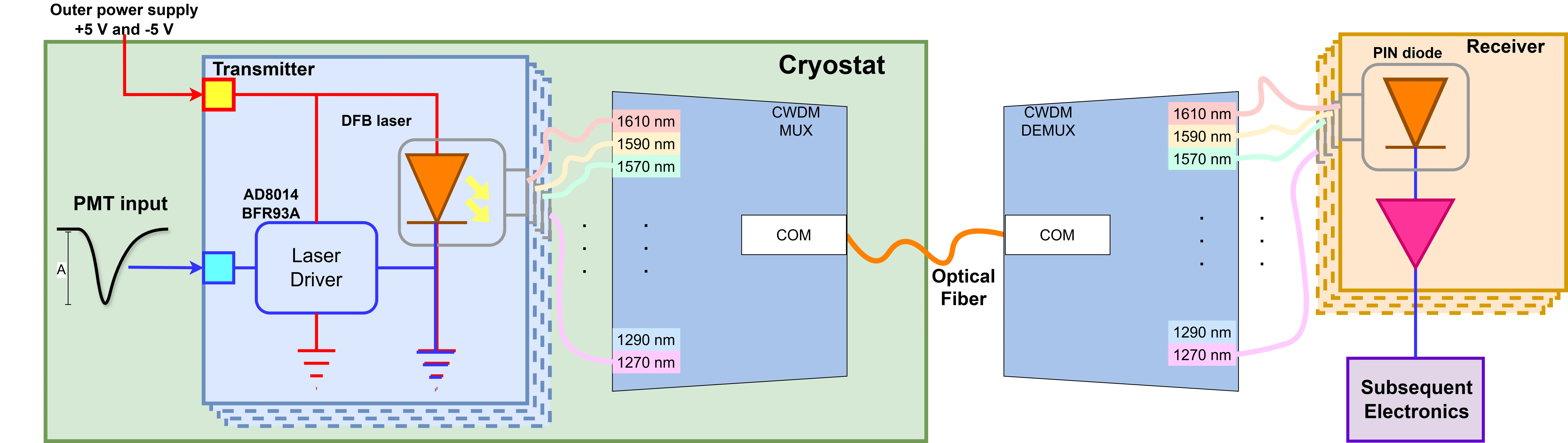
A thermos of liquid xenon cooled to minus 100 degrees Celsius. Inside are sensitive sensors that catch rare signals from dark matter particles. To bring these signals out, copper cables are usually used. But over the long haul, the signal weakens, and adjacent cables start 'cross-talking' — that's called crosstalk.
The new method works like a translator from the language of electricity to the language of light. An electrical signal from the sensor makes a laser shine brighter or dimmer — strictly proportional to the signal's strength. This light travels along a thin optical fiber to the outside, where a photodetector converts it back into an electrical pulse. The signal shape is preserved, as if you had transcribed the notes from one score to another without losing a single rest.
At minus 100 degrees, the system passes signals with frequencies up to 150 megahertz — tens of times faster than needed for the fastest events in the detector. The amplitude range reaches half a volt, and each channel consumes only 70 milliwatts — less than a bulb in a string of holiday lights. All this promises that future dark matter detectors will become more compact and reliable.
Optical fiber barely heats up and creates no interference, so it can be routed right through the cryostat wall — the sealed cold vessel — without risking the thermal insulation.
In the movie 'Interstellar', data from sensors near a black hole was transmitted to the ship via radio; in real experiments, light through optical fiber carries signals from icy depths.