A Gyroscope for Climate: Teaching Neural Networks Not to Make Up Energy ✛
Every few years, the warm current off the coast of Peru shifts, and fishermen come home empty-handed. This is El Niño, the breath of the tropical Pacific, which affects weather from Indonesia to California. Predicting its arrival is as hard as predicting where a stone thrown into a raging river will roll.
Scientists build simplified models of such turbulent systems because calculating every drop of the ocean is impossible. Neural networks learn well from data: they see months of observations and pick up patterns. But there's a catch. An ordinary neural network can reproduce average characteristics, yet when given an external nudge, say a change in solar activity, it may start to swing like a swing pushed out of rhythm. It doesn't have to conserve energy because it doesn't know physics.
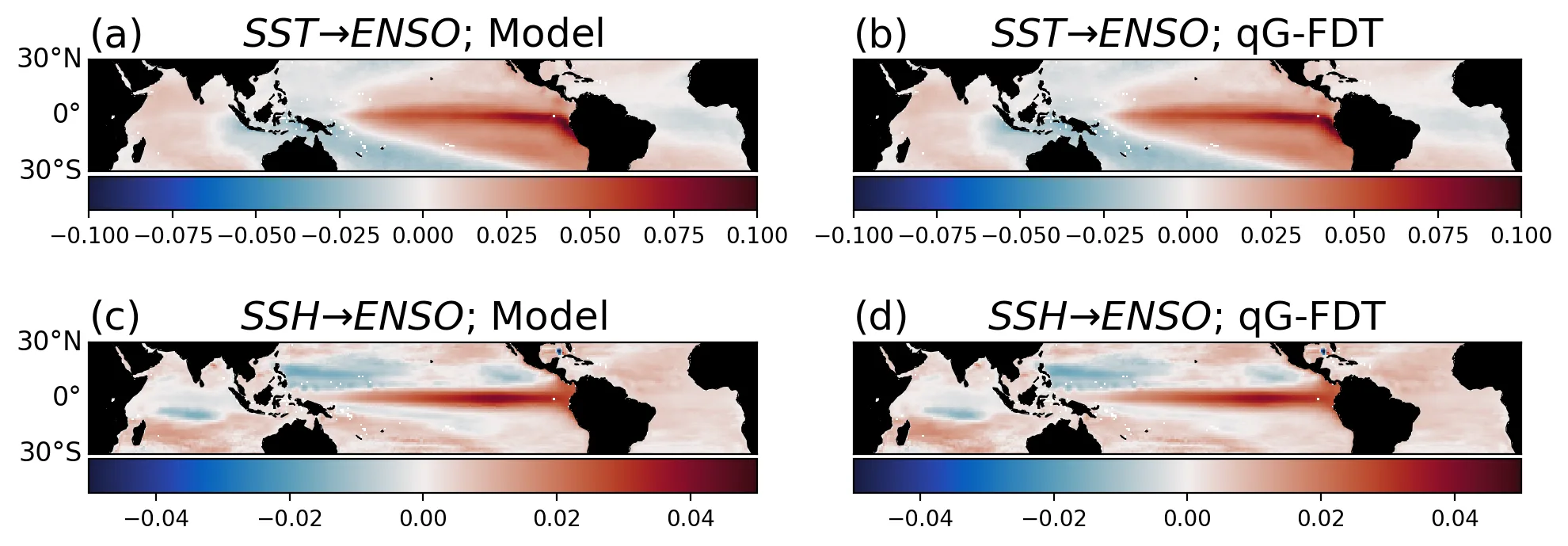
But how do you check that the model responds correctly to a perturbation if it was trained only on calm data? The authors use the fluctuation-dissipation theorem, which links spontaneous fluctuations to the response to external forcing. It's like estimating how loudly a bell will ring when struck by watching it tremble in random gusts of wind.
The method was tested on idealized turbulence models, then applied to real tropical climate data. A model with 20 variables reproduced El Niño's non-Gaussian distribution and its spectrum with a peak in the 2–5 year range. Moreover, it could generate an extreme event comparable to the record El Niño of 1997/1998, even though such an event appeared only once in the training data.
The gyroscope inside the neural network keeps the model from swinging out of control. It stays within the bounds of physics, so you can ask the model about things that weren't in the data: how would the climate respond to an unexpected shock? Previously, such questions were asked with caution because models could give nonsensical answers. Now we have a way to build reliable simplified versions of the ocean and atmosphere that not only remember the past but also honestly answer about the future.
The model was able to generate an extreme El Niño event comparable to the record-breaking 1997/1998 event, even though such an event occurred only once in the training data.
The idea of predicting a complex system's response to intervention without actually intervening evokes the 'psychohistory' from Isaac Asimov's Foundation series, where the future of large populations is computed using statistical laws.