Physical Constraints and Response Validation in Discrete Turbulence Models ✛
Context
Models of turbulent systems, from the atmosphere to the ocean, are often too complex for direct simulation, so scientists build simplified versions that retain key statistical properties. Alongside this work on the preprint server are studies using neural networks for gravitational lensing maps of galaxies, for fast stabilization of power grids, and for tracking indoor heat; all tackle a similar problem: extracting useful dynamics from limited data. However, most such models do not guarantee physical correctness: they may reproduce average characteristics but fail under external forcing. This paper stands out because it embeds energy conservation directly into the neural network architecture and validates the model's response using a theorem that links spontaneous fluctuations to perturbations.
Methods
The authors propose a discrete form of turbulent dynamics in which the nonlinear operator is represented by an orthogonal matrix (a rotation) that conserves energy. This operator is parameterized by a neural network: it predicts a skew-symmetric matrix, from which an orthogonal matrix is built via the matrix exponential. The linear part is first initialized using ordinary least squares, providing a stable starting point. To validate the response, they use the fluctuation-dissipation theorem (FDT), which allows computing the system's reaction to a small perturbation using only unperturbed data. The FDT also yields causal links between variables, which are added to the training as regularization if they pass validation. The model was tested on the stochastic Charney-DeVore model and the broken-symmetry Lorenz-96 model, and then on real ORAS5 reanalysis data for tropical dynamics.
Results
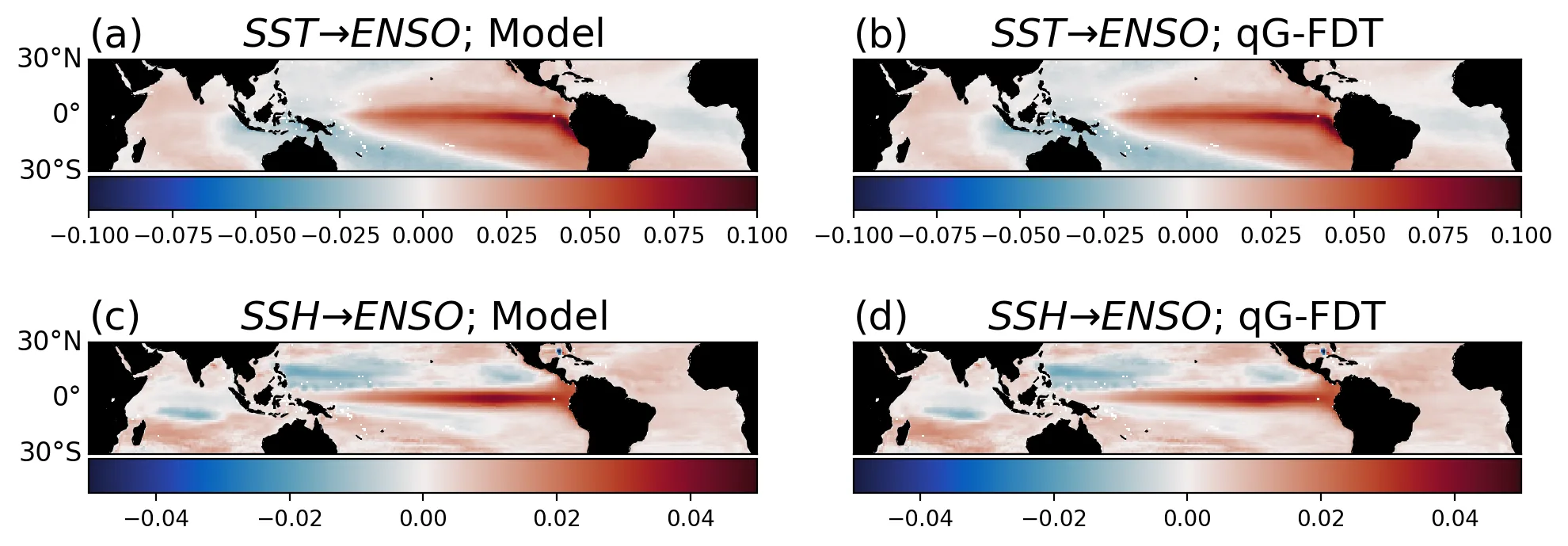
On idealized models, the physically constrained emulators remained stable and accurately reproduced responses to weak and strong forcings, despite being trained only on unperturbed data. For instance, in the Charney-DeVore model, the causally regularized model outperformed the purely physical one in variance response accuracy. In the real tropical application, a 20-variable model reproduced the non-Gaussian distribution of El Niño and its spectrum with a peak in the 2-5 year range. Adding a non-Markovian stochastic closure scheme significantly improved agreement with the FDT benchmark for 12-month cumulative sensitivities. The resulting sensitivity maps over 10 years showed that El Niño is most strongly influenced by sea surface temperature perturbations in the eastern equatorial Pacific, the subtropical North Pacific, and the tropical Atlantic.
Implications
This work differs from neighboring studies by being the first to combine a strict physical constraint (energy conservation) with FDT-based response validation in discrete time. This allows building models that not only reproduce statistics but also respond correctly to external forcings, a property critical for climate predictions and testing causal hypotheses. Such an approach could become a standard for validating the reliability of any emulator of complex systems.
Future development
Looking ahead, the method could be extended to higher-dimensional systems using convolutional architectures for spatial data. It may also be possible to use FDT response operators as targets for calibrating already trained models, complementing causal regularization. An important direction remains developing automatic methods for selecting thresholds for causal links to reduce reliance on manual tuning.
Impact
The method is applicable in climatology for analyzing El Niño sensitivity, in weather forecasting for creating robust emulators, and in other fields where turbulence must be modeled from limited data.
Next steps
Immediate next steps include applying the method to larger climate datasets and testing on systems with known governing equations for further validation.
Key open problems
In climate dynamics, an open question is which large-scale variables provide a Markovian description of the system so that responses to perturbations are accurate. This work shows that even with incomplete observability, predictions can be improved using stochastic closures, but choosing the right slow variables remains a key unsolved problem.
The knowledge machine's view
This section is addressed to the author of the paper and their colleagues. Neighbouring works were found by meaning-based search across our archive, not by word overlap. We do not review: we show the field around the work.
What the work does
The authors build discrete turbulence models in which the nonlinear part is an orthogonal matrix, parameterized by a neural network through a skew-symmetric matrix and the matrix exponential, which guarantees energy conservation. To test the response to external forcing, they use the fluctuation-dissipation theorem in discrete time, training only on unperturbed data. The method is validated on idealized Charney–DeVore and Lorenz-96 models, then applied to ORAS5 reanalysis data for tropical dynamics, where it reproduces El Niño statistics and identifies its long-term causal factors.
Where its strength is
The hard physical constraint (energy conservation) enforced via orthogonality of the nonlinear operator, combined with FDT-based response validation, is a rare pairing that allows building models that not only reproduce statistics but also respond correctly to perturbations. Such an architecture could serve as a foundation for transferring the approach to more complex systems.
Where it could go next
- It might be interesting to see how the approach with orthogonal nonlinearities and FDT validation could combine with the algebraic structures used to learn tropical dynamics in 2607.00237: there the neural network relies on an algebraic skeleton, and joint use could yield more interpretable or robust models.based on: Tropical Blueprint: A Neural Network Learns from an Algebraic Skeleton arXiv:2607.00237
- Closely related is 2607.12722, where a neural network quickly recovers the equation of state of neutron stars; perhaps their fast training techniques or architectural tricks for physically motivated models could help accelerate or improve your parameterization of skew-symmetric matrices.based on: Listening to the Stars: AI Decoder Instantly Reconstructs the Neutron Star Equation of State arXiv:2607.12722
Worth trying
- Test whether adding algebraic invariants (as in 2607.00237) improves the response accuracy to strong perturbations in the tropical model.
- Use fast training ideas from 2607.12722 to reduce the time for fitting the matrix exponential in the orthogonal layer.
- Test your FDT validation scheme on solar cycle data (2602.16656) to assess the method's transferability to other climate oscillations.
Why this may matter
Models with guaranteed physical correctness and validated response could become the basis for more reliable forecasts of climate phenomena such as El Niño, and for understanding causal links in complex geophysical systems.
Nearby works in our archive
- Neural Network Learns to Feel the Earthsimilarity 0.56
- Tropical Blueprint: A Neural Network Learns from an Algebraic Skeletonsimilarity 0.56
- Solar Cycles: How Magnetic Swings Sway the Futuresimilarity 0.55
- Neural Network Charts a Precise Gravitational Map of Galaxiessimilarity 0.54
- The Gas That Pretends to Be a Brainsimilarity 0.53
- A Thermostat That Likes to Glue Probabilities Togethersimilarity 0.53
- Listening to the Stars: AI Decoder Instantly Reconstructs the Neutron Star Equation of Statesimilarity 0.53
The archive is sparse around this work: the closest review is only 0.56, against a usual 0.64. It looks like few have drilled nearby.
The model was able to generate an extreme El Niño event comparable to the record-breaking 1997/1998 event, even though such an event occurred only once in the training data.
The idea of predicting a complex system's response to intervention without actually intervening evokes the 'psychohistory' from Isaac Asimov's Foundation series, where the future of large populations is computed using statistical laws.
Key numbers
- tropical model dimension: 20 variables (10 for sea surface temperature, 10 for sea surface height)
- training sample length: 712 months (about 59 years)
- response validation horizon: 12 months
- sensitivity forecast horizon: 120 months (10 years)
- strong forcing amplitude in Lorenz-96 model: 10 times larger than natural variability