Neutrino Hunters in Antarctic Ice express
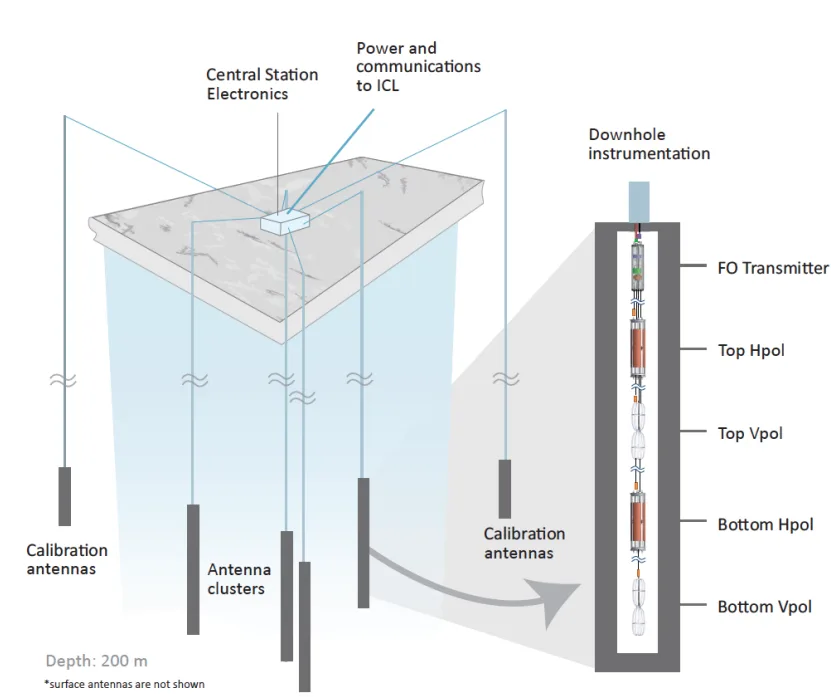
Deep within the Antarctic ice, at depths where sunlight never reaches, antennas hang suspended. They listen not for sounds but for radio waves, waiting for a signal from a particle that is nearly impossible to catch. A neutrino passes through the Earth like a bullet through fog, but occasionally, very rarely, it grazes an ice atom. That collision produces a brief radio flash, and the antennas record it.
Five such stations, scattered across the ice plateau, have been operating for nearly 30 years. Each station consists of several antennas lowered into boreholes dozens of meters deep. They capture the radio signal from two sides, as if listening with both left and right ears. Previously, data from each station were analyzed separately, but now they have been combined for the first time, like fitting together pieces of a mosaic.
The combined search targets the most energetic neutrinos: those carrying energy comparable to a tennis ball serve, yet smaller than an atom. Such particles arrive from distant galaxies, black holes, or stellar explosions. If the antennas catch them, it will be the first step toward a new map of the sky — drawn not with light but with neutrinos.
This analysis is set to be the most stringent among all ice-based detectors: if no particles are found, that too is a result. It will reveal how rare such neutrinos are and help verify a mysterious signal recently observed in the Mediterranean Sea. Most importantly, it will refine the method for next-generation detectors: more antennas, more ice, more chances to hear the cosmos.
Antarctic ice is so transparent to radio waves that an antenna at a depth of 200 meters can 'hear' a signal born a kilometer away.