A Superconductor That Remembers express
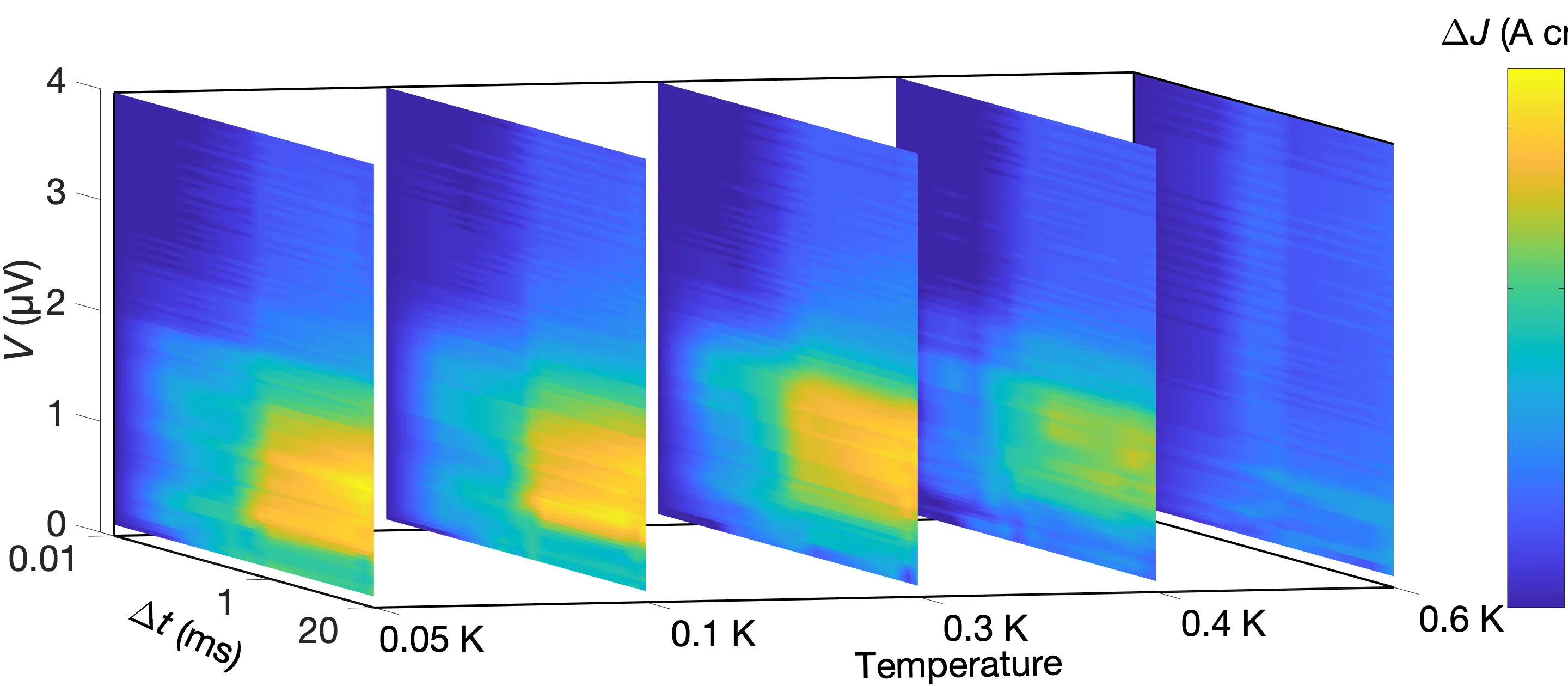
Ordinary computer memory constantly uses energy to store ones and zeros. Superconductors, on the other hand, carry current with zero loss — if you could build memory from them, it would barely draw any power. The catch is that superconductors can't remember: their state changes too easily.
Uranium ditelluride crystals turned out to be the exception. When placed in a magnetic field and hit with a short current pulse, they transition to a state where current flows even better. A second pulse flips them back. The material 'remembers' its state for hours.
Inside a superconductor, magnetic field lines gather into vortex filaments — tiny tubes around which current flows. Uranium ditelluride has two types of these filaments. A current pulse stirs them up, creating disorder that pins the filaments more firmly in place, so current flows more strongly. It's like a pile of sand: shake it, and the grains settle tighter, making the pile more stable.
This kind of memory doesn't need extra layers of magnets or semiconductors — everything required is already in the crystal itself. That opens the door to ultra-efficient memory devices for future computers.
Original abstract
as written by the authors arXiv:2603.02450
If a computer could be assembled from superconducting components, the energy efficiency would far surpass that of conventional electronics. Historic research efforts towards this goal yielded pivotal breakthroughs in the development and discovery of scanning tunnelling microscopy and high temperature superconductivity. Although recent strides have been taken in advancing superconducting diode and switching technologies, harnessing read/writeable memory functionality in superconducting platforms has remained challenging. Here we show that bulk single crystal specimens of the triplet superconductor candidate uranium ditelluride (UTe$$_2$$) possess such properties. Upon applying a magnetic field to access an intermediate regime straddling two distinct superconducting phases, we find that direct current pulses can push the material in and out of a metastable state possessing an enhanced critical current $$J_c$$. This switching is controllable by the strength and duration of the stimuli, with the system `remembering' whether it is in the high or low $$J_c$$ state for extended periods. We interpret this to be due to competition between two distinct vortex species, which can be perturbatively pushed into a non-equilibrium high-disorder configuration with stronger pinning forces and thus higher $$J_c$$. Rather than requiring proximate magnetic or semiconducting interfaces, this memory functionality appears to be an intrinsic property of UTe$$_2$$ rooted in the superconducting order itself. Our findings underscore the rich complexity of quantum vortex matter, and demonstrate the viability of engineering a new class of superconducting memory elements with ultralow-power switching.
The superconductor uranium ditelluride remains superconducting even in very strong magnetic fields, where ordinary superconductors give up.