A Laser Tape Measure That Can Hear Music express
Two laser beams, like two pencils, draw an invisible scale on the wall. One tip moves slightly faster than the other, and by the way their strokes alternately coincide and diverge, you can calculate the distance to the wall with an accuracy down to the thickness of a spider's thread.
In the new work, physicists made these two beams work continuously, without pauses. Usually, for such precision, lasers need to be stabilized, like holding pencils in perfectly steady hands. Here, the lasers were left free, and the lack of stability was compensated by speed: the device takes 11,500 measurements per second. That's enough to catch the trembling of a mirror attached to a speaker and, from that trembling, reconstruct the sound.
Such a tool is needed in factories where machines cut parts with micron-level precision. It can constantly check the position of a cutter or drill without stopping the work. And it doesn't require complex electronics for signal processing, the data streams in like sound from a microphone.
Original abstract
as written by the authors arXiv:2603.07741
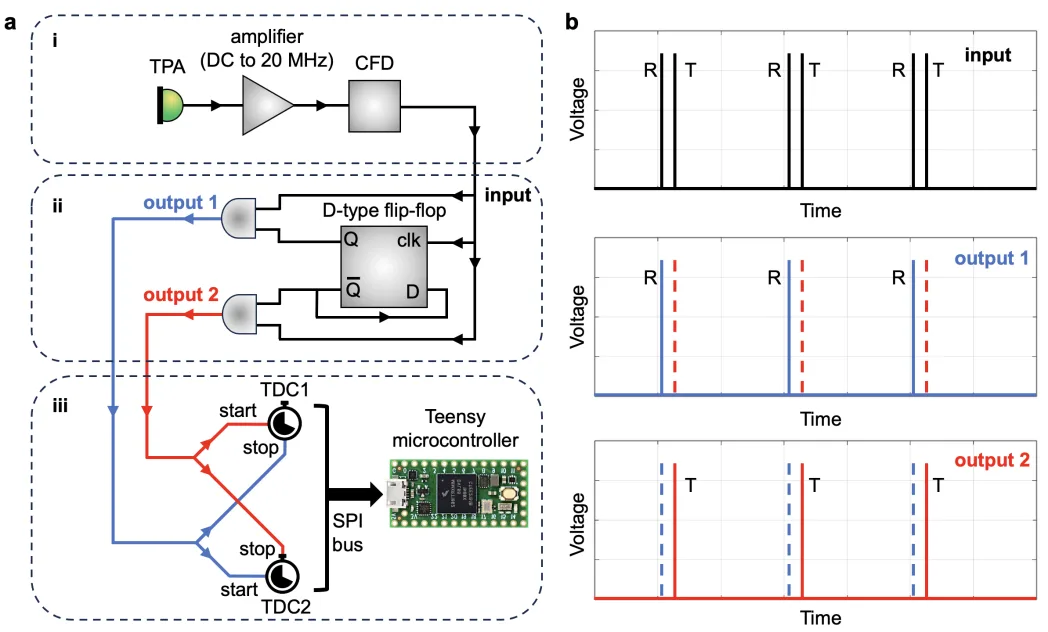
Dual-comb distance metrology combines sub-um precision with absolute distance measurement over meter-scale non-ambiguity ranges. The most common interferometric implementation requires sophisticated approaches to achieve continuous streaming due to the need for digitization at near-gigasample/s rates. Here, we exploit the naturally low data burden of two-photon dual-comb LiDAR to demonstrate continuously-streamed distance metrology at 11.5 kHz, reaching a precision of nearly 1 um in an averaging time of 10 ms. Using free-running 500 MHz Er,Yb:glass femtosecond lasers we achieve sampling rates >10 kHz, sufficient to demonstrate the capture of a four-minute audio track from the displacement of a loudspeaker-mounted mirror. The ability to perform high-speed yet low-data-burden distance metrology using unstabilized lasers presents exciting opportunities for diverse applications in industrial machine-tool control and calibration.
Over four minutes of recording, the laser tape measure made about 2.8 million measurements—11,500 per second. That's like photographing a flying bullet every 0.00009 seconds.
In the movie 'Minority Report,' gestures control an interface without touching — a similar principle of tracking fast movements would be needed for precise touchless remotes.