Magnetic Stiffness, Heard express
A magnet, like a compass needle, likes to point in a certain direction. But what if the material is layered, like a stack of pancakes? Scientists took just such a magnet made from a compound of chromium, germanium, and tellurium and set out to find out how stubbornly it resists having its magnetization turned.
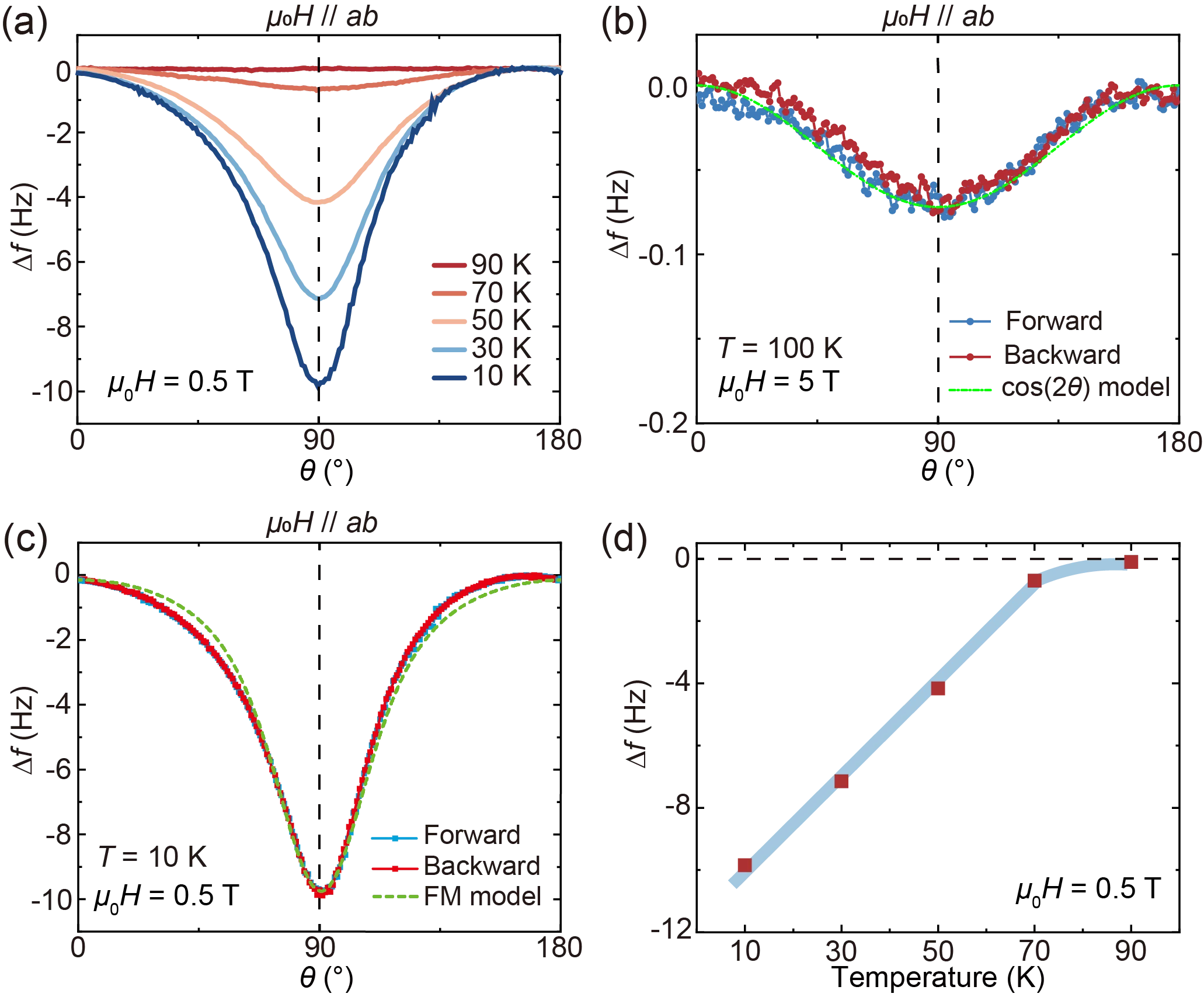
To do this, they glued the sample onto a quartz tuning fork — a tiny pronged device that rings at a high frequency. When a magnetic field pulls the magnetization sideways, the tuning fork's vibration changes slightly. From that change, they could precisely measure the magnetic stiffness — the material's resistance to having its internal magnet rotated.
It turned out that at low temperatures, the magnet behaves like a flat two-dimensional sheet: its magnetization barely leaves the plane. When heated or subjected to a strong field, the picture changes — a sharp dip appears in the response curve as the magnetization reaches saturation. It's as if a stubborn door suddenly gives way when you push hard enough.
This method is like a stethoscope for magnetic materials. It hears internal stresses that ordinary magnetometers miss. And it has already helped distinguish spin-driven magnetism from orbital magnetism in another material — the superconductor CsV3Sb5. Now physicists have a reliable tool to listen to the "magnetic heartbeat" of thin films and layered crystals.
Quartz tuning forks have been used in wristwatches for half a century. Today, the same tiny forks help physicists measure forces billions of times smaller than the weight of a grain of sand.
In Stanislaw Lem's novel "Solaris," the planet's ocean reacts to researchers' magnetic fields. Perhaps future probes with quartz tuning forks will be able to "hear" magnetic anomalies on distant worlds.