Light Through a Glass Bead: Catching Scattered Rays express
A flashlight beam in fog breaks into thousands of faint specks. Each speck is light that has bounced off countless water droplets before reaching your eye. To make sense of this mess, physicists construct a special table — the scattering matrix. It records how each incoming ray turns into a set of outgoing ones.
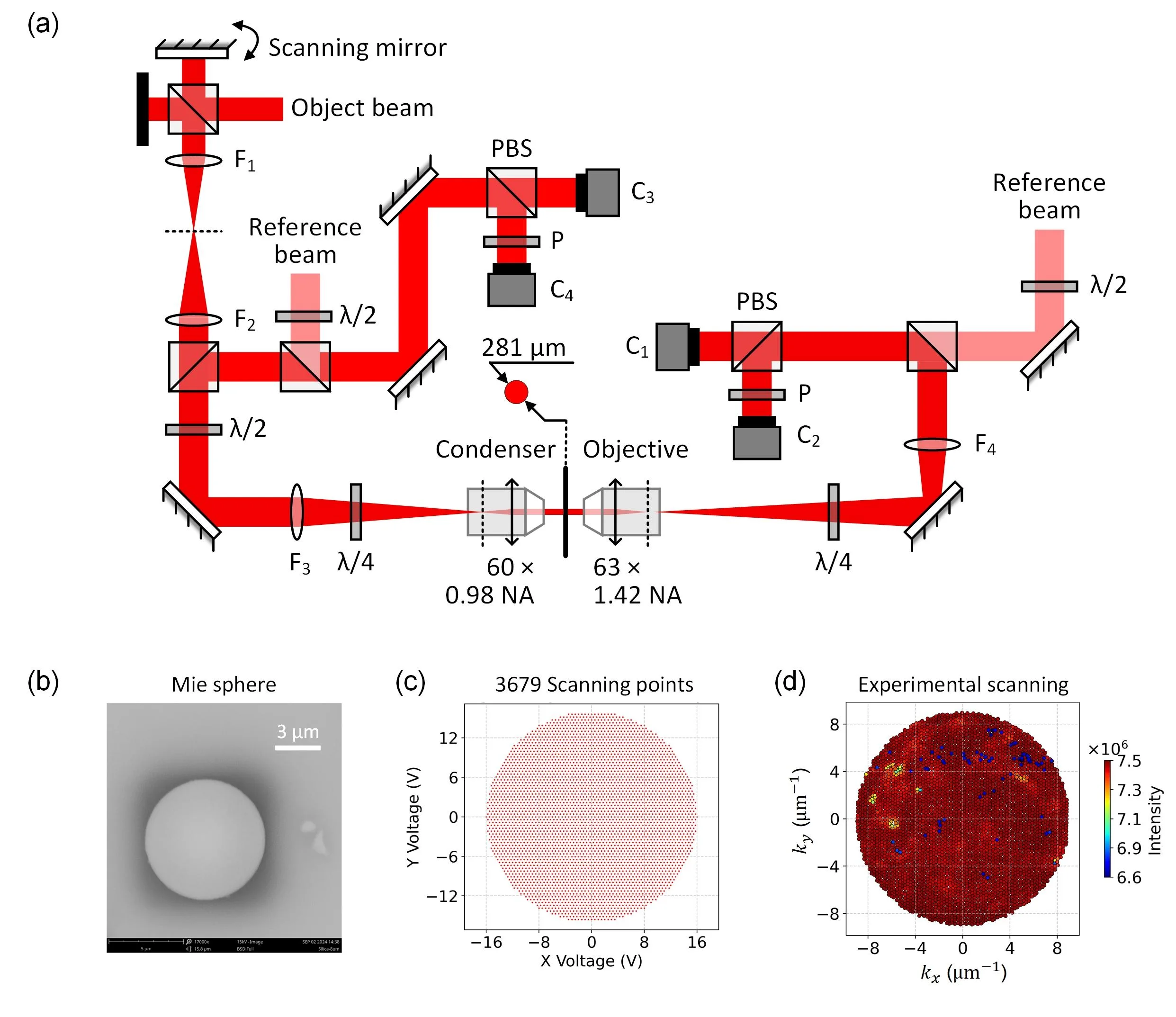
The authors of the new study skipped the fog and used a single glass bead — the simplest possible scatterer. They illuminated it with a laser from various angles and recorded how light emerged in all directions. To do this, they used holography: the laser beam was mixed with a reference beam, and from the interference pattern they reconstructed the full light wave — not just its intensity but also its phase. This allowed them to measure the scattering matrix with precision down to the polarization of light.
After correcting for optical distortions and recalculating angles, the measured matrix matched the theoretical one. This means the method works and can now serve as a benchmark for testing more complex media — for instance, biological tissues, where light scatters off cells and organelles.
Original abstract
as written by the authors arXiv:2603.17827
Transmission matrices are valuable tools to describe and control light transport through scattering media. There are only a few cases where the transmission matrix can be compared to microscopic theories. Here we measure the polarization-complete transmission matrix of a single dielectric sphere using off-axis holography with angle scanning and reconstruct complex fields in both transmission and reflection under circular polarization. After aberration correction and angular mapping, the scattering amplitude extracted from the transmission matrix closely follows Mie theory. This work provides a calibrated benchmark for angle-resolved transmission matrix measurement and enables quantitative characterization of spherical and quasi-spherical scatterers.
Mie theory explains why clouds are white and the sky is blue: large droplets scatter all colors equally, while tiny air molecules scatter blue light more strongly.