Mass spectrometry is a powerful analytical technique that measures the mass-to-charge ratio of ions to identify and quantify molecules. By ionizing a sample and separating the resulting ions based on their mass, it provides a 'molecular fingerprint' that reveals the chemical composition of complex mixtures, from biological tissues to interstellar gas clouds.
History
The first mass spectrograph was built by J.J. Thomson in 1912, and the technique was refined by Francis Aston in the 1920s to discover isotopes of elements.
How it works
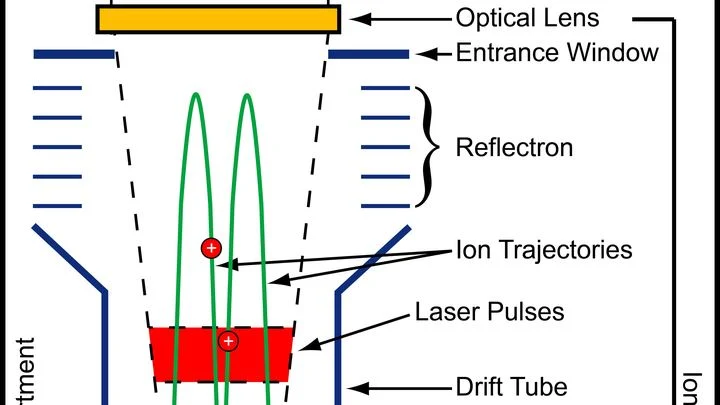
The sample is first ionized, often by electron impact or electrospray, creating charged particles. These ions are then accelerated through an electric field and deflected by a magnetic field or analyzed by time-of-flight. Lighter ions travel faster or are deflected more than heavier ones, allowing a detector to record the abundance of each mass. The resulting mass spectrum is a plot of ion intensity versus mass-to-charge ratio, which can be matched against known compounds or used to deduce molecular structures.
In practice
Mass spectrometry is used in proteomics to identify proteins, in clinical diagnostics to detect metabolic disorders, and in environmental monitoring to trace pollutants.
Fun fact
Mass spectrometers on Mars rovers have been used to analyze the chemical composition of rocks and soil, searching for signs of past life.
When an alpha particle tears through a gas, it leaves behind not a continuous track but a chain of individual ionizations: tiny flashes where electrons are knocked off atoms. In a living cell, such flashes damage DNA, and the denser they are packed into a clump, the more severe the damage.
The instrument shines an infrared beam at a sample, and molecules respond with their own absorption pattern, like bells of different tones. This pattern, the spectrum, holds information about the chemical composition. But to read it, a specialist usually consults a library of reference records, which is slow and not always possible.
When sugar goes into tea, it dissolves. But why doesn't it just fall back out? It's all about chemical potential — a quantity that shows how 'favorable' it is for a substance to be in a given place and state. For a pure substance, it's easy to calculate, but for a mixture of several components, it's a real puzzle.
The scene is lit by spotlights, but the most interesting action happens in the shadows — where molecules invisible to the eye are hiding. The new camera picks up the heat of these "invisible" objects and turns it into ordinary light.
A drop of blood from a vein falls under three beams, and each one drags its own clues into the light. The infrared beam makes molecules vibrate — from that trembling, you learn how much sugar and fat is in the sample. A green laser scatters off proteins and lipids, shifting color — revealing the remodeling of cell membranes.
A hundred people are talking at once in a large hall. You try to hear one, but voices blend, some whisper, and you don't even suspect the existence of others. That's roughly how a conventional laser gas analyzer feels when dozens of substances mix in a combustion chamber or a factory pipe.
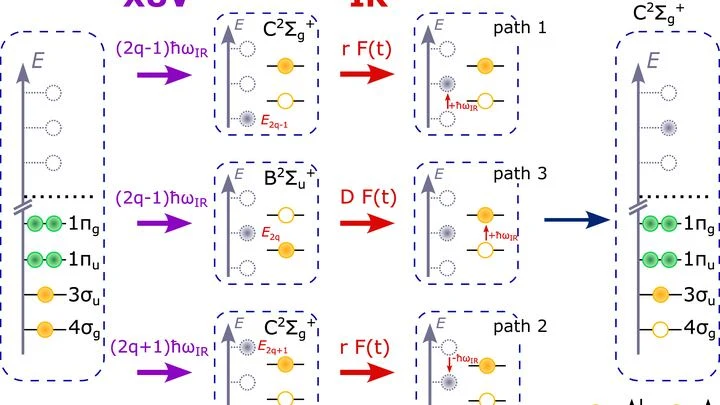
A high-speed camera capable of capturing the motion of electrons is an attosecond interferometer. It sends two laser pulses at a substance with a tiny delay. The first, ultraviolet, acts like a flash, knocking an electron out of the molecule. The second, infrared, like an invisible hand, gently nudges or slows this electron in flight.
Hot massive stars are the kitchens of the Universe, where heavy elements are cooked up. They end their lives in supernova explosions. To understand their recipe, astronomers use spectroscopy — the analysis of the rainbow band of light passed through a prism. Previously, deciphering such a 'menu' took hours.
A laser flash lasts a few femtoseconds — imagine a single instant stretched into a million parts. Such a flash mixes many colors, from red to violet. Instruments that measure the pulse shape often err: they see some colors well and others poorly, blurring the picture.
The authors propose a simple fix.
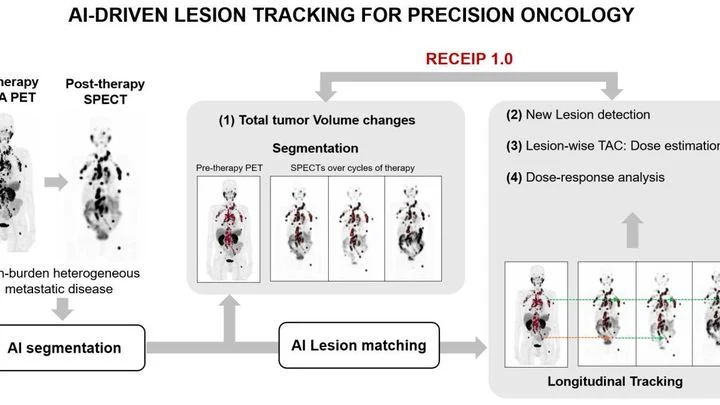
When treating prostate cancer, doctors often see not one tumor but many lesions in bones and lymph nodes. Each lesion can respond to therapy differently: one shrinks, another stays the same, a third grows. Previously, the disease was assessed as a whole, like judging the weather by the average temperature over a year.
In a particle accelerator, nuclei shatter into fragments like a porcelain cup dropped on the floor. Each fragment flies through silicon wafers, which register the impact and its strength. But to distinguish a real signal from random noise, you need a threshold: below it, readings are considered interference.
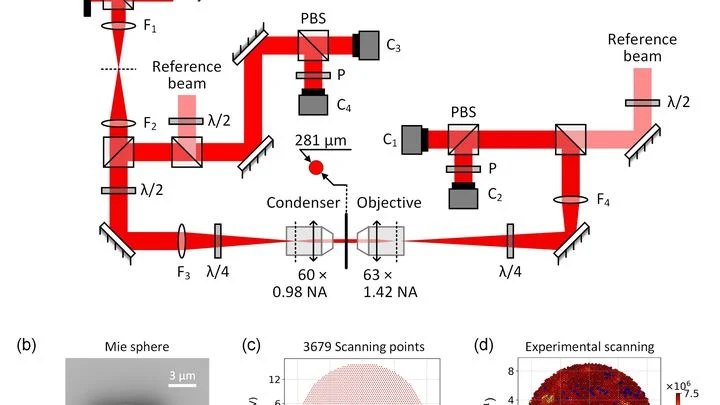
A flashlight beam in fog breaks into thousands of faint specks. Each speck is light that has bounced off countless water droplets before reaching your eye. To make sense of this mess, physicists construct a special table — the scattering matrix. It records how each incoming ray turns into a set of outgoing ones.
A mass spectrometer works like a molecular shredder: it breaks a substance into charged fragments and weighs each one. From this 'fingerprint,' chemists can tell what was in the sample. But if the molecule is new and its fragments don't match anything known, the instrument just shows a set of peaks, and what lies behind them is a mystery.
The authors of the paper proposed a workaround.
A drop of blood is a bustling city in miniature. Thousands of different molecules scurry through it, each leaving its own trace. But peering directly into this city is hard: the streets are tangled, and there are so many inhabitants that counting them all individually is out of the question.
Scientists have found a way to listen to the whole city at once, without singling out its residents.
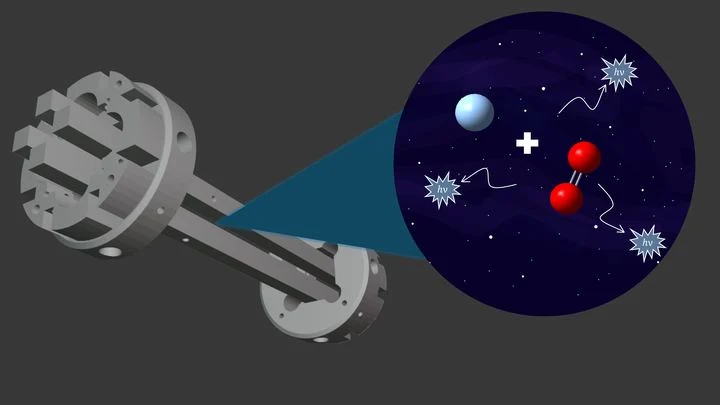
In the cold, sparse clouds of space, particles rarely meet, but sometimes an ion and a neutral molecule pass close enough to stick together. As they do, they emit light, like a muted flash carrying away excess energy. This process is called radiative association, and it is responsible for the formation of many molecules in interstellar space.