Noise as Evidence: How Much Interference Betrays Unquantized Gravity
In a dark room, an invisible clock is ticking. Its passage reveals itself only through a barely perceptible trembling of the hands. This is roughly how physicists are now trying to hear whether gravity is quantized: not through a direct conversation with carrier particles, but through the noise that any theory where the gravitational field remains classical must leave behind.
The idea is simple. If gravity is not made of quanta, it must behave like a crowd that pushes objects not perfectly smoothly, but with a slight jitter. That jitter is the noise. The authors of a new paper have built a general mathematical framework that describes such jitter for any model without gravitons. They required only three things: that Newton's law holds on average, that the evolution does not peek into the future, and that the laws do not change under uniform motion. From these modest conditions grew a whole map of possible noises.
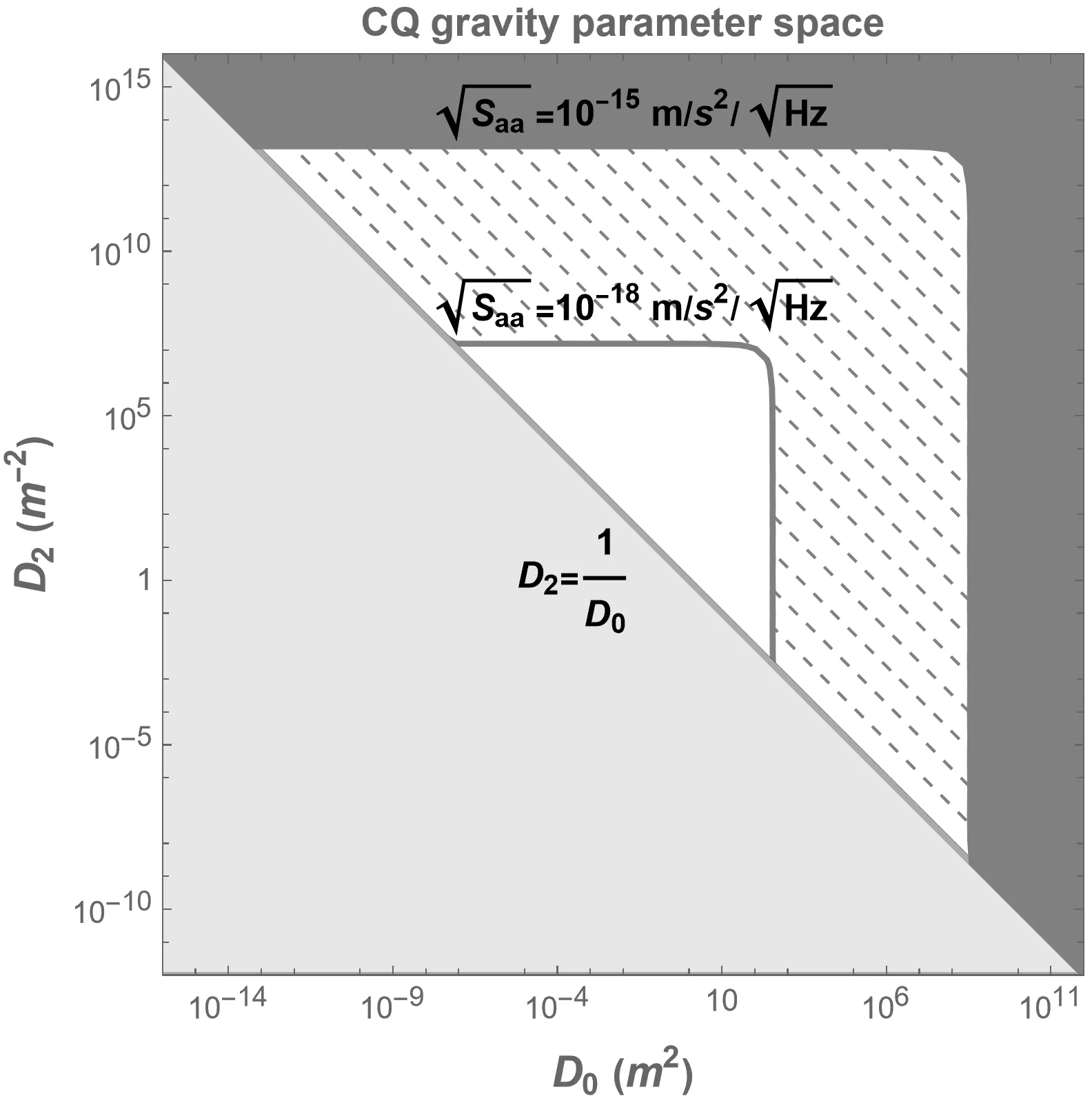
This threshold is not out of reach. For two oscillators of one milligram each at a distance of one millimeter, it corresponds to an acceleration of about $10^{-18}$ m/s²/√Hz. That is a thousand times quieter than what the LISA Pathfinder spacecraft can already measure. A difference of three orders of magnitude sounds daunting, but engineers are already working on sensors with quantum noise suppression, and the goal does not look like fantasy.
Previously, such estimates were made in a rough approximation, assuming the noise was Gaussian and overlooking the fact that it acts on both masses in a correlated way. The new work accounts for these subtleties for the first time. It turned out that earlier calculations underestimated the noise for single masses. Now specific models can be tested precisely. For example, Oppenheim's classical-quantum gravity always produces noise above the entanglement threshold, while entropic gravity, on the contrary, entangles, but its presence is revealed by a special pattern of correlations.
The ticking of a clock in a dark room can be measured even without seeing the clock itself. So it is here: there is no need to observe quantum entanglement directly. It is enough to measure the noise and compare it with the threshold. If it turns out to be lower, then gravity is quantum, and entanglement has already happened. If it is higher, entire families of theories can be crossed out. Experimentalists have only to prick up their ears.
The noise threshold for millimeter-scale masses is only a thousand times below what has already been achieved in the LISA Pathfinder space experiment. In other words, the required sensitivity is not fantastically far away but lies within engineering reach.
The idea that gravity might be not quantum but stochastic echoes Greg Egan's novel Schild's Ladder, where physics in different regions of space obeys different rules. Here the question is what rules hold in our Universe, and the answer may come from laboratory noise.