Noise as Evidence: How Much Interference Betrays Unquantized Gravity
Context
The question of whether gravity is quantum long remained purely theoretical. Now tabletop experiments are emerging that can detect the gravitational interaction between small masses. For such experiments to be meaningful, we need a clear understanding of what exactly distinguishes quantized gravity from its alternatives. This work follows a line of research that has already shown that unquantized models must introduce noise, but earlier approaches relied on Gaussian approximations and missed important effects, such as nonlocal correlated noise and non-Gaussian evolution of individual masses.
Methods
The authors formulate the evolution of massive bodies as a Lindblad equation, general enough to cover both quantum and non-quantum gravity. They impose three conditions: Newton's law holds on average, the evolution is local in time, and Galilean symmetry is present. From these conditions they derive the most general form of the dissipative terms, which depends on functions of position. Then, for three experimental schemes, two mechanical oscillators, two masses in a superposition of positions, and a hybrid of a mechanical mass plus a two-level system, they compute the threshold noise below which entanglement necessarily arises. The calculations do not assume Gaussianity, which allows an exact description of real models.
Results
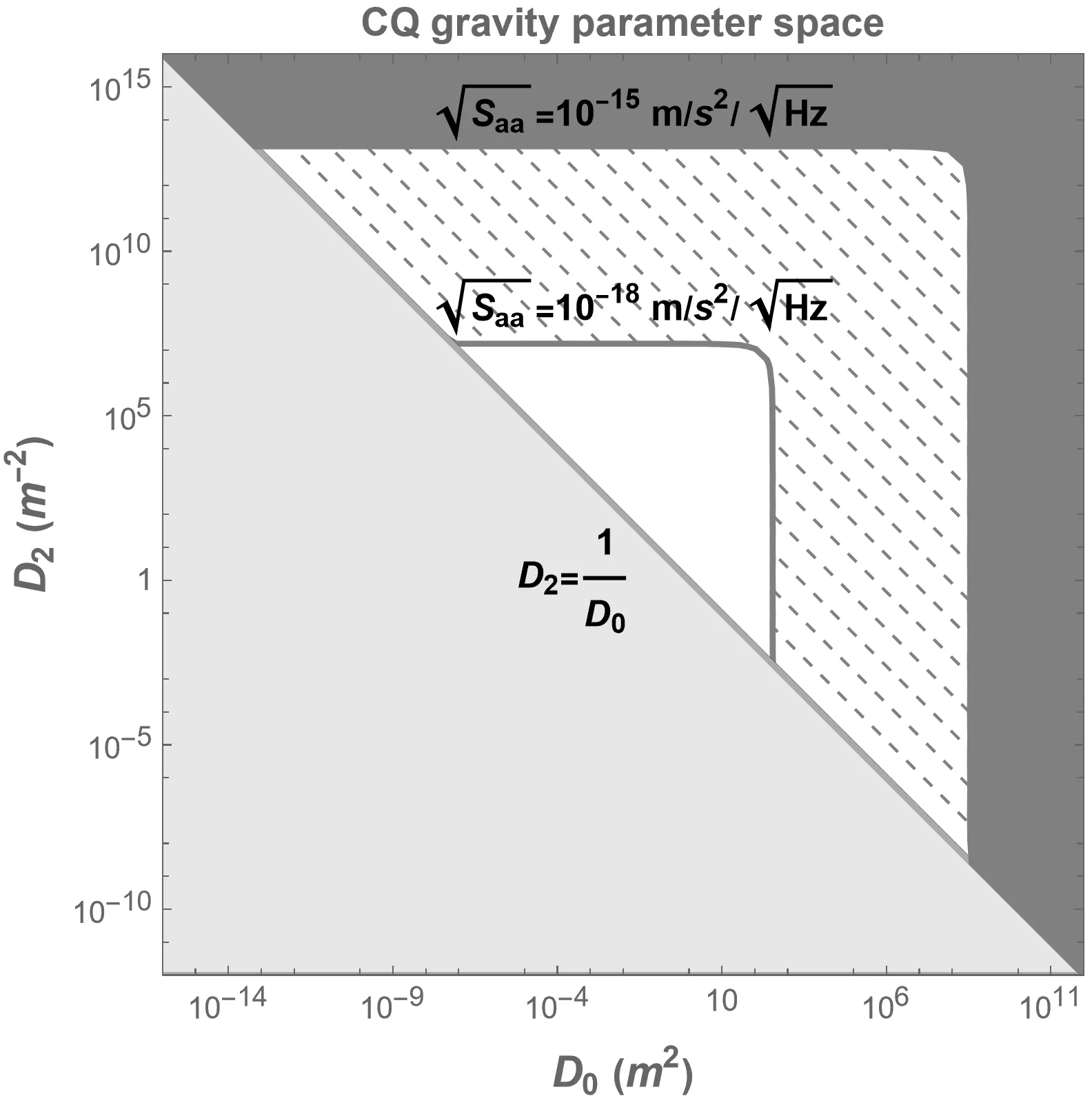
For a pair of oscillators with masses of 1 mg each at a distance of 1 mm, the threshold in terms of force spectral density is about 2.8×$10^{-47}$ N²/Hz, which corresponds to an acceleration of roughly $10^{-18}$ m/s²/√Hz. That is a thousand times below the level of LISA Pathfinder. For the Bose scheme with masses of 10 fg and a superposition of 100 μm, the decoherence rate threshold is about 6 Hz. For the hybrid scheme with an atomic interferometer the threshold is even lower: on the order of $10^{-16}$ Hz. It is shown that classical-quantum gravity always produces noise above the entanglement threshold, whereas the nonlocal entropic model, conversely, entangles masses but is betrayed by a characteristic noise.
Implications
The work stands out from neighboring studies in that it does not restrict itself to the Gaussian approximation and accounts for correlated noise acting on both masses. This makes it possible for the first time to describe noise accurately in models of Oppenheim's classical-quantum gravity and in entropic gravity. It turns out that earlier calculations underestimated the noise for individual masses. Now experimentalists have a clear target: measure noise below the threshold and thereby prove the entangling nature of gravity, even without observing the entanglement itself directly.
Future development
The next step: improving the sensitivity of force sensors to the level of $10^{-18}$ m/s²/√Hz. This will require quantum noise suppression in mechanical systems. As sensitivity grows, it will become possible to successively rule out parameter regions of non-quantum models. It is also important to investigate whether entanglement can be distinguished from gravitons and from nonlocal entropic models, which also entangle but with a different correlation pattern.
Impact
The results will influence the planning of quantum gravity experiments: they provide quantitative benchmarks for force sensors. They also refine the theoretical constraints on models of classical-quantum and entropic gravity.
Next steps
Build mechanical oscillators with noise below the threshold of 10^-18 m/s²/√Hz. Carry out noise measurements in existing setups to place the first constraints on the parameters of non-quantum models.
Key open problems
The work is directly tied to the unsolved problem of quantum gravity: is the gravitational field quantum? It offers a way to test this without a full theory of quantum gravity, through noise measurements in low-energy experiments.
The noise threshold for millimeter-scale masses is only a thousand times below what has already been achieved in the LISA Pathfinder space experiment. In other words, the required sensitivity is not fantastically far away but lies within engineering reach.
The idea that gravity might be not quantum but stochastic echoes Greg Egan's novel Schild's Ladder, where physics in different regions of space obeys different rules. Here the question is what rules hold in our Universe, and the answer may come from laboratory noise.
Key numbers
- acceleration threshold: 10-18 m/s²/√Hz
- force spectral density threshold: 2.8×10-47 N²/Hz
- distance between masses: 1 mm
- mass of oscillators: 1 mg
- decoherence rate threshold for the Bose scheme: 6 Hz