Magnons and Excitons Open the Path to Quantum Communication express
Quantum computers and sensors operate at microwave frequencies, but transmitting their signals over long distances is conveniently done via optical fibers, which use light. To bridge these two worlds, we need an intermediary — a device that converts microwaves into optical photons and vice versa without destroying fragile quantum information.
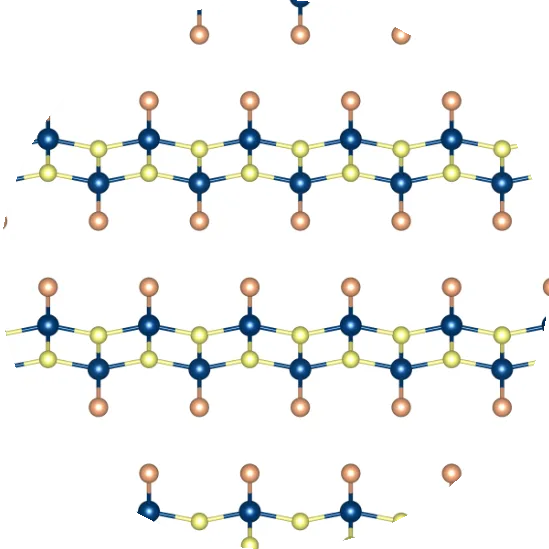
In the new work, the layered crystal CrSBr serves as such an intermediary. Inside it, microwaves induce collective oscillations of magnetic moments — magnons. These oscillations affect electronic excitations, excitons, which interact strongly with light. As a result, the laser beam reflected from the crystal acquires modulation: additional sidebands appear near the main frequency. Enhancing this effect near exciton resonances allowed coherent conversion without complex resonators.
This approach promises a broad frequency band, about 300 MHz, and scalability. The authors showed that several exciton-polariton resonances inherit the magnon coupling, which could expand the optical tuning range and reduce losses. This is a step toward practical quantum networks where microwave qubits are connected via optical channels.
Original abstract
as written by the authors arXiv:2604.03441
Coherent interfaces between microwave-frequency quantum systems and low-loss optical links are essential for quantum networks. However, existing microwave-optical transducers often trade conversion efficiency against added noise, bandwidth, and device integrability. Here, we demonstrate coherent microwave-to-optical transduction based on magnon-exciton coupling in the layered antiferromagnet CrSBr. Driving the antiferromagnetic resonance with microwave signals imprints coherent modulation on a reflected optical probe, generating optical sidebands that are resonantly enhanced near excitonic transitions. While prior magnon-based approaches to microwave-to-optical transduction have typically relied on intrinsically weak off-resonant magneto-optical effects (e.g., Faraday rotation), our scheme exploits strong light-matter interactions at exciton resonances. Even in a bulk crystal without cavity enhancement, we observe coherent conversion over an intrinsically broadband window of ~ 300 MHz. We further show that multiple exciton-polariton resonances inherit the magnon-coupled response, suggesting a route to broaden the usable optical detuning range and to mitigate optical dissipation. Our results establish magnon-coupled excitons in layered magnets as a scalable platform for broadband microwave-optical interfaces, with pathways to higher cooperativity via reduced magnetic volume and cavity integration.
CrSBr is a layered antiferromagnet in which the magnetic moments of adjacent layers point in opposite directions, like compass needles pointing in different ways.