What a Cosmic Hurricane Sounds Like express
When water boils in a kettle, waves of steam ripple through the kitchen. A similar process happens in space, in plasma — gas so hot that electrons are stripped from atoms. Around black holes and neutron stars, this plasma isn't just hot: its particles zip around at nearly the speed of light. When such a medium is jolted by an explosion or a star's magnetic field, waves race through it, like ripples on a pond, but instead of water, you have charged particles, and instead of wind, magnetic fields.
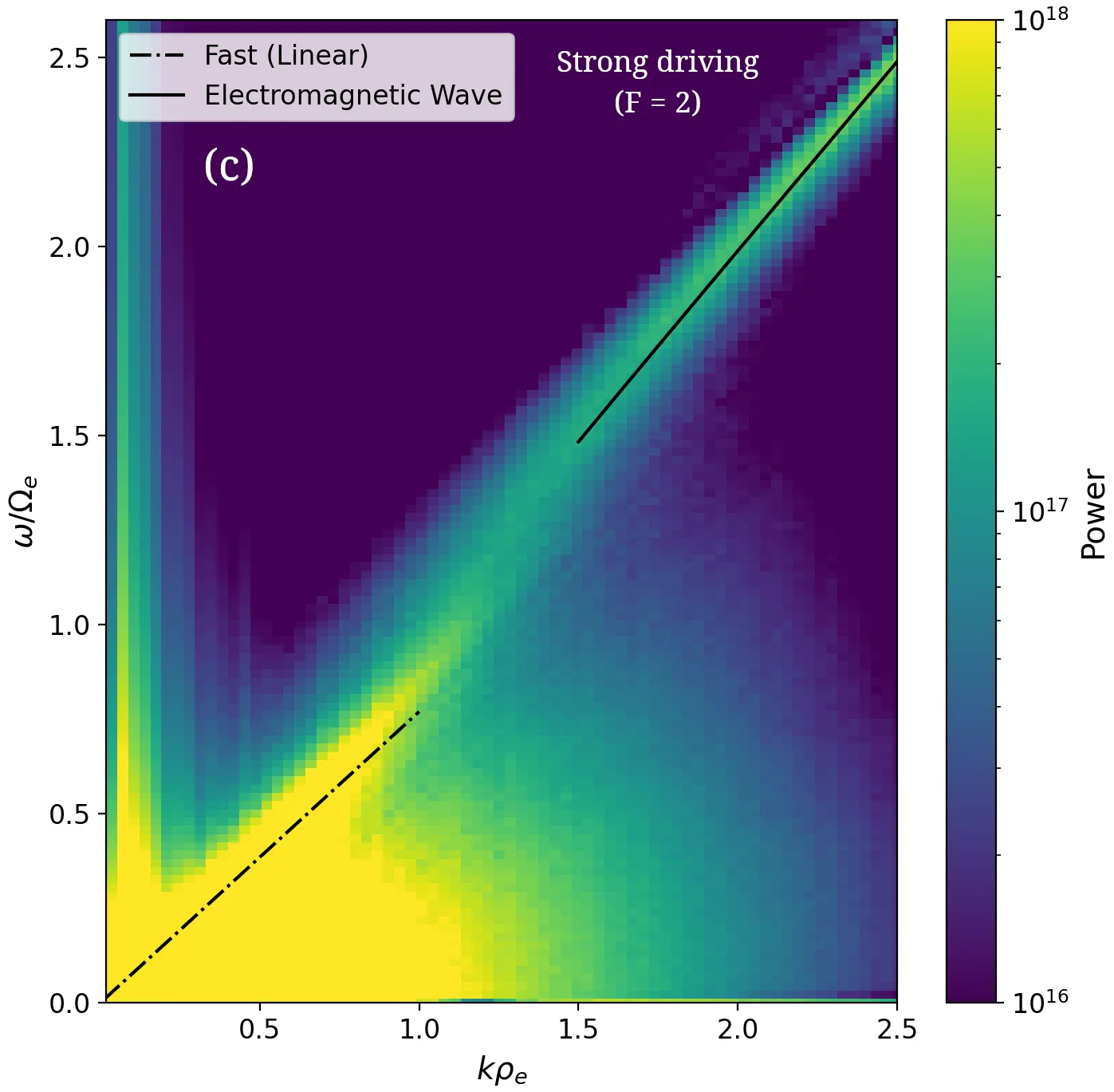
For a long time, no one could trace in detail how these waves morph into shock fronts — sharp jumps in density, like the wake of a speedboat suddenly turning into a wall. Researchers have now run the first computer simulation that 'shoves' the plasma with increasing force. Under gentle nudges, fast magnetosonic waves appeared — oscillations where the magnetic field and gas pressure work together like a spring. Their spectrum, how energy is distributed across different vortex sizes, matched theoretical predictions. But when the pushes got stronger, the waves began overtaking each other and collapsing into shock fronts.
This transition from 'calm' waves to shock-driven turbulence is key to understanding how black holes heat up the surrounding gas and why it glows in X-rays. Now astrophysicists can model more precisely how energy from infalling matter is redistributed in jets — plasma streams shooting from the poles of black holes. Water boils the same way on Earth and in a distant quasar: it's just that in space, that 'kettle' is the size of the Solar System.
Original abstract
as written by the authors arXiv:2604.04276
We present fully kinetic simulations of driven 2D turbulence in a relativistic plasma, designed for the first time to induce a fast magnetosonic cascade. As the driving strength increases, turbulence transitions from a weak wave-dominated regime to strong shock-driven dynamics. Using spatiotemporal Fourier analysis, we identify fast modes, finding that the weak turbulence regime exhibits spectral properties that are in excellent agreement with theoretical expectations. Our results are relevant for the modeling of turbulence in high-energy astrophysical plasmas.
Fast magnetosonic waves in plasma are like sound, but they travel at near-light speed and can accelerate particles to energies unattainable in terrestrial accelerators.
In Stanisław Lem's novel 'Fiasco', turbulence in relativistic plasma disrupts communication with an alien ship — similar processes are now being modeled on supercomputers.