Hunting for Microscopic Black Holes express
From 2016 to 2018, at the Large Hadron Collider at CERN, protons collided at energies of 13 teraelectronvolts, as if two peas were accelerated to speeds where their impact spawns a whole swarm of new particles. Among this swarm, physicists searched for the most exotic guests: microscopic black holes, string balls, and electroweak sphalerons. None of them appeared, but the search itself was the most thorough in history.
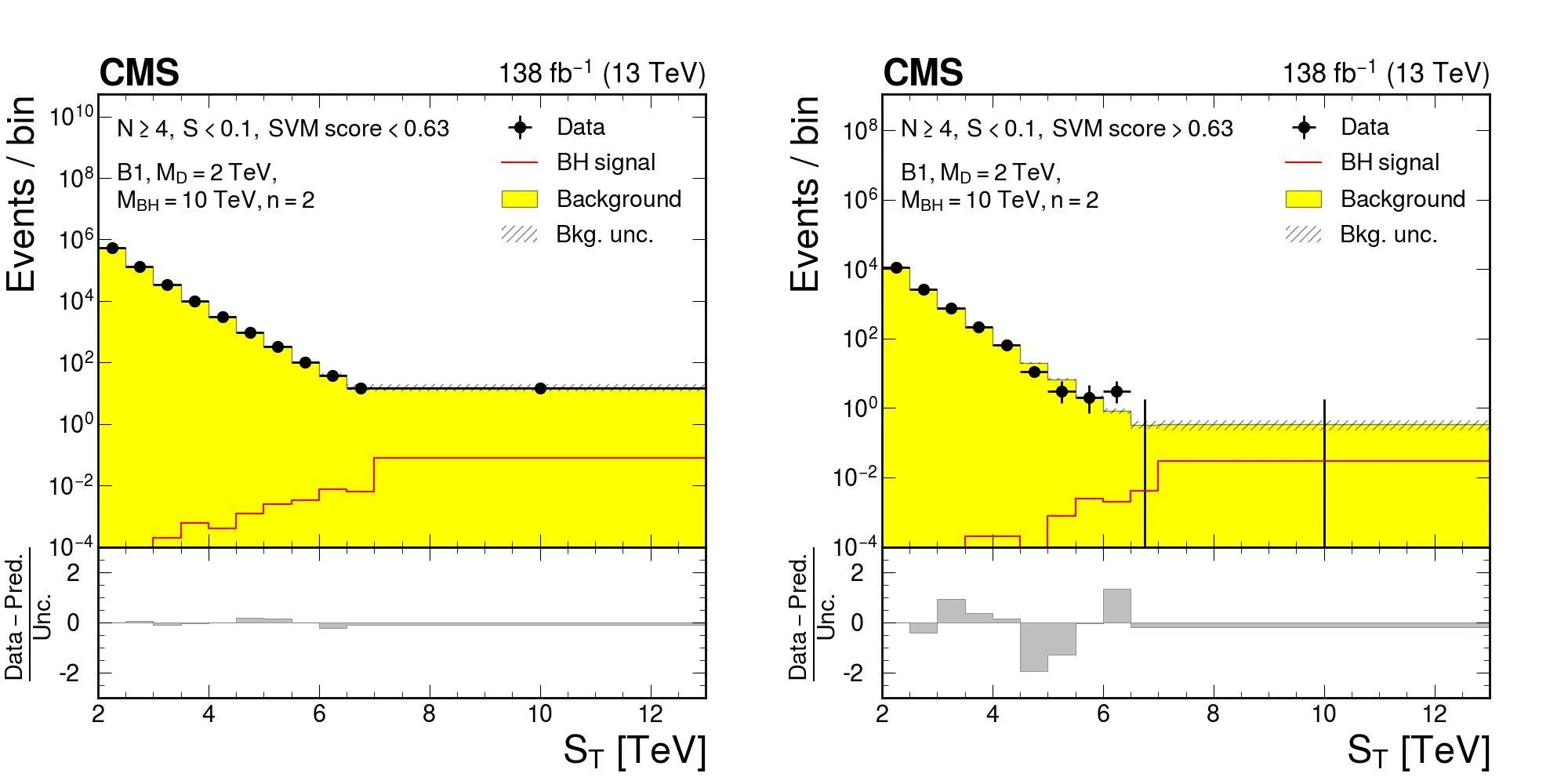
To avoid missing a signal, the researchers employed two new approaches. The first method relies on the shape of the distribution of the sum of transverse momenta of all particles in an event: it remains unchanged regardless of which particles are produced. The second method sorts events by the similarity of their characteristics, much like sorting photos by resemblance, highlighting unusual collisions. This allowed them to establish that black holes lighter than 8.4–11.4 teraelectronvolts (roughly 9,000 times heavier than a proton) do not exist with 95% probability. And the fraction of quark-quark interactions above the electroweak sphaleron threshold does not exceed 0.0034.
Such a result is not disappointing but rather refines the boundaries of the possible. Every un-found object is a brick in the wall separating tested laws of physics from bold hypotheses. The collider, like a giant sieve, sifts through reality, and what doesn't pass through the mesh remains only in the imagination of theorists.
Original abstract
as written by the authors arXiv:2604.10732
A search for microscopic black holes, string balls, and electroweak sphalerons using proton-proton collisions at $$\sqrt{s}$$ = 13 TeV recorded with the CMS detector at the CERN LHC during the 2016$$-$$2018 data taking, and corresponding to an integrated luminosity of 138 fb$$^{-1}$$, is presented. Two search strategies based on control samples in data are used. Model-independent limits on the cross section of physics phenomena with multiple energetic jets, leptons, and photons are set using a method that relies on the shape invariance of the scalar sum of the transverse momenta of all objects in the event. Model-dependent limits on black hole and sphaleron production are set using a newly introduced method that has been developed for the identification of collider events with distinct kinematic features by separating them into classes based on phase space proximity. In the context of models with large extra dimensions, semiclassical black holes and string balls with masses below 8.4$$-$$11.4 TeV and 9.0$$-$$10.7 TeV, respectively, are excluded at 95% confidence level, significantly extending the reach beyond previous searches. Results of a dedicated search for electroweak sphalerons are used to derive an upper limit of 0.0034 at 95% confidence level on the fraction of quark-quark interactions above the nominal sphaleron transition energy threshold of 9 TeV.
A microscopic black hole, if born at the collider, would evaporate in a tiny fraction of a second due to Hawking radiation — before it could even absorb a single atom of the detector.
In the TV series 'Stargate SG-1', microscopic black holes were used as weapons capable of destroying an entire planet — physicists at the LHC are checking whether such objects are possible in principle.